Dub Partners Alternatives: 7 Affiliate Platforms Compared
Payout caps, payout fees and partner network access decide more than any feature list. Here is how the main alternatives compare for SaaS and creator programs.
By Nora Ellis, Affiliate Marketing & Creator Economy Writer · with Wooly Network, Editorial · 5 October 2026 · 18 min · Affiliate Marketing
The main Dub Partners alternatives are Rewardful, FirstPromoter and Tolt for Stripe based SaaS programs, PartnerStack for B2B SaaS partner ecosystems, Refersion and impact.com for ecommerce brands that want a partner marketplace, and Wooly Network for brands that want creators to discover and apply to their campaigns. Dub itself is very good at link management and developer friendly tracking. Teams usually start shopping for three reasons: a monthly payout cap of $2,500 on Business and $15,000 on Advanced, a payout fee of 5% by ACH or 8% by card that the brand pays on top of commissions, and partner network access that only comes with Enterprise.
Last checked October 2026. Pricing and features change, so confirm on each vendor's site before you sign. We refresh this page every three months.
Nobody changes affiliate software for fun. Moving partners means new links, a polite email that half of them ignore, and a month of reconciling two dashboards that disagree by eleven dollars. So when a team starts searching for dub.co alternatives, it is rarely about a missing feature. It is about a number on the invoice, or a limit they hit on the 28th of a good month. This guide starts with those numbers, then compares seven platforms on the things that actually move your cost.
What does Dub Partners do well?
Credit where it is due. Dub started as a link management product and it shows: short links, QR codes, click analytics and a clean interface that people actually enjoy using. The partner program, Dub Partners, sits on top of that link layer, which means the thing that is hardest to get right in affiliate tracking (the link and the click) is the thing Dub was built around.
- Developer friendly setup. Dub lists integrations with Stripe and Shopify for conversion tracking, plus Zapier, Make, Slack and Cal.com, and guides for Supabase, Better Auth and Appwrite. Stripe refunds automatically mark the matching commission as refunded, which saves a monthly argument.
- Sensible partner experience. Partners are paid to a bank account through Stripe Express at no extra cost above $10, or in USDC with a 0.5% transaction fee, according to Dub's help center.
- Useful extras on every partner plan. Tax form collection for US and non US partners, dual sided incentives (reward the partner and the customer) and an AI landing page generator.
- A real free trial. Dub offers a 14 day free trial on all paid plans, plus a 25% discount for open source projects and non profits.
Partner features start on the Business plan at $90 a month. Advanced is $300 a month, and Enterprise is custom annual billing. Annual billing gives a 10% discount, which works out to roughly $81 and $270 a month (our arithmetic; the page does not print those numbers). The Free and Pro plans are link plans only, with no partner program.
If your program is mostly partners you already know (customers, users, a few friendly newsletters) and your monthly commissions sit comfortably under the caps, Dub is a very reasonable home. The rest of this article is for everyone else.
Why do teams look for Dub Partners alternatives?
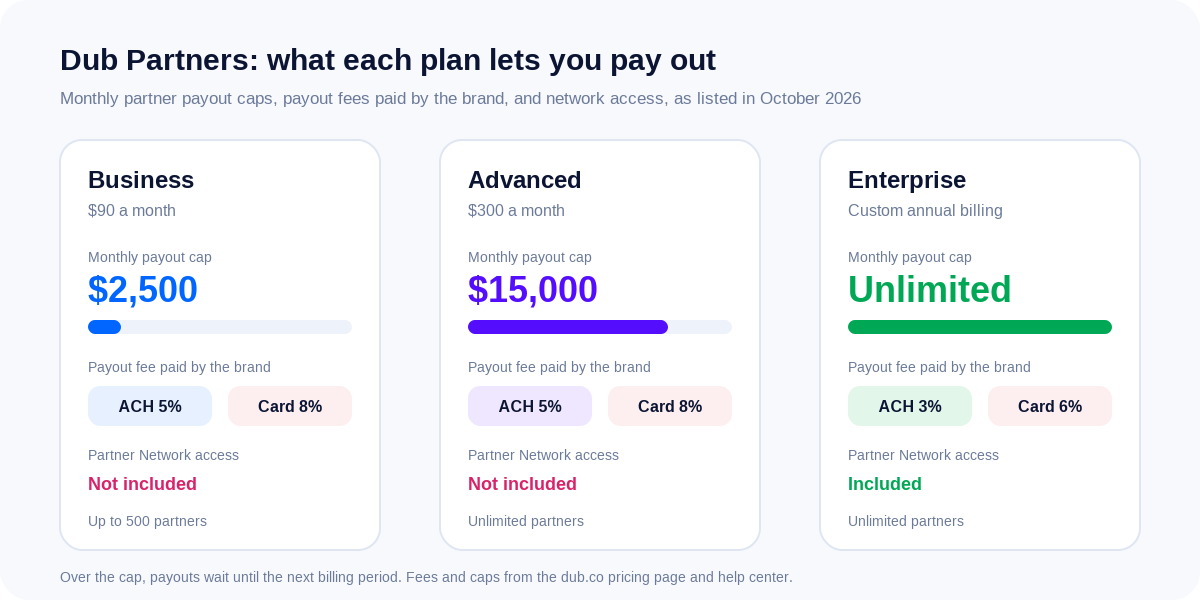
The three numbers that send most teams shopping: the cap, the fee and the network.
1. Monthly payout caps per plan
Dub limits how much you can pay partners each month: $2,500 on Business, $15,000 on Advanced, unlimited on Enterprise. The pricing FAQ is blunt about what happens at the line: "When you exceed your monthly payouts limits, you won't be able to send payouts until the next billing period."
Translate that into revenue. At a 20% commission, $2,500 in payouts is $12,500 of partner driven sales. That is a nice month for a young program, and also exactly the month you do not want to tell your best creator their money is waiting. The jump to Advanced is $90 to $300, more than three times the subscription, triggered by success rather than by any feature you needed. Procurement teams love a cost that rises when things go well. Founders, less so.
2. The payout fee is paid by the brand
On top of the subscription, Dub charges a fee on every payout, and the program pays it, not the partner. Per Dub's partner payouts article:
| Payment method | Business and Advanced | Enterprise | Timing |
|---|---|---|---|
| ACH | 5% | 3% | Up to 4 business days |
| Credit card | 8% | 6% | Instant |
On $15,000 of monthly payouts, that is $750 a month by ACH or $1,200 by card, on top of the $300 subscription. Dub itself recommends ACH for larger payouts. Payout fees are not unusual in this category (several alternatives below charge something similar for automated payouts), but you should model them as part of the real price, not a footnote.
3. Partner network access only on Enterprise
Business and Advanced give you excellent tools to manage partners you bring yourself. Discovery, meaning access to Dub's Partner Network and a listing in its Program Marketplace, is an Enterprise feature. Enterprise means custom annual billing, which in practice means a discovery call, a second call with someone more senior, and a PDF with a number on page seven. If finding new partners is your bottleneck, the plans you can buy on a credit card do not solve it.
Dub Partners alternatives compared: the big table
Here is the shortlist side by side, with Dub as the baseline. Prices are monthly list prices from each vendor's pricing page in October 2026 unless marked otherwise.
| Platform | Entry price | What the plan limit measures | Fees on payouts or sales | Marketplace or network | Best for |
|---|---|---|---|---|---|
| Dub Partners (baseline) | $90 (Business) | Partner payouts: $2,500, $15,000, then unlimited on Enterprise | 5% ACH or 8% card, paid by the brand (3% or 6% on Enterprise) | Enterprise only | Link first, developer led programs |
| Rewardful | $49 (Starter) | Affiliate revenue: $7,500, $15,000, $30,000 on entry Enterprise | 0% transaction fee; optional Managed Payouts at 3% | None listed | Simple Stripe SaaS programs |
| FirstPromoter | $49 (Starter) | Affiliate revenue: $5,000, $15,000, then above $15,000 | None listed | None | SaaS with recurring commissions |
| Tolt | $69 (Basic) | Affiliate revenue: $10,000, $20,000, $50,000, then custom | 0% commission; 2% on automated payouts | None listed | Stripe or Paddle SaaS wanting more headroom |
| PartnerStack | Quote only (reportedly about $1,500 billed annually) | No partner limit | Reportedly a platform fee on commissions; partners pay withdrawal fees | Yes, from Launch | B2B SaaS partner ecosystems |
| Wooly Network | $99 (Growth) | Live campaigns: 1 on Growth, up to 4 on Scale | Operational fee on creator payouts only (see pricing) | Yes, built in marketplace | Brands that want creators to apply |
| Refersion | $39 plus 3% of affiliate sales | Scale tier for brands above $1M GMV a year | 3% of affiliate driven sales on Launch, 2% on Growth | Yes, free marketplace listing | Ecommerce brands |
| impact.com | From $30 (Starter) | Essentials includes $2,500 in partner payouts, 20% above that (self serve terms) | 2.5% transaction fee on partner driven transactions; one time setup fee | Marketplace from Essentials ($500) | Large, multi channel partnership programs |
How do payout caps compare with revenue caps?
The table hides a trap. Dub caps payouts (what you pay partners). Rewardful, FirstPromoter and Tolt cap affiliate attributed revenue (what partners sell). Those are different numbers, and the gap between them is your commission rate.
To compare like with like, convert everything at one commission rate. Here is the same idea at a hypothetical 25% commission:
| Plan | Monthly price | Listed limit | Equivalent at 25% commission |
|---|---|---|---|
| Dub Business | $90 | $2,500 in payouts | About $10,000 in affiliate revenue |
| Dub Advanced | $300 | $15,000 in payouts | About $60,000 in affiliate revenue |
| Rewardful Starter | $49 | $7,500 in affiliate revenue | About $1,875 in payouts |
| Rewardful Growth | $99 | $15,000 in affiliate revenue | About $3,750 in payouts |
| FirstPromoter Starter | $49 | $5,000 in affiliate revenue | About $1,250 in payouts |
| Tolt Basic | $69 | $10,000 in affiliate revenue | About $2,500 in payouts |
| Tolt Pro | $199 | $50,000 in affiliate revenue | About $12,500 in payouts |
Two things fall out of this. First, at a 25% rate, Dub Business and Tolt Basic offer roughly the same headroom, at $90 and $69. Second, Dub Advanced is generous for its price if you pay high commissions, because a payout cap gets roomier relative to revenue as your rate rises. A 40% recurring program on Dub Advanced can track $37,500 of monthly affiliate revenue before the cap bites. Revenue capped tools go the other way: generous rates eat the same revenue limit faster in payout terms, but the limit itself does not move.
Also check what happens at the limit. Dub states that payouts stop until the next billing period. For the others, read the plan terms or ask support before you assume anything; "we will contact you about an upgrade" and "tracking stops" are very different emails to receive. If you are still setting commission levels, our guide to affiliate commission rates by industry helps you pick a number before you pick a tool.
The 7 Dub Partners alternatives, one by one
1. Rewardful
Rewardful is the closest thing to a default for Stripe based SaaS. Starter is $49 a month for up to $7,500 a month in affiliate attributed revenue, one campaign and two team members. Growth is $99 for up to $15,000 with unlimited campaigns and a branded portal. Enterprise starts at $149 for up to $30,000 on the entry tier. Annual billing is twelve months for the price of ten. There is a 0% transaction fee on affiliate revenue on every plan, and affiliates are unlimited.
Payouts go through PayPal mass payouts or Wise bulk payouts, which you trigger yourself. If you want Rewardful to handle it, Managed Payouts cost the merchant a 3% processing fee, and affiliates may also pay withdrawal fees. It integrates with Stripe, Paddle and Chargebee among 20+ integrations, and there is a 14 day free trial. There is no marketplace on the pricing page, so recruiting is on you.
Where it beats Dub: lower entry price, no fee on payouts you send yourself, and fast setup if your billing lives in Stripe. Where Dub wins: link management, and more payout headroom at high commission rates.
Pick it if you sell a subscription through Stripe, Paddle or Chargebee, already know who your first affiliates will be, and want the simplest possible setup.
2. FirstPromoter
FirstPromoter is aimed squarely at affiliate software for SaaS. Starter is $49 a month (or $490 a year) for up to $5,000 a month in affiliate revenue, up to 1,000 affiliates and 3 campaigns. Business is $99 for up to $15,000. Enterprise is $149 for anything above $15,000, and it includes managed automatic payouts for SaaS companies, subject to approval. Recurring and lifetime commissions are supported, and there is a 14 day free trial with no card. No setup fee or transaction fee is listed, and there is no marketplace.
Where it beats Dub: a flat $149 once you are past $15,000 in affiliate revenue, which is a pleasant ceiling for a growing program. Where Dub wins: Starter's $5,000 revenue limit is tight, and Dub's link tooling is stronger.
Pick it if you run a SaaS program with recurring commissions and want a predictable bill as volume grows.
3. Tolt
Tolt is the newer, roomier option in the Stripe tier. Basic is $69 a month for up to $10,000 a month from affiliates, Growth is $99 for up to $20,000, Pro is $199 for up to $50,000, and Enterprise is custom above that. Tolt charges "0% commission" on revenue; automated payouts carry a 2% processing fee and cover PayPal, Wise, local bank, crypto and wire. Integrations are Stripe and Paddle, with Chargebee mentioned too. There is a 14 day free trial with no card and a 30 day refund policy.
Where it beats Dub: more headroom per dollar at typical commission rates, and a lower fee on automated payouts (2% against 5% by ACH). Where Dub wins: broader integrations beyond subscription billing, and the link product.
Pick it if you are on Stripe or Paddle, expect to grow past $10,000 a month in affiliate revenue, and want to automate payouts without paying 5%.
4. PartnerStack
PartnerStack calls itself "the only affiliate platform built for B2B", and the product backs that up: affiliate links, lead and deal registration, CRM integrations, partner payments built for B2B SaaS sales cycles, and a marketplace where B2B partners discover programs, included from the first plan. Plans are Launch, Growth and Enterprise, and there is no limit on partners.
Pricing is quote only. Uppercut reports a starting point of about $1,500 a month billed annually, and Vendr reports a median buyer spend of $19,616 a year. Annual contracts are reportedly standard, and a platform fee on commissions is reportedly charged, though estimates vary and the vendor does not publish one. Partners pay their own withdrawal fees: $2.25 plus 0.25% (capped at $20) through Stripe, or 2% (capped at $20) through PayPal. Commissions are typically paid on the 13th of each month. G2 reviewers reportedly rate it 4.7 out of 5.
Where it beats Dub: marketplace access without an Enterprise plan, B2B partner types beyond affiliates, CRM depth. Where Dub wins: price transparency, no annual contract, a free trial, and you do not need a demo to start.
Pick it if you are a B2B SaaS company with a real sales cycle, resellers or agencies in the mix, and a budget that can absorb an annual commitment.
5. Wooly Network
Wooly Network is a newer affiliate and creator marketplace, and it solves a different problem from most tools on this list. Instead of only managing partners you recruit yourself, you publish a campaign once and creators discover it and apply. You choose instant or manual approval. Campaigns can pay CPA, CPL, revenue share (one time or recurring), a fixed amount per sale or a sponsorship, with optional limited time, launch, bonus and seasonal incentives.
Brand plans are Growth at $99 a month (one live performance campaign) and Scale at $249 (up to four campaigns, plus a server to server conversion API, app install tracking, a fraud review queue, cross device attribution and automated Stripe payouts). Enterprise is custom. Annual billing gives two months free. There is no setup fee, no network minimum, and you can cancel anytime. An operational fee applies to creator payouts only, so it costs nothing in a month when nothing sells; the details are on the pricing page. Creators join free and Wooly takes nothing from their commissions. Creators are paid monthly, on a fixed cycle, through Stripe. There is no free trial, but you can try a campaign demo before signing up.
Where it beats Dub: discovery is part of the paid plans rather than an Enterprise extra, and it supports CPL and sponsorship models natively. Where Dub wins: link management, developer tooling, a free trial, and a longer track record. Wooly is not trying to be an enterprise partnership suite.
Pick it if your bottleneck is finding creators rather than managing the ones you have. If you want the full head to head, we compare the two in detail in a follow up piece.
On Wooly Network: brands publish a campaign once, set the payout model and approval rules, and creators apply from the marketplace. You can see how it works on the affiliate marketplace for brands page, including a campaign demo.
6. Refersion
Refersion is built for ecommerce brands, especially on Shopify. Its pricing has a free Marketplace Listing tier, then Launch at $39 a month ($29 billed annually) plus 3% of affiliate driven sales, Growth at $199 ($159 annually) plus 2%, and a custom flat fee Scale tier for brands above $1M in GMV a year. Annual billing saves 20%. The Refersion Affiliate Marketplace gives brands a discovery channel, and no setup fee is listed.
The percentage of sales is the part to model. On $20,000 a month in affiliate driven sales, Launch costs $39 plus $600, and Growth costs $199 plus $400. A percentage of sales grows faster than a percentage of payouts, because sales are always bigger than commissions.
Where it beats Dub: a marketplace without an enterprise contract, and ecommerce specific workflows. Where Dub wins: a flat subscription at low volume, SaaS integrations, links.
Pick it if you sell physical products on Shopify and want a marketplace listing from day one.
7. impact.com
impact.com is the heavyweight, and its pricing is now public for the first three tiers: Starter from $30 a month, Essentials from $500, Pro from $2,500, and Enterprise on request. A 2.5% transaction fee applies to partner driven transactions. On self serve Essentials, the $500 includes $2,500 in partner payouts and anything above that is charged at 20%. There is a one time setup fee that depends on your onboarding, with no amount published. The marketplace (impact.com cites 90,000 partners) starts at Essentials, and self serve plans require an ecommerce integration such as Shopify, BigCommerce or WooCommerce. G2 reviewers reportedly rate it 4.4 out of 5.
Where it beats Dub: scale, tracking depth on higher tiers (cross device, offline, call tracking on Enterprise), and a large partner marketplace. Where Dub wins: simplicity, a SaaS friendly setup, and a price you can predict without a spreadsheet.
Pick it if you run a large, multi channel partnership program with a team to match. If impact.com is already on your shortlist, our guide to Impact.com alternatives for startups and growing brands covers the cheaper routes, and the head to head Wooly Network vs Impact.com comparison walks through cost at different program sizes.
What do Dub Partners competitors cost at $5,000 a month in commissions?
List prices only tell you so much. Say you run a hypothetical program paying $5,000 a month in commissions at a 25% rate, which means $20,000 a month in affiliate driven revenue. Here is roughly what each option costs per month, before payment provider fees and taxes.
| Platform | Plan needed | Subscription | Fees at this volume | Approximate monthly total |
|---|---|---|---|---|
| Dub Partners | Advanced (Business caps at $2,500) | $300 | 5% ACH on $5,000 = $250 | $550 ($700 by card) |
| Rewardful | Enterprise entry tier ($20,000 is above Growth) | $149 | None if you pay via PayPal or Wise yourself; $150 with Managed Payouts | $149 to $299 |
| FirstPromoter | Enterprise (above $15,000) | $149 | None listed | $149 |
| Tolt | Growth (up to $20,000) | $99 | 2% automated payouts = $100 | $99 to $199 |
| PartnerStack | Quote | Reportedly about $1,500 billed annually | Reported platform fee, not published | Not publicly listed |
| Wooly Network | Growth or Scale, depending on campaigns and features | $99 or $249 | Operational fee on creator payouts (see pricing) | Subscription plus operational fee |
| Refersion | Growth | $199 | 2% of $20,000 in sales = $400 | $599 (Launch would be $639) |
| impact.com | Essentials, self serve terms | $500 | 20% on $2,500 of payouts above the included amount = $500 | $1,000 plus setup fee |
The Stripe tools are clearly cheapest at this size if you only need tracking and payouts. The more expensive rows are buying something else: discovery (PartnerStack, Refersion, impact.com, Wooly) or enterprise depth (impact.com). That is the honest framing for most of these decisions. You are not choosing between cheap and expensive software; you are choosing whether you pay to find partners or find them yourself.
Which Dub Partners alternatives fit which program?
- Early SaaS, under $10,000 a month in affiliate revenue, partners already lined up: Rewardful or Tolt. Stay on Dub if you love the links.
- SaaS with recurring commissions, growing fast: FirstPromoter or Tolt, both with predictable top tiers.
- B2B SaaS with resellers, agencies and long sales cycles: PartnerStack, if the budget allows an annual contract.
- Shopify brand that wants a marketplace without a sales process: Refersion, or impact.com Starter if you expect to grow into Essentials.
- Brand that needs creators to find it: Wooly Network, or Refersion for pure ecommerce.
- Large, multi channel program with a partnerships team: impact.com, or Dub Enterprise if you are already on Dub and like it.
For a wider view of how networks, marketplaces and tracking tools differ, see our affiliate networks comparison, and if SaaS is your world, affiliate marketing for SaaS covers commission structures and recurring payouts.
How do you switch from Dub Partners without losing partners?
- Settle what you owe first. Check holding periods (Dub lets programs set 0 to 90 days per group) and pay out pending commissions before you cancel, or agree a final date with partners in writing.
- Decide what happens to existing links. Partner links live in old videos, newsletters and bios forever. Ask Dub support how links behave after a downgrade, and plan redirects before you change anything.
- Export partners and history. Names, emails, payout details you are allowed to keep, and twelve months of commissions for reference.
- Run both systems for a month. New links on the new platform, old links still tracked on Dub, so nobody loses a sale during the overlap.
- Test conversions end to end. Place a real test order or sign up through a new partner link and confirm it shows up with the right amount. Then refund it and check the clawback.
- Tell partners early, once, clearly. One email with the new link, the date old links stop counting, and when their next payout lands. Then a reminder a week before. Partners forgive changes; they do not forgive surprises in their earnings.
On Wooly Network: if part of the reason you are leaving is recruiting, a marketplace changes the migration math, because existing partners can move across and new creators can apply to the same campaign. You can compare plans before you commit to anything.
If you are weighing a move, start with the numbers: your monthly payouts, your commission rate and whether you need help finding partners. Those three facts pick the platform for you faster than any demo. Brands curious about the marketplace route can look at how campaigns work for advertisers.
Common questions
What is the payout limit on Dub Partners?
According to Dub's pricing page in October 2026, the Business plan ($90 a month) allows $2,500 in partner payouts per month, Advanced ($300 a month) allows $15,000, and Enterprise is unlimited. If you exceed the limit, you cannot send payouts until the next billing period.
How much are Dub Partners payout fees?
Dub charges the program, not the partner, a fee on each payout: 5% by ACH or 8% by credit card on Business and Advanced, and 3% or 6% on Enterprise. ACH takes up to four business days; card funding is instant.
Does Dub Partners have a partner marketplace?
Yes, but only on Enterprise. Partner Network access and a Program Marketplace listing are listed as Enterprise features. Business and Advanced are for managing partners you recruit yourself.
What is a cheaper alternative to Dub Partners for SaaS?
For Stripe based SaaS, Rewardful starts at $49 a month with a 0% transaction fee, FirstPromoter starts at $49, and Tolt starts at $69 with more revenue headroom. Their plan limits are measured on affiliate revenue rather than payouts, so convert at your commission rate before comparing.
Which Dub alternative includes partner discovery without an enterprise contract?
Refersion offers a free marketplace listing, PartnerStack includes its marketplace from the Launch plan (quote only, reportedly annual), impact.com includes marketplace access from Essentials at $500 a month, and Wooly Network includes a creator marketplace on its Growth and Scale plans.
Keep reading
- Impact.com alternatives for startups and growing brands
- Wooly Network vs Impact.com: which affiliate platform fits
- Affiliate marketing for SaaS
- Best affiliate networks compared: how to choose the right one
Related reading
- Affiliate Platform Comparisons and Alternatives — Honest side by side comparisons of the affiliate networks and partner platforms brands shortlist most, with pricing, fees, contracts and who each one suits best.
- Dub Partners Pricing Explained: Plans, Payout Fees, Limits — What each Dub plan includes for affiliate programs, how payout fees and monthly payout caps change the real cost, and a worked example at three sizes.
- PartnerStack vs Impact: Which Partner Platform to Choose — A neutral comparison of the two best known partner platforms: who each one is built for, how pricing works, and when neither is the right fit.
More from the Wooly Network Blog