Impact.com Alternatives for Startups and Growing Brands (2026)
Why growing brands look beyond Impact, the platforms worth shortlisting instead, and how their pricing, contracts and partner discovery really compare.
By Nora Ellis, Affiliate Marketing & Creator Economy Writer · with Wooly Network, Editorial · 3 October 2026 · 17 min · Affiliate Marketing
The strongest impact.com alternatives for startups and growing brands in 2026 are Awin and Refersion if you want a partner network attached, Dub Partners, Rewardful or Tapfiliate if you want lean tracking software for partners you recruit yourself, PartnerStack for B2B SaaS, Shopify Collabs for small Shopify stores, Trackdesk for a software plus marketplace middle ground, and Wooly Network if you want a creator marketplace on a flat monthly plan. impact.com itself now publishes its prices (Starter from $30 a month, Essentials from $500, Pro from $2,500), so the real question is no longer "how much is the secret quote" but what you pay once you need its marketplace, and how that fee grows with your program.
Last checked October 2026. Pricing and features change, so confirm on each vendor's site before you sign. We refresh this page every three months.
This is a buyer's guide, not a takedown. impact.com is a serious platform and for some brands it is the right one. But most of the people searching for impact alternatives are not enterprise partnership teams with a procurement department and a quarter to spare. They are a founder, a growth lead, or one very busy marketer who wants affiliates live before the next board update. If that is you, read on.
Is impact.com still expensive in 2026?
Less than its reputation suggests, at the bottom of the range. For years the standard complaint was that impact.com pricing was quote only, sold through long sales cycles, with reportedly high annual minimums. That changed. According to its pricing page in October 2026, impact.com lists four tiers:
| impact.com plan | Published starting price | How it is sold | Partner discovery |
|---|---|---|---|
| Starter | From $30 a month: the greater of $30 or 2.5% of locked partner costs | Self serve, credit card | Automated partner recommendations only |
| Essentials | From $500 a month, includes $2,500 of partner payouts, then 20% on payouts above that (self serve terms) | Demo, or self serve | Partner Marketplace access (impact.com says 90,000 partners) |
| Pro | From $2,500 a month | Demo | Marketplace plus keyword search for partners |
| Enterprise | Contact sales | Sales led | Everything above, plus fraud scoring and partner deduplication |
Two more details from the same pricing page matter. There is a one time setup fee that "is dependent on the number of technical resources your onboarding requires", and no amount is published. And the self serve plans require an ecommerce integration (Shopify, BigCommerce, WooCommerce, Adobe Commerce or Squarespace are the listed platforms). You can pay annually; no minimum contract term is published, though third party reviewers such as Uppercut report that sales led contracts are often annual or multi year.
So Starter is genuinely cheap. If you run a Shopify store, already know who your affiliates are, and just need link and promo code tracking, $30 a month is hard to argue with. Nobody should switch away from that to save money.
Why do growing brands look for impact.com alternatives?
Because the cheap tier is not the tier most growing brands actually need. In our experience, four things push people to shop around, and price on the sticker is only one of them.
1. Marketplace access starts at $500 a month
The reason many brands pick a network in the first place is discovery: being found by partners you have never heard of. On impact.com, Partner Marketplace access starts at Essentials. Starter gives you "automated partner recommendations", which is a nudge, not a marketplace. The jump from $30 to $500 a month is the moment a lot of founders open a new browser tab and type "impact.com alternatives".
2. Percentage fees that grow faster than you expect
On Starter you pay 2.5% of partner costs. On Essentials, under the self serve terms in impact.com's help center, payouts above the included $2,500 a month are charged at 20%. That is not a typo and it is not a hidden fee; it is printed. But it means the platform bill rises in step with your success, which is fine at $3,000 of monthly commissions and a real line item at $20,000. Sales led accounts "may differ", says impact.com, which in procurement language means "bring a calculator to the call".
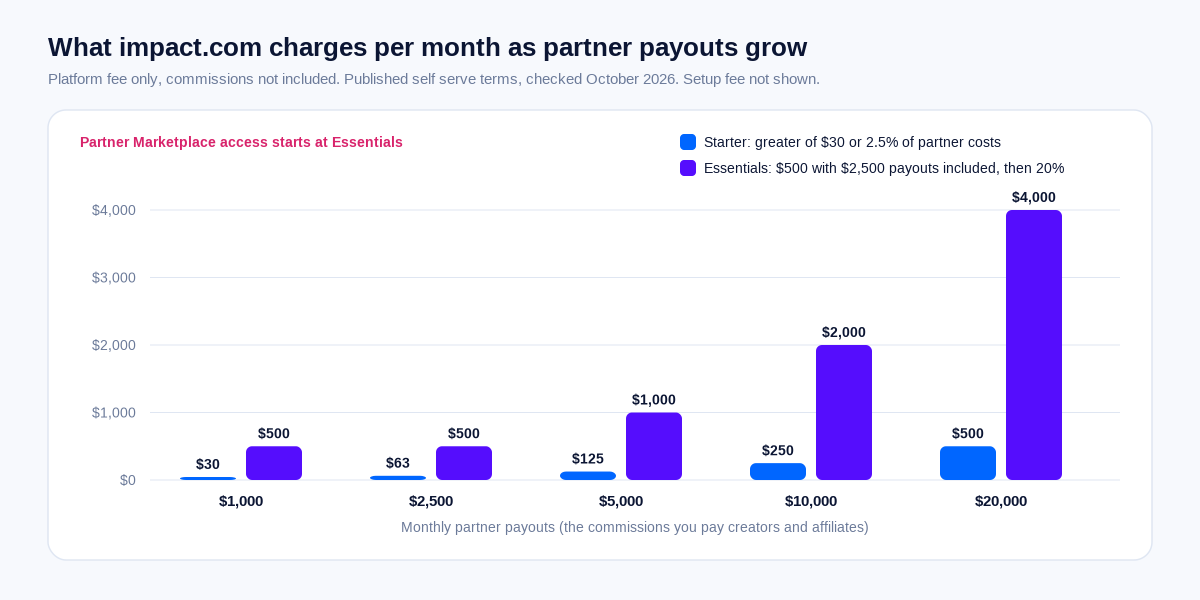
Starter stays cheap but has no marketplace. Essentials includes the marketplace and grows with every payout dollar above $2,500.
3. The setup fee nobody can quote you in advance
A one time fee tied to "technical resources" is reasonable for a platform this deep. It is also impossible to budget before you talk to someone. If your finance lead wants a number before the demo, you will not get one from the website.
4. The platform does not recruit your partners for you
This is the big one, and it is true of almost every tool on this list. A marketplace of 90,000 partners is a phone book, not a sales team. You still write the brief, set the commission, message partners, approve them and keep them active. Brands that leave impact.com because "affiliates did not work" usually had a recruiting problem rather than a software problem. Our 30 day plan for recruiting your first 10 affiliates exists precisely because no platform does this part for you.
What are the best alternatives to impact.com for startups?
There are three families of alternative, and mixing them up is the most common shopping mistake. A true affiliate network brings partners and charges you for the introduction. Affiliate software tracks and pays partners you bring yourself and charges a subscription. Marketplaces sit between the two. Here is the shortlist we would give a friend, with prices from each vendor's own page in October 2026.
| Platform | Starting price | Fees on top | Marketplace or network | Best for |
|---|---|---|---|---|
| impact.com (for reference) | $30 a month Starter, $500 Essentials, $2,500 Pro | 2.5% of partner costs on Starter; 20% of payouts above $2,500 on Essentials (self serve); setup fee not published | From Essentials | Established and enterprise partnership programs |
| Awin | $49 a month (Access), from $99 (Accelerate) | 3.5% per transaction on Access, 2.5% on Accelerate (tracking fee); 3 month minimum on Access | Yes, Awin says 1M+ partners | Retail and ecommerce brands that want a large network |
| Refersion | $39 a month (Launch), $199 (Growth) | 3% of affiliate driven sales on Launch, 2% on Growth | Yes, Refersion Affiliate Marketplace, including a free listing tier | Shopify and DTC brands |
| PartnerStack | Quote only; reportedly around $1,500 a month billed annually | Reportedly a platform fee on commissions; partners pay withdrawal fees | Yes, PartnerStack Marketplace from Launch | B2B SaaS partner ecosystems |
| Dub Partners | $90 a month (Business), $300 (Advanced) | 5% payout fee by ACH, 8% by card; payout caps of $2,500 and $15,000 a month | Enterprise plan only | Developer friendly SaaS that recruits its own partners |
| Rewardful | $49 a month (Starter) | 0% transaction fee; optional managed payouts at 3% | None listed | The simplest Stripe based SaaS setup |
| Wooly Network | $99 a month (Growth), $249 (Scale) | Operational fee on creator payouts only; no setup fee, no network minimum | Yes, built in creator marketplace | Brands that want creators to find their campaigns without a sales led contract |
| Trackdesk | $299 a month (Business) | None listed | Yes, Affiliate Marketplace listing for 1 offer on Business | Teams that want full software plus a modest marketplace |
| Shopify Collabs | Free to install | 2.9% processing fee on automatic payments may apply | Yes, Collabs Network | Small Shopify stores working with creators |
| Tapfiliate | $89 a month (Launch), $74 billed annually | None listed; overages above 5,000 clicks and 500 conversions a month | None listed | Teams that want broad integrations and no setup fee |
For a wider view that includes the legacy networks, see our comparison of affiliate networks and how to choose one. Below, a short and honest verdict on each.
The shortlist, one verdict each
Awin: the big network with a small front door
Awin absorbed ShareASale (the ShareASale platform closed on October 6, 2025, according to Awin's announcement) and now sells a self serve Access plan at $49 a month plus a 3.5% tracking fee per transaction, with the first month free and a 3 month minimum. Accelerate starts at $99 a month with a 2.5% fee. Reviewers report that the tracking fee is charged on the sale value, not on the commission, and it sits on top of what you pay the partner. Its FAQ reportedly mentions that a one off integration fee may apply.
Verdict: the most direct impact.com alternative if what you want is reach into a mature publisher network. Just model the fee on revenue, because 3.5% of sales is a much bigger number than 3.5% of commissions.
Refersion: built for Shopify, now with a sales fee
Refersion still starts at $39 a month ($29 billed annually), but that Launch plan now carries 3% of affiliate driven sales, and Growth at $199 a month carries 2%. There is a free marketplace listing tier, which is a nice way to test whether partners show up before you pay.
Verdict: a sensible pick for DTC brands on Shopify that want a marketplace. Same warning as Awin: a percentage of sales compounds quickly once affiliate revenue is real.
PartnerStack: the B2B specialist
PartnerStack calls itself "the only affiliate platform built for B2B" and its marketplace is included from the Launch plan. Pricing is quote only. Uppercut reports a starting point around $1,500 a month billed annually, and Vendr reports a median buyer spend of about $19,600 a year. Partners pay their own withdrawal fees (for example, Stripe withdrawals cost $2.25 plus 0.25%, capped at $20, per PartnerStack's help center).
Verdict: if you sell B2B SaaS and want resellers, referral partners and affiliates in one place, PartnerStack is often the better choice. If you are a consumer brand, you will be paying for features you do not use, and enjoying a demo you did not need.
Dub Partners: link infrastructure that grew a partner program
Dub Partners starts on the Business plan at $90 a month and Advanced at $300. The brand pays a payout fee on top of commissions: 5% by ACH or 8% by card on those plans. Business caps partner payouts at $2,500 a month and Advanced at $15,000; when you hit the cap, payouts wait until the next billing period. Partner Network access and a marketplace listing are Enterprise only. There is a 14 day free trial.
Verdict: excellent for developer led SaaS that cares about links, analytics and a clean API, and that recruits its own partners. Not an answer to the "where do I find partners" problem below Enterprise.
Rewardful: the shortest path from Stripe to affiliates
Rewardful starts at $49 a month for up to $7,500 a month of affiliate attributed revenue, $99 for up to $15,000, and $149 and up for Enterprise. There is no transaction fee on any plan, a 14 day trial, and payouts run through PayPal or Wise, with an optional managed payouts service at 3%.
Verdict: for a Stripe billed SaaS that already has a community of fans, Rewardful is about as simple as affiliate software gets. It has no marketplace, so you bring every partner yourself. If you sell software, our guide to affiliate marketing for SaaS covers recurring commission design in more depth.
Wooly Network: a creator marketplace on a flat plan
Wooly Network is a newer marketplace, and it is not trying to be an enterprise partnership suite. Brands publish a campaign once (CPA, CPL, revenue share, a fixed amount per sale, or a sponsorship) and creators discover it and apply, with approval set to instant or manual. Plans are Growth at $99 a month (1 live performance campaign) and Scale at $249 a month (up to 4 campaigns, plus a server to server conversion API, app install tracking, a fraud review queue, cross device attribution and automated Stripe payouts). Enterprise is custom. There is no setup fee, no network minimum, and you can cancel anytime. An operational fee applies to creator payouts only, so it costs nothing in a month when nothing sells.
Verdict: worth a look if you want marketplace style discovery without the jump to a $500 tier or a sales cycle. Not the right tool if you need deep enterprise features such as call tracking or offline attribution.
On Wooly Network: you can try the campaign demo on the affiliate marketplace for brands page before you sign up, which is a faster way to judge fit than a discovery call.
Trackdesk: software first, marketplace included
Trackdesk's Business plan is $299 a month with unlimited clicks and conversions and a marketplace listing for 1 offer; Enterprise lists at $599 a month with 3 offers and a featured placement. There is a 14 day trial. The marketplace claims AI matching from more than 100,000 affiliates (a vendor claim).
Verdict: a reasonable middle ground for teams that want full featured tracking and a modest amount of discovery at a predictable price.
Shopify Collabs: free, and it shows in both directions
Shopify Collabs is free to install, with a 2.9% commission processing fee on automatic payments that may apply. It includes a creator discovery network. The App Store rating is 4.1 out of 5 from 427 reviews, and creators reportedly must be in the US, Canada or the UK.
Verdict: the obvious first step for a small Shopify store. You will outgrow it when you need finer commission rules, non Shopify tracking, or creators outside those three countries.
Tapfiliate: plain, broad, no setup fee
Tapfiliate's Launch plan is $89 a month ($74 billed annually) with 5,000 clicks and 500 conversions a month before overages; Scale is $179 a month. Its pricing FAQ says there are no extra or hidden setup fees.
Verdict: dependable software for brands that already have partners and want wide integrations. No marketplace, so budget time for recruiting.
How much do impact.com alternatives cost at real program sizes?
Sticker prices are a bad guide because every platform charges on a different base: some on sales, some on commissions, some flat. So here is one hypothetical program, priced across the shortlist.
The assumptions. Say you run an ecommerce brand with a $100 average order. Affiliates drive 250 orders a month, so $25,000 of affiliate revenue. You pay a 15% commission, so $3,750 a month goes to partners. Where a platform offers a choice, you pay partners by ACH. The table shows the platform cost only, on top of the $3,750 in commissions, using each vendor's published monthly price.
| Platform and plan | How the fee is calculated | Estimated monthly platform cost | Includes a marketplace? |
|---|---|---|---|
| impact.com Starter | Greater of $30 or 2.5% of $3,750 | About $94, plus setup fee | No |
| impact.com Essentials (self serve terms) | $500 plus 20% of the $1,250 above $2,500 | About $750, plus setup fee | Yes |
| Awin Access | $49 plus 3.5% of $25,000 in sales | About $924 | Yes |
| Refersion Growth | $199 plus 2% of $25,000 in sales | About $699 | Yes |
| Refersion Launch | $39 plus 3% of $25,000 in sales | About $789 | Yes |
| Dub Partners Advanced | $300 plus 5% ACH fee on $3,750 (Business caps payouts at $2,500) | About $488 | No (Enterprise only) |
| Rewardful Enterprise entry tier | $149, covers up to $30,000 of affiliate revenue, 0% fee | About $149, plus your own payout costs | No |
| Trackdesk Business | Flat $299 | About $299 | Yes, 1 offer |
| Shopify Collabs | Free, 2.9% of $3,750 if automatic payments apply | About $109 | Yes |
| Wooly Network Growth | Flat $99 plus an operational fee on creator payouts (see pricing page) | $99 plus the payout fee | Yes |
| PartnerStack | Quote only | Reportedly around $1,500 | Yes |
Three things jump out. First, impact.com Starter is one of the cheapest options here, which is the opposite of its reputation; it just does not include a marketplace. Second, fees on sales hurt more than fees on commissions: Awin and Refersion bill on $25,000, not $3,750. Third, the flat plans (Rewardful, Trackdesk, Wooly) stay flat as you grow, while every percentage plan grows with you. Double the program to $50,000 of revenue and the Essentials estimate becomes about $1,500, Awin Access about $1,799, while Trackdesk stays at $299.
For Wooly's operational fee and the current plan details, compare plans on the pricing page; we do not publish the percentage in articles because the pricing page is where it is kept current. Brands that only run collabs, rather than affiliate campaigns, can start on the free plan.
A note on what this table leaves out: your time. A platform that costs $200 more but brings you 20 qualified partners in the first month is cheaper than one that saves $200 and brings none. And commissions themselves will dwarf every number above, so get them right first; our breakdown of affiliate commission rates by industry is a good place to sanity check yours.
How do you choose the right impact.com alternative?
Skip the feature grid for a minute and answer five questions in order. Each one removes about half the list.
- Do you already have partners? If you have 30 creators who love you and just need links and payouts, buy software (Rewardful, Dub Partners, Tapfiliate, or impact.com Starter). If you have none, you need discovery, so look at networks and marketplaces (Awin, Refersion, PartnerStack, Trackdesk, Shopify Collabs, Wooly Network, or impact.com Essentials).
- What do you sell? B2B SaaS leans PartnerStack, Dub or Rewardful. Shopify retail leans Refersion, Shopify Collabs, Awin or impact.com. Apps and lead generation need install postbacks or lead events, so check the tracking list before anything else.
- Would you rather pay flat or pay a share? A percentage is kinder when revenue is small and unpredictable. A flat plan is kinder once revenue is real. Work out the crossover for your own numbers using the method above.
- How much procurement can you tolerate? If the answer is "a credit card and an afternoon", cross off anything quote only. If you need an MSA, security review and SSO, impact.com Pro or Enterprise, PartnerStack and Everflow are built for that conversation.
- Who will run it? Every platform assumes someone owns the program a few hours a week. If nobody does, no tool will save it, and that includes the expensive ones.
A rule of thumb we like: buy the platform for the program you will have in twelve months, not the one you hope to have in five years. You can migrate up. Migrating down out of a multi year contract is a much less fun meeting.
When is impact.com still the better choice?
Fairness matters here, because some readers should close this tab and book the impact.com demo. Stay with or choose impact.com if:
- You run a large, multi channel partnership program with affiliates, influencers, B2B partners and media publishers under one roof.
- You need enterprise tracking: call tracking, offline conversions, fraud scoring, attribution risk protection or partner deduplication, which impact.com lists on Enterprise.
- Your security and legal teams need it: SAML, contracts, and a vendor that has sold to large companies many times. impact.com cites more than 4,000 brands, and its G2 rating is reportedly around 4.4 out of 5.
- You are a small Shopify store that only needs tracking, in which case Starter at $30 a month is a fine deal.
The brands that should look elsewhere are the ones in the middle: past the point where Starter is enough, nowhere near needing Pro, and allergic to a fee that grows 20 cents for every payout dollar.
What to check before you sign with any affiliate platform
- Every fee, in writing. Subscription, transaction fee, payout fee, card surcharges, overage rules and any setup or integration fee.
- The fee base. Is the percentage on sales, on commissions, or on payouts? This one detail can triple your bill.
- Contract length and exit. Minimum terms, notice periods, auto renewal, and whether you can export partner data.
- Tracking method. Browser cookies alone lose conversions; server to server events and postbacks hold up better. Our explainer on how affiliate tracking works covers the trade offs.
- Payout experience for partners. Who pays withdrawal fees, how often partners are paid, and in which countries. Partners talk to each other about this.
- What discovery really means. Ask how many active partners in your category are on the marketplace, not how many accounts exist.
If you want a creator marketplace on a flat monthly plan with no setup fee, see how campaigns work on our page for brands or check brand pricing. If one of the other platforms above fits better, use it: the right tool is the one your team will actually run every week.
Common questions
How much does impact.com cost in 2026?
According to impact.com's pricing page in October 2026, Starter is priced from $30 a month (the greater of $30 or 2.5% of locked partner costs), Essentials from $500 a month, Pro from $2,500 a month, and Enterprise is quoted by sales. A one time setup fee applies, and its amount depends on your onboarding needs.
Does impact.com have a free trial?
impact.com says there are no minimum fees during your first 30 days on Starter, unless partners drive sales. If your program generates less than $30 in partner driven revenue in that period, impact.com charges you $30.
What is the cheapest alternative to impact.com?
It depends on what you need. For tracking only, impact.com Starter, Shopify Collabs and Rewardful are all low cost. For a marketplace, Refersion has a free listing tier and flat plans such as Wooly Network Growth ($99 a month) or Trackdesk Business ($299 a month) avoid percentage of sales fees. Model the fee base, because a percentage of sales grows quickly.
Which impact.com alternative is best for B2B SaaS?
PartnerStack is built for B2B SaaS partner ecosystems and includes its marketplace from the Launch plan, but pricing is quote only and reportedly starts around $1,500 a month billed annually. Smaller SaaS teams that recruit their own partners often choose Rewardful or Dub Partners instead.
Does impact.com charge a setup fee?
Yes. impact.com's pricing FAQ says there is a one time fee that depends on the number of technical resources your onboarding requires. The amount is not published, so ask for it in writing before you sign.
Do I need a marketplace, or just affiliate software?
If you already have partners, affiliate software that tracks and pays them is enough. If you have none and want partners to find you, choose a network or marketplace, and still plan to recruit actively, because a marketplace listing alone rarely fills a program.
Keep reading
- Best affiliate networks compared: how to choose the right one
- What is an affiliate network
- How to recruit your first 10 affiliates: a 30 day plan
- Affiliate marketing for SaaS
- How much should you pay affiliates: commission rates by industry
Related reading
- Affiliate Platform Comparisons and Alternatives — Honest side by side comparisons of the affiliate networks and partner platforms brands shortlist most, with pricing, fees, contracts and who each one suits best.
- Dub Partners Pricing Explained: Plans, Payout Fees, Limits — What each Dub plan includes for affiliate programs, how payout fees and monthly payout caps change the real cost, and a worked example at three sizes.
- PartnerStack vs Impact: Which Partner Platform to Choose — A neutral comparison of the two best known partner platforms: who each one is built for, how pricing works, and when neither is the right fit.
More from the Wooly Network Blog