How to create high-converting content
A creator's playbook for high-converting content: hooks that earn the first five seconds, link placement by format, the three metrics that matter, and the affiliate offers worth your next post.
By Nora Ellis, Affiliate Marketing & Creator Economy Writer · with Wooly Network, Creator Success · 31 August 2026 · 6 min · Playbooks
High-converting content is not louder content. It is content where the right person meets the right offer at the moment they are ready to act, and where the click is tracked, so you actually get paid for it. If you promote affiliate offers, sponsorships or brand campaigns on Wooly Network, this is the playbook. The same playbook works for paid collabs: One-Time Jobs, Recurring Jobs, Bounties and Paid Product Collabs.
The short version: hook fast, prove it works, ask once, track everything. Everything below is just detail.
Conversion is a maths problem, not a personality problem
Your earnings on any campaign come down to three numbers multiplied together: how many people see it, how many click, and how many of those buy. That is it. So a “bad” post is rarely a bad idea; it is usually a weak hook, a link nobody could find, or an offer that never fit your audience in the first place.
Which means you can fix conversion without becoming a different creator. (Good news, because your personality has a 30-day refund window at best.)
The anatomy of a high-converting post
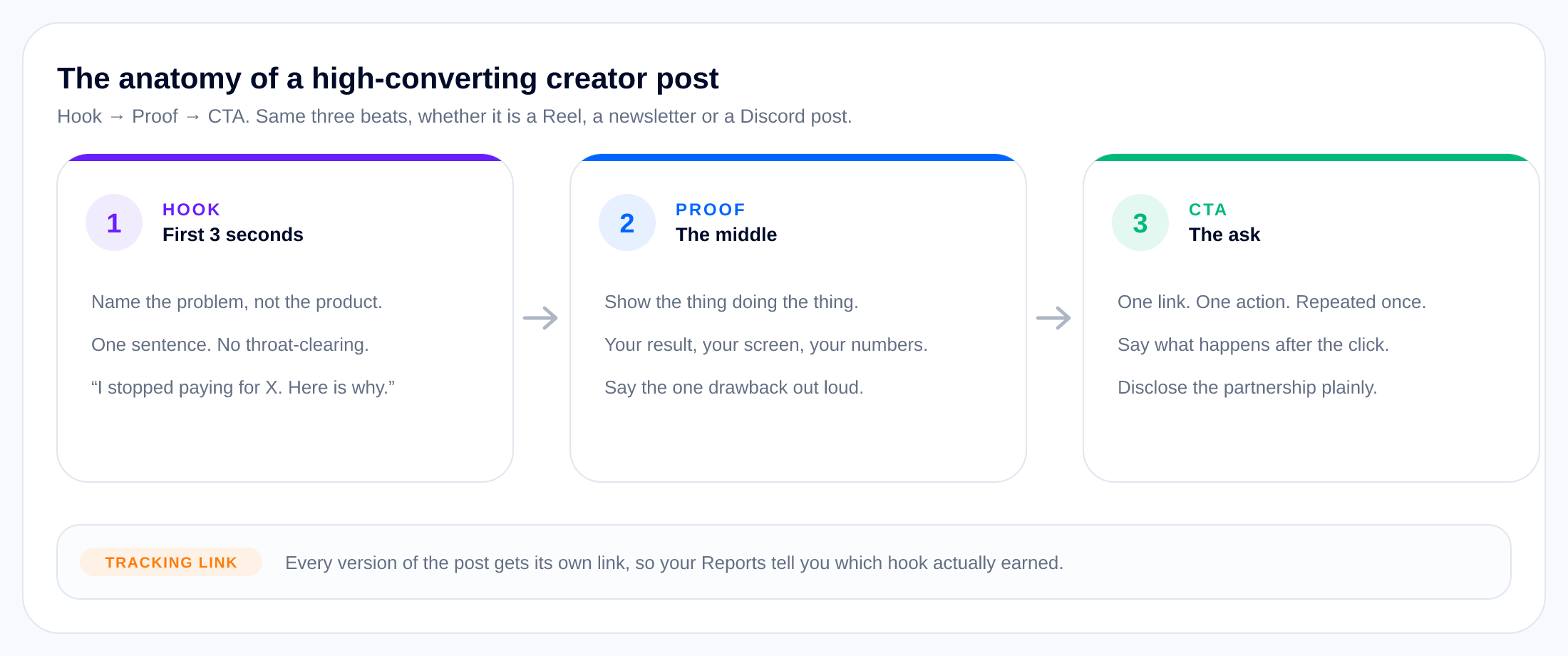
Three beats, in this order. It works for a Reel, a newsletter, a blog review or a Discord drop.
1. The hook: earn the next five seconds
Name the problem, not the product. “My inbox was costing me two hours a day” beats “Today's video is sponsored by…” every time. One sentence, no warm-up, and no promise you cannot keep in the next ten seconds.
2. The proof: show the thing doing the thing
Screens, results, before-and-after, your real numbers. And say the one drawback out loud: audiences trust a recommendation that admits a flaw roughly ten times more than a flawless one. It also filters out the people who would have refunded, and a refunded sale is a denied commission, not income.
3. The CTA: one link, one action
Say exactly what happens after the click (“free plan, no card”), give one link rather than five, and repeat it once at the end. Then place the link where your format actually gets clicked.
Hooks and link placement by format
| Format | Hook that works | Where the link lives | What to watch |
|---|---|---|---|
| Short video (Reels, TikTok, Shorts) | Problem in the first line, on screen and out loud | Pinned comment + link in bio, mentioned verbally | Clicks per 1,000 views |
| Long video / YouTube | Show the result in the first 15 seconds | First line of the description, plus a mid-roll mention | Click-through from description |
| Newsletter | Subject line = the outcome, not the brand | One inline text link high up, one button at the end | Click rate per send |
| Blog / SEO review | Answer the search query in the first paragraph | In the comparison table and after the verdict | Conversion rate per page |
| Community (Discord, Slack, Reddit) | Answer a real question, then mention the tool | One link inside a genuinely useful answer | Conversions per post |
Whatever the format, use a separate tracking link per version of the post. That is how you learn which hook earned instead of guessing.
The three numbers that tell you if it worked
| Metric | What it really tells you | Fix it by |
|---|---|---|
| Clicks | Your hook and placement are working | Rewriting the first line; moving the link |
| Conversion rate | The offer fits the audience you sent | Setting expectations before the click; choosing a better-matched offer |
| Earnings per click | Whether this campaign deserves your next slot | Swapping to a higher-commission or recurring offer |
All three sit in Reports & Analytics in your creator workspace, next to My Campaigns and Earnings & Payouts. Read them weekly, not daily; conversions arrive on a delay because advertisers review them first.
Pick offers that convert before you write a word
The fastest conversion win is choosing better. Before you apply, check the commission model, the cookie window and the approval rules on the offer page, and ask one blunt question: would I recommend this if nobody paid me? If the answer is no, your audience will hear it.
- Prefer offers your audience already searches for: demand you did not have to create.
- Recurring commissions compound; compare payout models in CPA vs CPL vs revenue share.
- Stack two or three complementary offers rather than one of everything; sponsorships vs affiliate deals explains the mix.
- Browse what is live now on the Wooly Network marketplace, or see how the platform works for creators.
Disclose it. Every time.
A clear “paid partnership” or “affiliate link” label at the top costs you almost nothing in conversions and protects everything you have built. It is also the law in most markets. Put it where it is seen before the click, not in a caption nobody expands.
Frequently asked questions
How long until I see conversions?
Clicks show up straight away; conversions appear once the advertiser reviews them, and commissions are paid after the brand's waiting period: 30 or 60 days, shown on every offer before you apply.
How many links should one post have?
One. A second link is a second decision, and decisions are where conversions go to die.
Do I need a big audience to earn?
No. A small, specific audience converts better than a large, general one, because the recommendation lands on people who were already looking.
What should I change first if nothing converts?
The hook, then the offer. In that order: a great offer with a buried hook never gets the chance to convert.
References worth bookmarking
- Google Search Central: Creating helpful, reliable, people-first content; what search engines reward, in Google's own words.
- FTC: Disclosures 101 for Social Media Influencers; how and where to label paid content.
- Nielsen Norman Group: How people read online; why the first line carries the post.
- YouTube: Paid product placements and endorsements; the platform rules for sponsored video.
Your turn
Find an offer worth your next post
Joining is free for creators. Apply to live campaigns, get your tracking link in minutes and keep 100% of your commissions, no thresholds, no deductions.
Browse the marketplace →Related reading
- How to Write a UGC Brief Creators Love (Free Template) — A good UGC brief template saves everyone a round of confused messages. Here is the anatomy of a brief, a full copyable template and a filled in example you can adapt today.
- What Is a Clipping Campaign? Pay Per Clip Content Explained — A clipping campaign pays fans or creators to cut long videos into short clips. Here is how pay per view and pay per approved clip actually compare.
- Creator Retainers: How Monthly UGC Deals Work and What to Charge — A creator retainer trades a lower per video rate for steady monthly work. Here is how to structure, price and end one without losing money on either side.
More from the Wooly Network Blog