CPA vs CPL vs Revenue Share: Which Payout Model to Choose
Four models, one decision: what each one buys, what each one attracts, where each one is gamed, and the hybrid setups that fix the weaknesses of all of them.
By Nora Ellis, Affiliate Marketing & Creator Economy Writer · with Wooly Network, Editorial · 17 September 2026 · 6 min · Performance Marketing
CPA pays a flat fee when a new customer buys, CPL pays a flat fee for a qualified lead, and revenue share pays a percentage of what a customer keeps spending. Choose CPA when you need a known cost per customer, CPL when the sale happens away from your website, and revenue share when retention is the business. The fourth option, a percentage of the first sale, is the default for anything sold once.
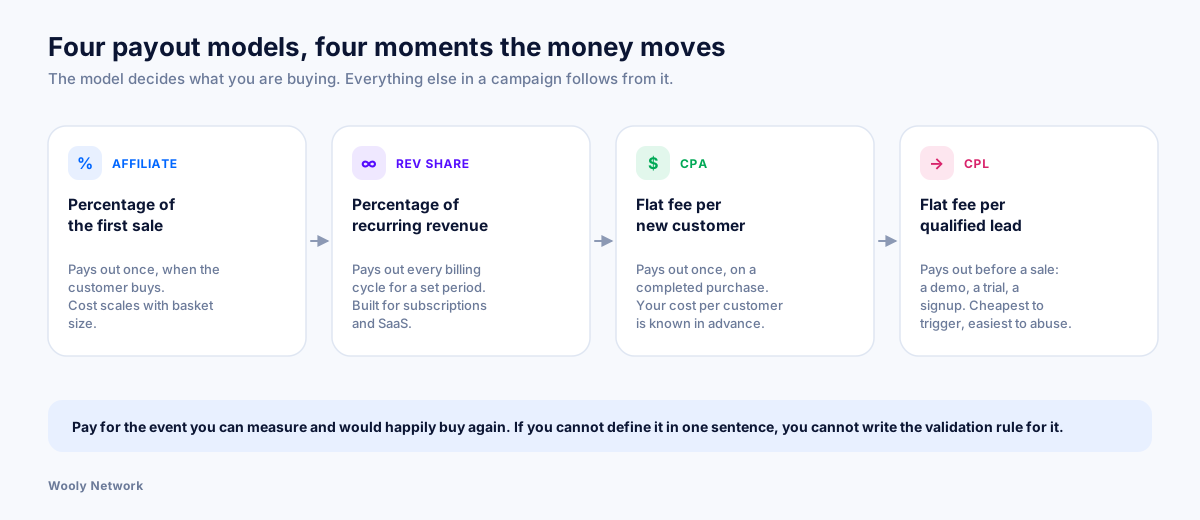
The model decides what you are buying. Everything else in the campaign follows from it.
The comparison, in one table
| % of first sale | Revenue share | CPA | CPL | |
|---|---|---|---|---|
| You pay | Once, on purchase | Every cycle, for a set period | Once, on purchase | On a qualified lead |
| Amount | Scales with basket | Scales with retention | Fixed | Fixed, small |
| Your risk | Low | Low, spread over time | Low | Real: you pay before revenue |
| Partner risk | High | Highest, and slowest to pay | High | Lowest |
| Attracts | Content and review partners | Long-term, niche-expert partners | Performance buyers | Volume partners |
| Best for | Ecommerce, one-off products | SaaS, subscriptions, memberships | Products with stable basket size | Demos, quotes, applications, trials |
| Main failure mode | Discount stacking | Paying forever by accident | Partners push the cheapest qualifying product | Low quality leads at volume |
Percentage of the first sale
The default for ecommerce, and the easiest to explain to a partner. Your cost moves with the order value, which means a partner who sends a customer buying three items earns proportionally more, which is exactly the incentive you want.
Where it breaks: discounting. If your commission is calculated on the post-discount total, a partner's effective rate falls every time you run a sale, and they notice. If it is calculated on the pre-discount total, a 20% code plus a 20% commission on a 45% margin product is a bad afternoon. Pick one, write it down, and be consistent.
Use it when: average order value varies, margin is a reasonably stable percentage, and the purchase is a one-off.
Revenue share
The partner earns a percentage of what the customer pays, every billing cycle, for a defined period: commonly 6 or 12 months, sometimes 24, occasionally lifetime. It is the strongest model in the channel, for one structural reason: it aligns the partner with retention rather than with the sale. A partner earning for twelve months has a direct financial interest in sending you customers who stay.
That alignment shows up in behaviour. Revenue share partners write longer content, qualify harder in the copy, and warn unsuitable readers off, because a churned customer costs them eleven months of income.
Where it breaks: an uncapped period. "Lifetime" sounds like a recruiting advantage and behaves like a permanent line on your cost of revenue, including for customers who upgraded, changed product and long ago stopped resembling the original referral. Twelve months is the setting that recruits well and stays defensible.
Two details to decide before launch:
- Do upgrades count? If the customer moves from $29 to $299, does the partner earn on the new figure? Most brands say yes for the period. Say so explicitly.
- What happens on a pause or downgrade? The common answer is that the commission follows whatever is actually billed.
Use it when: revenue is recurring and retention is the thing you are actually optimising.
CPA, a flat fee per acquired customer
You pay a fixed amount, say $45, when a new customer completes a purchase. The attraction is forecasting: a known, capped cost per customer regardless of basket size, which makes the channel easy to compare against paid media.
Where it breaks: the incentive is to trigger the fee as cheaply as possible. If your cheapest product is $19 and your CPA is $45, you have created a machine that loses money, and the partners doing it are behaving exactly as you asked. Fixes: a minimum order value in the validation rules, or different CPAs per product tier.
The other place it breaks is the word "new". A CPA campaign paying for new customers needs a definition of new that your system can actually enforce: by email, by payment method, by account. Write which one.
Use it when: basket size is stable, or you can tier the fee, and you need predictable unit economics.
CPL, a flat fee per qualified lead
You pay for something before a sale: a demo request, a free trial start, an application, a quote request. This is the only model that works when the purchase does not happen on your website, which makes it the standard in insurance, finance, education, home services and enterprise software.
It is also the model that carries real risk, because you pay before revenue exists. Everything depends on the word "qualified", and that word is doing an enormous amount of work.
A weak definition: "a completed form". A usable one:
A qualified lead is a form submission with a working email and phone number, from our serviceable countries, where the company has more than 20 employees, and which is not a duplicate of a submission in the previous 90 days. Leads that fail verification are not payable, and the reason is recorded.
Also decide the verification lag. Paying instantly on submission invites junk; holding for 7 to 14 days while leads are checked is normal and should be stated, so partners are not surprised by the wait.
Use it when: the sale happens off-platform or over a long cycle, and you can define and verify quality.
Hybrids, which is what mature programmes actually run
Once a programme has been running a while, the pure models start looking like a false choice.
| Hybrid | Shape | Solves |
|---|---|---|
| CPL plus CPA | Small fee for the lead, larger fee if it converts | Lets partners earn early while keeping quality tied to revenue |
| Flat fee plus revenue share | A bonus on the first payment, then a percentage | Revenue share's slow start, which is its biggest recruiting problem |
| Tiered rates | Rate rises after a volume threshold in a period | Rewards the partners who actually carry the programme |
| Rate by partner type | Content partners higher than coupon partners | The incrementality problem, properly rather than by complaint |
| Time-boxed boost | Double commission for a launch window | Concentrates attention when you need it |
On Wooly Network: all four models are campaign settings rather than custom work, so you can run a CPL campaign for demos and a revenue share campaign for self-serve signups side by side, each with its own attribution window, approval mode and validation rules. The campaign walkthrough is here.
How to choose, in four questions
- Does the customer keep paying? If yes, revenue share is your baseline and everything else is a variation on it.
- Does the purchase happen on your site? If no, you need CPL, and the definition of qualified is the whole project.
- Does basket size vary a lot? If yes, use a percentage. If no, a flat CPA is simpler for everyone and easier to forecast.
- Can you write the qualifying event in one sentence? If you cannot, you cannot write the validation rule either, and the model will produce arguments instead of customers.
Common questions
Which model do affiliates prefer?
Sophisticated partners compare earnings per click, not models. That said, CPL is easiest to earn on, revenue share pays the most over time, and percentage of sale is the most familiar. A well priced offer in any model will out-recruit a badly priced one in the fashionable model.
Can I change model after launch?
Yes, for future clicks, on any platform that freezes terms at click time. Tell partners before you do it. Changing the model silently is the fastest way to lose the partners who were producing.
What is CPS, and how is it different from CPA?
Cost per sale is usually used to mean a percentage of the sale, while CPA usually means a flat fee per acquisition. The terms are used loosely across the industry, so always check whether the number quoted is a percentage or a currency amount.
Is lifetime revenue share ever a good idea?
For a small number of strategic partners who are effectively a distribution channel, sometimes. As a public default on a marketplace offer, rarely: it is an unlimited liability offered to strangers, and a 12 month period recruits nearly as well.
Keep reading
- How much should you pay affiliates?
- How affiliate commissions work
- How to start an affiliate program for your business
- What is an affiliate network and how does it work?
- How affiliate tracking works
Related reading
- Spark Ads and Partnership Ads: How Creator Whitelisting Works — Whitelisting lets a brand run ads through a creator's own account. Here is how Spark Ads codes and Meta Partnership Ads permissions actually work.
- Affiliate Marketing for Brands: A Complete Guide — What the channel is actually good at, what it is bad at, how to budget for it honestly, and the operating rhythm that separates a programme that compounds from one that flatlines.
- Affiliate Marketing vs Influencer Marketing: What's the Difference? — One pays for a result, the other pays for a slot. A breakdown of who carries the risk, what each one costs, how to measure them honestly, and why most brands end up running both.
More from the Wooly Network Blog