What Is an Affiliate Network and How Does It Work?
The neutral layer between a brand and the people who recommend it: what a network actually does, how it differs from in-house software and an agency, and how money moves from a click to a payment.
By Nora Ellis, Affiliate Marketing & Creator Economy Writer · with Wooly Network, Editorial · 13 September 2026 · 10 min · Affiliate Marketing
An affiliate network is the neutral layer between brands that want customers and people who can recommend them. It hosts the offers, issues a tracked link to every partner, counts the clicks and the sales those links produce, settles the disagreements, and moves the money. Nobody pays for a promise. Everybody pays for a result that both sides can see.
That is the short version. The long version is worth your time, because the word "network" hides four very different products that are sold under the same name, and picking the wrong one is how a programme quietly stalls in month three.
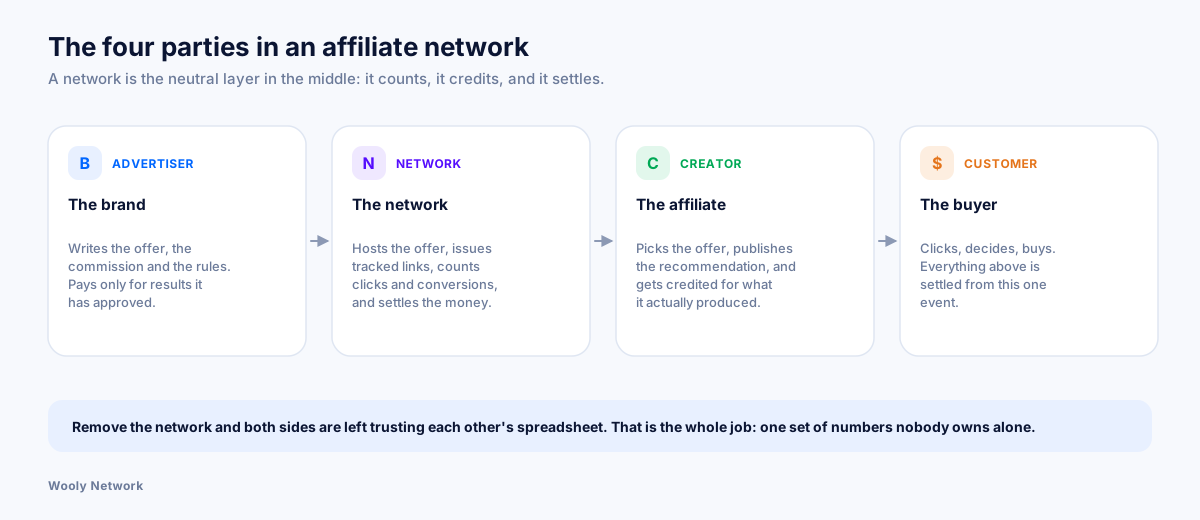
Remove the network from the middle, and both sides are left trusting the other one's spreadsheet.
The four parties, and what each one is actually buying
Affiliate marketing only has four roles. Every platform, every fee model, and every argument about attribution comes back to these.
| Party | What they bring | What they are buying | The risk they carry |
|---|---|---|---|
| Advertiser (the brand) | A product, a margin, and a commission budget | Customers at a price agreed in advance | Traffic that converts badly, or does not convert at all |
| Affiliate (creator, publisher, partner) | An audience and the trust attached to it | A fair count and a payment that arrives | Work published, credit lost, invoice ignored |
| Network | Tracking, contracts, dispute rules, settlement | A cut of what flows through it | Fraud, chargebacks, and being the one everyone blames |
| Customer | The only real money in the system | A product they were told about by someone they follow | Being sold something by an undisclosed advert |
Notice that the affiliate and the advertiser want the same thing from the middle: one set of numbers that neither of them controls. That is the entire product. Everything else a network sells is convenience built on top of it.
How the money actually moves
Most explanations stop at "the creator shares a link and earns a commission", which skips the five or six weeks where all the real questions live. Here is the full path.
- The click. A partner shares a tracked link. When someone follows it, the network records the click and, critically, freezes the campaign terms onto it: the commission rate, the payout model, and the attribution window as they existed at that second. A rate change next Tuesday cannot reach backwards into a click from today.
- The attribution window. The click is remembered for a set period, commonly 30 days. If the customer buys inside it, the partner is credited. Outside it, nobody is. This is a commercial decision dressed up as a technical one, and it is covered properly in how affiliate tracking works.
- The conversion. The advertiser's site or server reports the order, with a value. The network applies the frozen rate and calculates a commission. The advertiser's system reports what happened; it never gets to say what it is worth.
- The review. The commission sits pending while the advertiser checks it against published validation rules: refund windows, duplicate orders, cancelled subscriptions, traffic that broke the campaign terms. This step is where trust in a programme is won or lost.
- The payment. Approved commissions are grouped into a period and released on the payment terms the advertiser published, typically 30 or 60 days after the period closes, so refunds have time to surface.
If you want the state-by-state version with what each status means for both sides, read how affiliate commissions work.
Network, platform, agency, marketplace: they are not the same thing
These four words get used interchangeably by people selling all four. They solve different problems, and the tell is always the same question: who finds the partners?
| Model | What it gives you | Who finds partners | Typical fee shape | Examples |
|---|---|---|---|---|
| Affiliate network | Tracking, a partner pool, contracts and settlement in one place | The network, plus your own outreach | Percentage of commissions, often with a platform fee | Awin, CJ, Rakuten Advertising |
| Partnership platform (SaaS) | Powerful tracking and workflow, no audience attached | You, entirely | Monthly licence, often four figures | impact.com, PartnerStack |
| Self-hosted tool | A tracking script and a payouts dashboard bolted to your store | You, entirely | Flat monthly, low | Refersion, Rewardful, Tapfiliate |
| Agency or OPM | People who run the programme for you | The agency, on retainer | Monthly retainer plus a performance cut | Independent affiliate agencies |
| Creator marketplace | Discovery first: a catalogue both sides browse | Both sides, by searching | Subscription, or a cut of performance | Wooly Network, Shopify Collabs |
The honest summary: a self-hosted tool is cheap and lonely, a SaaS platform is powerful and lonely, an agency is neither cheap nor lonely, and a network or marketplace is the only shape that hands you tracking and a reason for partners to show up on the same day.
A quick test before you sign anything. Ask the vendor: "if I launch on Monday, where does my first partner come from?" If the answer is a list of tactics you have to execute, you are buying software, not a network. That is fine, as long as you priced the recruiting.
What networks charge, and who pays it
Fee structures are the least standardised part of the industry, but they collapse into three shapes.
- Override on commissions. The classic network model: the network takes a percentage on top of every commission you pay, commonly quoted in the region of 20% to 30% of the commission value, sometimes with a monthly platform minimum. Predictable for the network, and it rises exactly when your programme is working.
- Flat subscription. A fixed monthly fee for the software, with the commission cost staying entirely between you and the partner. Easier to forecast, and it stops punishing you for growth.
- Retainer plus performance. The agency shape, where you are paying for management time rather than for the rails.
One thing to watch: on the override model, your effective cost of sale is the commission plus the override plus any payment processing. A 20% commission with a 25% override is a 25% cost of sale, not a 20% one. Work that number out before you set your rates, and read how much you should pay affiliates alongside it.
On Wooly Network: pricing is a flat plan rather than a percentage of what your partners earn, so the cost of the rails does not climb every time a campaign works. You can see the plans here.
What a network does that a tracking script cannot
Tracking is the part everyone photographs. It is not the hard part.
- It is the referee. When an advertiser says a sale was a duplicate and a creator says it was not, somebody has to hold the record that decides it. A network holds a log neither side can edit, and rules both sides agreed to before the click happened.
- It stops the counting from being marking your own homework. A self-hosted script is owned by the advertiser. That is not an accusation; it is a structural fact, and every experienced affiliate knows it. It is why sophisticated partners discount self-hosted programmes when deciding where to spend their audience's attention.
- It filters the traffic. Click fraud is ordinary, not exotic. A network sees the patterns across thousands of campaigns: clicks from the same address seconds apart, conversions faster than a human could read a checkout page, sessions with no interaction at all. Those signals are worth far more pooled than they are alone.
- It carries the contract and the compliance. One set of terms, one place where partners are suspended, one place where disclosure rules live. In the United States, the FTC's endorsement guides require any material connection between an endorser and a brand to be disclosed clearly and conspicuously, and the liability does not stop at the creator.
- It settles. Hundreds of partners, dozens of countries, one payment run. Doing this yourself means invoices, currencies, and tax forms, and it is the single most common reason small programmes quietly die.
The two ways affiliate programmes go wrong
After the fifth or sixth programme you watch, the failures stop being varied.
The first is silent under-counting. The tag fires on the wrong page, or only on card payments, or not at all on mobile Safari. Partners publish, see zero, and leave. The advertiser concludes affiliate does not work for their category. Nothing was wrong with the channel; the counting was broken, and nobody looked. This is why the tracking article in this series spends its time on server-side reporting rather than on cookies.
The second is a queue nobody clears. Commissions sit pending for eleven weeks because approving them is somebody's fourth priority. The partners are not angry; they simply stop posting, and they tell each other. Affiliate is a channel where your reputation as a payer is your recruiting pitch, and it travels faster than any outreach email you will ever send.
How to judge a network before you commit
Six questions, in the order that matters. Any vendor who cannot answer all six in writing is telling you something.
- Can it count without a browser? Server-to-server reporting is not an advanced feature anymore; it is the floor. Ask directly.
- Who sees the offer before I recruit anyone? A catalogue with real partners in it, or an empty dashboard.
- How are disputes decided, and by whom? Look for published validation rules, not a support email address.
- When does money actually leave? Ask for the payment terms in days, and whether partners see them before applying.
- What does it cost when this works? Model the fee at ten times your current volume, not today's.
- What happens to my data if I leave? Partner lists, click history, order history. The answer should be "you export it".
Where a marketplace fits
Wooly Network is a marketplace built on network rails. Advertisers publish a campaign with its commission, its payout model, its attribution window, and its validation rules, and creators browse those offers the way they would browse anything else: by category, by channel, by what the offer actually pays. Approval can be instant or manual. Tracking runs through a single tag plus a signed server-side webhook for the events a browser should never be trusted with, and commissions move through the same five states described above, in public, where both sides can see them.
The design goal is narrow: make the terms legible before anybody commits, then make the counting boring.
For brands, that means one place to publish offers, approve creators and pay commissions. Here is how the affiliate marketplace for brands works end to end.
If you are a brand, the next step is how to start an affiliate program. If you are a creator, start with how to find affiliate programs, then open a free creator account and look at what is live.
Common questions
Is an affiliate network the same as an ad network?
No, and the difference is what you pay for. An ad network sells impressions or clicks, and the risk of those clicks converting is yours. An affiliate network sells outcomes: you pay after a sale or a qualified lead has happened, and the risk of traffic that does not convert sits with the partner.
Do I need a network if I only have three affiliates?
Probably not for the tracking. You may still want one for the counting, because three partners who trust your numbers are worth more than thirty who do not, and a neutral record is cheaper than an argument. The real trigger is the fourth or fifth partner, when manual payouts start eating a morning a month.
How long does an affiliate programme take to work?
Expect the first partner to publish within two weeks and the first meaningful revenue somewhere between weeks six and twelve, because content has to be made, indexed, and found. Programmes judged at week four are almost always killed early.
Can a creator work with more than one network?
Yes, and most do. The offers are different, the categories are different, and there is no exclusivity in the normal case. Watch for individual campaign terms that ask for it, which is a rare and usually paid arrangement.
Wooly Network is free for creators and takes no fee from your commissions, so it can sit alongside any network you already use. See what the free affiliate marketplace for creators includes.
What is a reasonable attribution window?
Thirty days is the common default and a fair starting point. Shorter windows suit impulse purchases; longer ones suit considered buys with a research phase. For context, Amazon Associates uses a 24-hour window to add an item to the cart, after which the cart itself stays attributed for 90 days, which is an unusually specific answer to the same question.
Keep reading
This guide is the map. The rest of the series goes one level deeper on each part of it.
- How to start an affiliate program for your business
- How to find affiliates for your business
- Affiliate marketing for brands: a complete guide
- Affiliate marketing for creators: a complete guide
- How affiliate commissions work
- CPA vs CPL vs revenue share
- How much should you pay affiliates?
- How affiliate tracking works
- How to find affiliate programs
Related reading
- Affiliate Platform Comparisons and Alternatives — Honest side by side comparisons of the affiliate networks and partner platforms brands shortlist most, with pricing, fees, contracts and who each one suits best.
- Dub Partners Pricing Explained: Plans, Payout Fees, Limits — What each Dub plan includes for affiliate programs, how payout fees and monthly payout caps change the real cost, and a worked example at three sizes.
- PartnerStack vs Impact: Which Partner Platform to Choose — A neutral comparison of the two best known partner platforms: who each one is built for, how pricing works, and when neither is the right fit.
More from the Wooly Network Blog