How Much Do UGC Creators Charge? 2026 Rates by Platform, Niche and Experience
A clear, numbers first look at UGC rates in 2026, where sources disagree, what pushes a price up, and worked budgets for brands and creators.
By Nora Ellis, Affiliate Marketing & Creator Economy Writer · with Wooly Network, Editorial · 22 October 2026 · 7 min · Creator Monetization
UGC rates in 2026 run from about $50 for a beginner video to $3,000 or more for a premium creator with usage rights included, and sources genuinely disagree on the middle: some put the typical video under $500, others closer to $500 to $1,200. The honest answer is that your price depends on experience, format, niche and what the brand plans to do with the footage afterward, more than on any single published number.
If you have gone looking for "the" UGC rate online, you have probably noticed three surveys that do not agree with each other. That is not a scam, and it is not three wrong answers. It is three different samples of creators, at different experience levels, quoting different scopes of work. Let's pull it apart.
How much do UGC creators charge per video in 2026?
JoinBrands reports most working professionals charge $500 to $1,200 per video, with true beginners at $150 to $400. Influencer Marketing Hub's 2026 survey, cited via Conbersa, found that about 80% of reported UGC costs sit under $500, with most brand spend landing around $150 to $300. Insense splits it by tier: beginner videos at $50 to $400, premium videos at $500 to $3,000 or more.
Read together, these three agree on more than they disagree: beginners cluster under $400, most brand budgets land in the low hundreds, and a smaller group of experienced creators command $500 and up. The spread exists because "a UGC video" is not one product, it is a range of scopes.
| Experience level | Typical per video range | Source |
|---|---|---|
| Beginner | $50 to $400 | JoinBrands, Insense |
| Most brand spend (any level) | $150 to $300 | Influencer Marketing Hub via Conbersa, 2026 |
| Working professional | $500 to $1,200 | JoinBrands |
| Premium or specialist creator | $500 to $3,000 plus | Insense |
What makes a UGC video cost more or less?
Four factors move the number more than anything else, and none of them is luck.
Experience and proof of delivery
A creator with reviews, a fast turnaround history and a polished portfolio can ask for more because the brand's risk is lower. See our guide on how to become a UGC creator with no followers if you are still building that first set of proof.
Format and length
A 15-second talking head clip is cheaper than a multi-scene unboxing with B-roll, voiceover and text overlays. Raw footage alone, with no editing, usually prices below a fully edited deliverable.
Niche
Technical or regulated niches (finance apps, supplements, medical adjacent products) often pay more because scripting and compliance take longer and fewer creators are comfortable with the subject.
Usage rights
This is the one beginners miss most often, and it is big enough to get its own section below.
How much do usage rights add to a UGC rate?
Usage rights are priced as a percentage on top of the base rate, according to Sideshift's add-on framework, and they are the most common reason a quote looks "too high" to a brand that has not budgeted for them.
| Usage type | Typical add-on | Typical duration |
|---|---|---|
| Organic use only (brand's own social) | 10 to 20% of base rate | 3 to 12 months |
| Paid media (running it as an ad) | 25 to 50% of base rate | 30 to 90 days |
| Whitelisting (ads run from the creator's account) | 30 to 50% of base rate | 30 to 60 days |
Whitelisting and standard paid usage are separate agreements, and if a brand wants Spark Ads style whitelisting, the creator's original post generally needs to stay live for as long as the ad runs. Treat each of these as its own line item, never a vague "and you can use it everywhere."
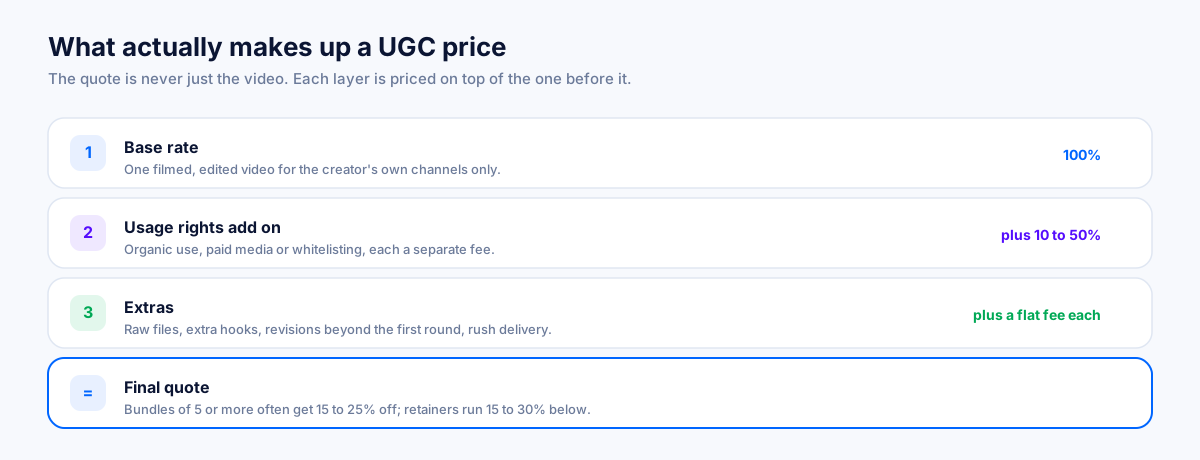
A quote is rarely one number. It is a base rate with layers added for rights and extras.
What do bundles and retainers cost compared to single videos?
Buying more than one video, or committing to a monthly arrangement, usually earns a discount against the one-off per-video price. Bundles of five or more videos commonly get 15 to 25% off the per-video rate, and ongoing retainers run 15 to 30% below the equivalent one-off price, since the creator trades flexibility for predictable income.
For a brand, this makes a monthly package the more efficient way to keep a content pipeline running, and for a creator it trades a bit of upside for steadier work. Wooly's Recurring Job format is built for exactly this: a brand sets up monthly content from the same creator, billed each month, with a minimum term the brand sets upfront, so both sides know what they are committing to before the first video ships.
BUDGET PLANNING
Price a collab before you post the brief
Wooly's collab templates fill in a suggested price range, usage rights and dates for each job type in one click.
Start free as a brandWhat is a realistic budget example for a small brand?
Say you sell a $40 serum and want five videos for paid ads from mid-tier creators quoting $300 each for organic use. Add paid media usage at 35% of base rate: $300 times 0.35 equals $105 per video, for a total of $405 per video, or $2,025 for five, before any bundle discount. Apply a 20% bundle discount and you land closer to $1,620 for five ad-ready videos. That is a number you can actually put in a spreadsheet, not a guess.
How much can a UGC creator realistically earn per month?
A creator doing four videos a month at a $300 average base rate, with occasional usage add-ons, is looking at roughly $1,200 to $1,800 a month part-time, before retainers or bundles change the math. Full-time creators juggling multiple brands and retainers push well past that, but it takes a working portfolio and consistent applying to get there, not a single viral post.
How should a brand decide what to pay for UGC?
Start from the usage you actually need, not the lowest number you can find online. A brand running five videos purely as organic social posts can budget toward the lower end of the ranges above. A brand planning to run the same five videos as paid ads for three months needs to add the paid media usage percentage to every quote, or the campaign budget will be wrong by the time invoices arrive. It helps to decide this before posting a brief, since changing the usage terms after a creator has already quoted is one of the more common sources of friction in this kind of work.
On Wooly, this gets handled in the brief itself: deliverables, usage rights and duration, exclusivity and the number of revisions are all set in writing before the collab goes live, so a creator is quoting against the real scope rather than guessing at it.
What is a fair way for a creator to compare two competing offers?
Normalize both offers to the same usage terms before comparing the dollar figure. A $400 offer with paid media usage for 90 days can be worth less per month of usage than a $250 offer for organic use only over the same period, once you divide by what you are actually granting. Write out the base rate, the usage type and the duration for each offer side by side, and the better deal usually becomes obvious within a minute.
Common questions
Why do UGC rate numbers vary so much between sources?
Different surveys sample different experience levels and scopes of work. Beginner-heavy samples report lower averages, while samples of working professionals report higher ones. Neither is wrong, they are measuring different populations.
Is $100 per video too low to accept?
Not for a true beginner building a first portfolio, as a short-term strategy. Once you have five or more completed jobs and a review, raise toward the $150 to $400 range reported for most brand spend.
Do raw files cost extra?
Often yes. Raw, unedited footage handed over for the brand's own editing is commonly priced as an add-on separate from the finished, edited deliverable, since it hands over more creative control.
What is the difference between usage rights and whitelisting?
Usage rights control where and how long a brand can repost your content. Whitelisting lets the brand run ads directly from your account using your handle, which is a separate agreement and usually priced and timed on its own.
Do rush jobs cost more?
Yes, a rush fee on top of the base rate is standard when a brand needs a fast turnaround, since it usually means the creator reshuffles other work to fit the deadline.
Should creators quote a flat rate or a range?
A rate card with a base rate and clearly listed add-ons works better than a single flat number, since it lets you quote accurately once a brand explains the usage they actually need.
ONE PLACE FOR UGC
Price, brief and pay for UGC without the spreadsheet
Set usage rights and price ranges in the brief, fund the collab, and release payment once the work is approved.
Compare plansWhichever side of the deal you are on, start from the creator side or the brand side of Wooly to see how rates, briefs and payments connect in one place.
Keep reading
- What is UGC, a complete guide to user-generated content for brands
- How to become a UGC creator with no followers
- What is a creator marketplace and how do the five collab types compare
- How much affiliate marketers typically earn, for comparison
Related reading
- How to Become a UGC Creator With No Followers (Step by Step) — A beginner's path into user generated content: no audience required, just a phone, a niche and three videos that prove you can deliver.
- What Is UGC? The Complete Guide to User Generated Content for Brands — User generated content now mostly means paid creator content made to look native. This guide covers what UGC is, where brands use it and what it costs to get started.
- Affiliate Marketing for Creators: A Complete Guide — How to turn an audience into recurring income without burning it: choosing offers by the maths rather than the rate, where links belong in each format, and the terms that decide whether you get paid.
More from the Wooly Network Blog