What Is a Creator Marketplace? How Brands and Creators Work Together in 2026
A creator marketplace is where brands and creators find each other and run the deal end to end. Here is how it actually works, and when it beats an agency or cold outreach.
By Nora Ellis, Affiliate Marketing & Creator Economy Writer · with Wooly Network, Editorial · 19 October 2026 · 7 min · Growth Marketing
A creator marketplace is an online platform where brands and content creators find each other, agree terms and run a paid collaboration in one place, instead of emailing, invoicing and tracking payment separately. Brands post briefs or search a directory of creators; creators apply or get invited; the platform usually handles the brief, the payment and often the usage rights. In 2026 the term covers everything from UGC marketplaces to affiliate platforms with a built in creator directory.
Five years ago "influencer platform" meant a database with filters and an email button. That was never the hard part. The hard part was always getting paid on time, agreeing what the brand could do with the content afterward, and not chasing someone for three weeks for a dropbox link. A proper creator marketplace fixes the parts around the content, not just the discovery.
What is a creator marketplace, exactly?
It is a two sided platform: brands on one side, creators on the other, and a set of tools in the middle that turn a conversation into a paid, documented collaboration. At minimum that means a brief format, a way to agree price and rights, and a payment flow. Better ones add discovery search, ready made brief templates, messaging, revision tracking and reporting.
Wooly Network, for instance, calls itself a creator marketplace for UGC, collabs and affiliate deals. Brands can start free on the Free plan for collabs, no card required, and pay for the work they commission with a fee added on top. Creators join free, forever. That free to join model is common across the category: the marketplace earns from the brand side of the deal, not by charging creators to be listed.
The five ways brands and creators work together
Most marketplaces support a handful of deal shapes. Wooly groups them into five, and the split is a useful mental model even if you use a different platform.
| Deal type | What it is | When it fits |
|---|---|---|
| One Time Job | A single video, post or demo, paid once the work is approved | A product launch, a one off ad creative need |
| Recurring Job | Monthly content from the same creator, billed each month, with a minimum term the brand sets | An ongoing content pipeline, a brand face |
| Bounty or Competition | Ranked prizes, or a set amount per approved entry | You want volume and variety fast |
| Paid Product Collab | The brand ships the product at its own cost and either pays a fee on top or offers the product as the only payment | Physical products, limited budget |
| Affiliate Campaign | Commission per tracked sale, lead or install, paid monthly | You want cost tied directly to results |
Notice that only one of the five is "pay per sale". A lot of people still use "affiliate" and "creator marketplace" as if they were the same thing, which is exactly the shift this site made: affiliate is one lane of five, not the whole road.
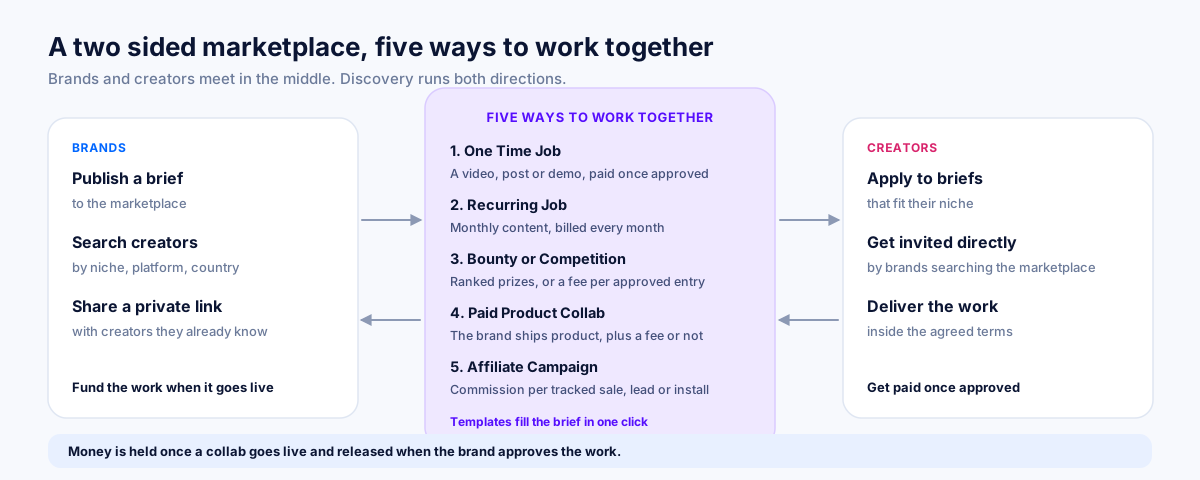
Discovery runs both directions: brands post or search, creators apply or get invited.
Creator marketplace vs agency vs database vs cold outreach
These four options solve the same problem at different prices and different levels of effort. None is wrong; they fit different stages.
| Option | Who does the work | Typical cost | Speed to first content |
|---|---|---|---|
| Creator marketplace | You brief, platform handles matching, payment and rights | Platform fee plus what you pay creators | Days |
| Agency | Agency sources, negotiates and manages creators for you | Monthly retainer plus creator fees, often the highest total cost | Weeks |
| Creator database | You get contact details, you do the outreach and admin | Subscription, no platform fee on deals | Weeks, depends on your time |
| Cold outreach | You find creators on social media yourself, manually | Free to search, slow, uneven response rate | Unpredictable |
How does a creator marketplace work day to day?
On the brand side, you usually start from a template (a TikTok UGC pack, an unboxing, a monthly retainer, a review bounty) that fills in a suggested brief, price range, usage rights and dates, and everything stays editable. You publish it or search creators directly by niche, platform, country and audience, and invite the ones you like, or share a private link with creators you already know.
On the creator side, you build a profile, browse briefs that match your niche and apply, or wait for an invite. Once a brand accepts, the brief is fixed: deliverables, usage rights, how long the post stays live, exclusivity and revisions are all written down before anyone films anything, which removes most of the "wait, that was included?" arguments later.
Payment is the part most people actually worry about. On Wooly, the brand funds the collab once it goes live, the money is held, and it is released to the creator once the brand approves the work. If a brand goes quiet on delivered work, it is approved automatically after a set period, so a creator is never left waiting forever for a reply. Payouts go to the creator's bank through Stripe. That one sentence, read carefully, answers most of the "will I actually get paid" nerves that keep good creators off a platform.
FOR BRANDS
Post your first brief in minutes
Start free, pick a template, and let creators apply while you keep every term editable.
See how it works for brandsHow do you pick the right creator marketplace?
Match the platform to the deal shape you actually need, not the one with the flashiest homepage. A few questions narrow it fast.
Does it support the deal type you need today?
If you mostly need one off UGC videos for ads, a pay per video platform is simplest. If you want an ongoing content pipeline, you need recurring billing, which far fewer platforms handle cleanly. If your goal is pay per sale, you need affiliate tracking, not a UGC tool wearing an affiliate badge.
Who holds the money, and when?
Ask exactly when a brand pays and when a creator gets paid. "Held until approved, released after" protects both sides. "Pay upfront, hope for the best" protects neither.
Can you find creators two ways?
A platform that only lets creators apply to open briefs misses the brands that already know who they want. One that only lets you search misses the discovery that open briefs create. The better marketplaces do both, plus private invite links for creators you already work with.
Our comparison of affiliate marketing and influencer marketing covers the two older models a creator marketplace often sits between, and affiliate marketing for creators and what is an affiliate network explain how that older model works if affiliate is the lane you are most interested in.
Is a creator marketplace worth it for a small brand?
Usually yes, more so than for an established enterprise brand with an agency already on retainer. A small brand has the most to gain from a tool that replaces hours of manual sourcing, invoicing and chasing with a templated flow, and the least to lose by starting on a free plan rather than signing an annual contract. The honest caveat: a marketplace still needs you to write a clear brief and respond to delivered work. It removes the admin, not the judgment calls.
One more practical point before you compare specific platforms: pricing structures vary a lot. Some charge brands a flat monthly fee regardless of volume, some take a fee on top of what creators are paid, and some combine both. None of that is a red flag by itself, but you should know which one you are looking at before you commit a budget to it. Compare plans and pricing for the platform you are considering before you post your first brief.
GET STARTED
One marketplace, five ways to work with creators
Post a job, run a bounty, ship a product collab or launch an affiliate campaign, all from one brief.
Start free as a brandCommon questions
Is a creator marketplace the same as an influencer platform?
They overlap heavily. "Influencer platform" historically meant a searchable database of accounts by follower count. A creator marketplace adds the transaction layer: briefs, pricing, usage rights and payment, often for creators with small or no followings who are hired for content rather than reach.
Do creators pay to join a creator marketplace?
On most modern marketplaces, no. Creators join free and the platform charges the brand side, either a subscription, a fee on top of what creators are paid, or both. Always check a specific platform's pricing page before assuming.
What is the difference between UGC and influencer marketing on these platforms?
UGC is paid for the content itself, usually without posting to the creator's own audience. Influencer marketing pays for the creator's audience and endorsement, posted on their channel. Many marketplaces, including Wooly, support both plus affiliate deals in one place.
How much does it cost to use a creator marketplace?
It varies widely: some charge brands a flat monthly fee, some take a percentage of creator payouts, some charge per listing. Wooly's Free plan for collabs adds a fee on top of each collab with no monthly cost, while paid plans lower that fee and affiliate campaigns run from the Growth plan.
Can a small brand use a creator marketplace without an agency?
Yes, that is the point of most of them. The brief templates and guided flows exist specifically so a single marketer can run a creator program without hiring an agency to manage it.
What happens if a creator does not deliver the work?
On a marketplace with payment protection, work that is never delivered can be refunded to the brand, and problems can be reported so the platform's team can step in, rather than the brand simply losing the money.
Keep reading
- Affiliate marketing vs influencer marketing
- Affiliate marketing for creators
- How affiliate commissions work
- What is an affiliate network
Related reading
- How to Find Affiliates for Your Business — Seven recruiting channels ranked by what they actually return, the outreach message that gets replies, and how to tell a partner who will publish from one who will not.
- How to Write an Affiliate Program Brief (With a Template You Can Copy) — The one page partners actually read before deciding whether to promote you, section by section, with a full worked example you can paste and edit in twenty minutes.
- How to Recruit Your First 10 Affiliates: A 30 Day Plan — A week by week sequence for going from an empty programme to ten active partners, with the outreach template, the list of people to contact first, and the response rates to expect.
More from the Wooly Network Blog