Paid Product Collabs: How to Send Products to Creators and Get Guaranteed Content
A paid product collab pairs the free product with a small fee so creators actually post. Here is how to run one, from shipping to approval.
By Nora Ellis, Affiliate Marketing & Creator Economy Writer · with Wooly Network, Advertiser Success · 29 October 2026 · 7 min · Creator Monetization
A paid product collab is when a brand ships a creator a free product and also pays a fee for a guaranteed piece of content, instead of hoping the free product alone earns a post. It fixes the biggest weakness of pure gifting: most gifted creators never post at all. For a product with real margin, a small fee on top of the product cost is usually the cheapest way to get content you can actually plan around.
Ask any ecommerce founder about gifting and you will hear the same story: a lot of free boxes shipped into the void. Some come back as beautiful content. Most come back as nothing, not even a thank you story. A fee changes that quickly, because the moment money is attached, a collab has a deadline and an obligation, not just good intentions.
What is the difference between seeding, gifting and a paid product collab?
Seeding and gifting mean the same thing: you send a product for free and hope for content, with no payment and usually no written agreement. A paid product collab is the hybrid: the brand still ships the product at its own cost, but it also pays a fixed fee, or sets the product itself as the only payment under a clear written brief with a deadline and deliverables. That written brief is what turns a hopeful gift into a real job.
Product seeding
Free product, no fee, usually no brief. Low cost per unit sent, very low and unpredictable return in content.
Paid product collab
Free product plus a fixed fee, with a brief spelling out what the creator delivers and by when. Higher cost per creator, much higher certainty you get something to use.
Why does gifting alone get such a low post rate?
Because there is nothing holding the creator to it. Skeepers reports gifted collaborations average a post rate of only 20% to 40%, and a Traackr survey of 305 marketers found that 65% still ship product to creators who never post at all. Creators get sent products constantly; without a deadline, a brief, or money on the table, your box sits in a pile with twenty others.
Under FTC rules, a free product is a material connection and must be disclosed whether or not the creator was paid, so gifting does not even avoid the compliance work. Our guide to FTC disclosure rules covers the basics that apply just as much to a box of free product as to a paid link.
How does a paid product plus fee collab work?
The brand ships the product at its own cost, including customs where it applies, and either pays a fixed fee per creator on top of the product, or offers the product itself as the only payment when the item's retail value is high enough to be the reward. Both versions need the same thing: a brief that states exactly what content is owed, the usage rights, the deadline and how many revisions are included.
On Wooly, this is the Paid Product Collab format, one of five ways brands and creators work together alongside One Time Jobs, Recurring Jobs, Bounties and Affiliate Campaigns. A ready-made collab wizard template fills the brief, price range, usage rights and dates in one click for a paid product collab, and everything stays editable from there, so you are not writing a brief from a blank page every time. Brands can start free on the Free plan, with Wooly's fee added to each collab; see pricing for how the fee changes on paid plans.
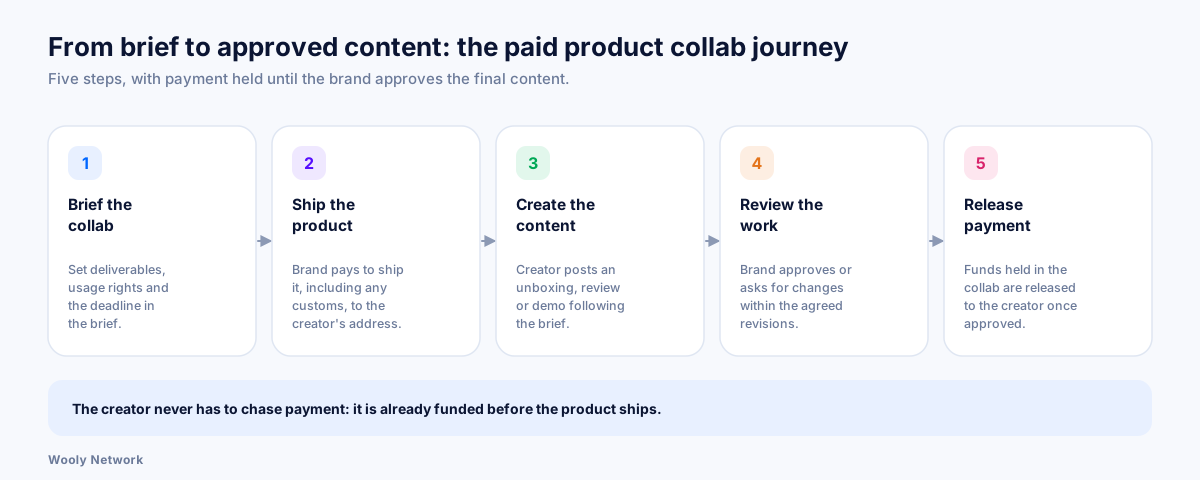
The fee only releases once the brand approves the delivered content.
TEMPLATES INCLUDED
Start a paid product collab in minutes
Pick a template, set your product and fee, and publish to the marketplace or invite creators directly.
Start free as a brandProduct only or product plus fee: which should you choose?
Use product only when the retail value is genuinely attractive to the creators you want, usually $60 and up, and your niche has enough creators who collect products as part of their content anyway (beauty, home, pets). Use product plus fee for anything cheaper, anything where you need a specific deliverable (a demo, a 30-day results video, a certain number of hooks), or when you are working with creators who already charge for UGC and treat free product as a nice extra, not a wage.
| Approach | What the creator gets | Typical post rate | Best for |
|---|---|---|---|
| Gifting, no brief | Free product only | 20% to 40% | Brand awareness at near-zero planned cost, when any content is a bonus |
| Product only, with a brief | Free product, deliverable agreed | Much higher than gifting, close to guaranteed | High value or aspirational products, niches that already collect gifted items |
| Product plus fixed fee | Free product plus a payment, deliverable agreed | Guaranteed once accepted | Lower cost products, specific deliverables, professional creators |
How do you plan shipping and timelines for a product collab?
Ship before you need the content, not after. Build in time for customs if you are shipping across a border; a package stuck at customs for a week will blow a content calendar faster than any creator delay. A realistic plan: confirm the creator and address on day one, ship within two business days, build in five to ten days for delivery depending on destination, then give the creator five to seven days after the product arrives to film and submit. That is roughly two to three weeks from confirmation to a first draft, so plan your launch date backward from that.
What goes wrong most often
Wrong address, no tracking number shared with the creator, and a brief that forgets to say what happens if the package is lost or damaged. Fix all three before you ship a single unit: confirm the address in writing, send tracking the moment it exists, and state in the brief that a lost package gets reshipped once before the deadline moves.
Step by step: running a paid product collab
- Write the brief. Deliverable, usage rights, deadline, revisions, and whether it is product only or product plus fee.
- Find the creators. Publish to a marketplace and let creators apply, or search by niche, platform, country and audience and invite them directly, or send a private link to creators you already know.
- Confirm and fund. Lock the fee (if any) so the creator knows the collab is real, not a maybe.
- Ship. Pay for shipping yourself, including customs, and share tracking right away.
- Review on delivery. Approve the content, or request the agreed number of revisions.
- Release payment. The fee pays out once you approve the work, so creators are not left chasing an invoice.
This is where payment protection genuinely matters for both sides: the brand funds the collab when it goes live, the money is held, and it releases to the creator once the work is approved. If a brand goes quiet on delivered work, it is approved automatically after a set period, so a creator who did the job is never left waiting forever. Creator payouts run through Stripe.
ONE PLACE FOR COLLABS
Run your next product collab on Wooly
Start free, publish a brief or invite creators directly, and only pay out once the work is approved.
Start free as a brandCommon questions
What is product seeding?
Product seeding is sending a product to a creator for free with no payment, usually with no written agreement about what they deliver in return. It can build goodwill, but Skeepers reports only 20% to 40% of gifted creators post, so it is not a reliable way to plan a content calendar.
How much should I pay on top of the product for a paid product collab?
It depends on the format and the creator's experience, but it is common to treat the fee like any other UGC rate, often lower than a cash-only job since the product itself has value. State the fee range in the brief so creators can decide if it is worth their time before they apply.
Do I have to pay for shipping and customs?
Yes. In a paid product collab, the brand covers the cost of shipping the product, including customs where it applies, as part of making the collab worthwhile for the creator. Factor that cost into your budget alongside the fee.
What if the creator never posts after I send the product?
This is exactly what a brief and a held payment solve. If a creator accepts a paid product collab brief and does not deliver, the collab was never released to them, since payment only moves on approved work. For pure gifting, you have little recourse, which is the point of using a brief in the first place.
Is a paid product collab the same as influencer gifting?
No. Influencer gifting is free product with no obligation. A paid product collab adds a written brief, a deadline and usually a fee, which is what turns a hopeful gift into a guaranteed deliverable.
Can I use the content from a paid product collab in ads?
Only if the usage rights in your brief say so. The default without paid usage rights is organic use on the creator's own channels; running the content as a paid ad or whitelisting it needs its own separate usage rights agreement.
Keep reading
- What is a creator marketplace
- What is UGC
- How much do UGC creators charge
- UGC usage rights explained
- How to write a UGC brief creators love
- Affiliate marketing for creators
Related reading
- UGC Usage Rights Explained: Organic, Paid Ads, Whitelisting and How Long to License — UGC usage rights decide where a brand can post a video and for how long. Here is the ladder from organic use to full whitelisting, in plain English.
- UGC Rate Card: How to Price Videos, Bundles and Usage Rights (Template) — A copyable UGC rate card template with a base rate formula, usage rights add ons, bundle discounts and a script for handling lowball offers.
- How Much Do UGC Creators Charge? 2026 Rates by Platform, Niche and Experience — A clear, numbers first look at UGC rates in 2026, where sources disagree, what pushes a price up, and worked budgets for brands and creators.
More from the Wooly Network Blog