UGC Usage Rights Explained: Organic, Paid Ads, Whitelisting and How Long to License
UGC usage rights decide where a brand can post a video and for how long. Here is the ladder from organic use to full whitelisting, in plain English.
By Nora Ellis, Affiliate Marketing & Creator Economy Writer · with Wooly Network, Editorial · 26 October 2026 · 9 min · Creator Monetization
UGC usage rights are the permission a brand buys to use a creator's video beyond the creator's own feed, and they come in three main tiers: organic use on the brand's own channels, paid media usage in ads, and whitelisting, which runs ads through the creator's own account. Each tier costs more than the last and should always have a stated duration. Get this wrong and either the brand is running an ad it never actually licensed, or the creator is giving away months of ad usage for the price of one post.
Here is the thing nobody explains clearly enough: a video and the right to use that video are two separate products. The filming fee buys the footage. Usage rights buy where it can travel after that. Mixing the two up is the single most common billing dispute we hear about from both sides, so let's sort out the ladder properly. One quick note before we go further: this article explains common industry terms and practice, not legal advice, and you should have a lawyer review your own contracts.
What are UGC usage rights?
UGC usage rights are the specific permissions a brand negotiates to use a creator's content outside the platform where the creator originally posted it. A creator who shoots a video owns the copyright the moment they press record, in most jurisdictions, even if the brand paid for the shoot. The payment buys a license: a defined, time-boxed permission to use that footage in certain places. Without a written license, a brand that reposts a creator's video to its own Instagram grid, let alone runs it as a paid ad, is on shaky ground.
The license needs four things spelled out, every time: which channels (the creator's own, the brand's own, paid ads, or whitelisted through the creator's handle), how long, whether it is exclusive to one brand or not, and what happens if the brand wants to extend it later. Skip any one of those four and you will be emailing back and forth about it eventually, usually right when a campaign is performing well and someone wants to scale the budget.
How does the UGC usage rights ladder work?
Each rung buys a wider right to use the same footage, and each rung costs more than the one below it. Based on common add-on pricing reported by platforms like Sideshift, here is how the three main tiers usually break down.
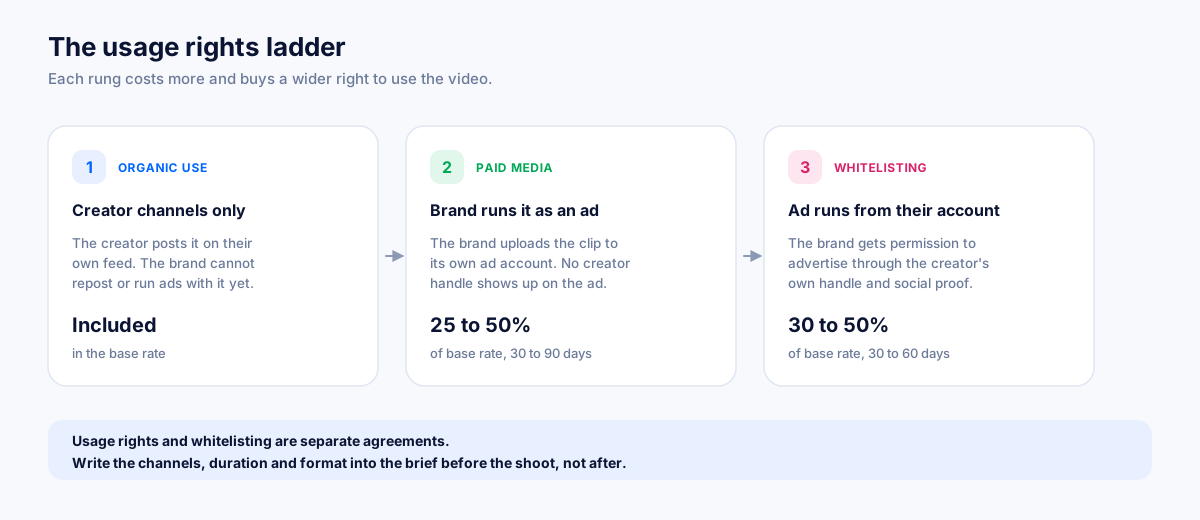
Each step up the ladder adds a wider right to use the footage, for a set extra cost and a set window.
Organic use: included in the base rate
This is the baseline every UGC fee already covers: the creator posts the video to their own channel, and often the brand can repost it organically to its own feed too (confirm that specifically, it is not automatic everywhere). No paid spend is attached. This is where most first collabs start and stop, and for a brand testing a new creator relationship, that is usually the right call.
Paid media usage: 25 to 50% of the base rate
This tier lets the brand run the footage as a paid ad from its own ad account, with no creator handle attached, usually for 30 to 90 days. Reported add-on pricing from Sideshift puts this at roughly 25 to 50% of the base filming rate, scaling with duration and how many channels it covers (just Meta, or Meta plus TikTok plus YouTube).
Whitelisting: 30 to 50% of the base rate
Whitelisting gives the brand permission to run the paid ad through the creator's own account, so the ad carries their handle and social proof. This is the most expensive tier, reported at roughly 30 to 50% of base for 30 to 60 days, and it is a separate agreement from paid media usage, not an upgrade bundled into it. Whitelisting means the ad runs from the creator's own account, through a code or a permission grant, not through the brand's own ad account.
CREATOR SUCCESS
Keep control of your own rates
Join Wooly free and set your own usage rights and prices on every collab you apply to.
Join free as a creatorHow much do usage rights add to UGC pricing?
Usage rights typically add anywhere from a quarter to double the base video fee, depending on which tiers you stack and for how long. Say a creator's base rate for a single video is $300. Add paid media usage at 35% ($105) and you are at $405 for three months of ad use. Add whitelisting instead of, or on top of, paid media at 40% ($120), and a full stack with both runs the fee past $500 for a video that started at $300. None of this is arbitrary once you see it as a ladder; it is the same logic as licensing a photo for a billboard versus a blog post. For a full breakdown of how base rates themselves are set, see our guide to UGC rates by platform, niche and experience, and for a ready-made pricing sheet, our UGC rate card template builds usage rights percentages right into the formula.
| Usage tier | What it allows | Typical add-on | Typical duration |
|---|---|---|---|
| Organic use | Creator's own channel, often brand repost too | Included in base rate | No expiry stated, confirm in writing |
| Paid media usage | Brand runs it as a paid ad from its own account | 25 to 50% of base rate | 30 to 90 days |
| Whitelisting | Ad runs from the creator's own account and handle | 30 to 50% of base rate | 30 to 60 days |
| Extension | Renewing any tier past its first window | Not listed, negotiate per renewal | Set a new end date each time |
What should a UGC usage rights clause say?
A usage rights clause should name the exact channels, the exact start and end date, and whether the license is exclusive. Vague language like "social media use" or "marketing purposes" is the number one source of disputes, because it can mean anything from one Instagram story to a national TV buy. Here is what a clean clause includes:
- Channels: name them (Instagram feed, TikTok ads, Meta ads, YouTube pre-roll), not a category
- Start and end date: a calendar date, not "a few months"
- Paid or organic: state both separately, they are not the same right
- Whitelisting: yes or no, and which platform's whitelisting tool
- Exclusivity: can the creator do similar content for a competitor during this window
- Renewal: is it automatic, or does the brand ask again at the end date
On Wooly, these terms live directly in the collab brief: deliverables, usage rights from creator channels only up to full commercial use, how long the content stays licensed, exclusivity and revisions are all set before work starts, so neither side is guessing later. Ready-made collab templates fill most of this in automatically, and everything stays editable before you send the brief.
What happens when usage rights run out?
When the license expires, the brand has to stop running the content in the channels covered, or go back and renew. This is the part everyone forgets until a performance team asks "can we just keep this ad live? It's still converting." Technically, no, not without a new agreement. In practice, plenty of brands quietly keep ads running past the end date and hope nobody notices. We would not recommend it: creators do check, platforms like TikTok and Meta can show a creator which ads used their content, and a rights dispute after the fact costs far more than a renewal would have.
Build the renewal conversation into your calendar the day you sign the first license, not the week it expires. A creator who gets a friendly "this is working, can we extend 60 more days at the same rate" message two weeks early will usually say yes. A creator who finds out their face has been running in ads for a month past the agreed date will usually say no, loudly, and tell other creators about it.
Common mistakes with UGC usage rights
The biggest one is treating a filming fee as if it automatically includes ad usage. It does not, anywhere, by default. The second is agreeing to "unlimited usage" without a date, which some creators accept early in their career because it sounds simple, and then regret the moment one video starts running everywhere forever for a one-time fee. The third is forgetting that whitelisting is a separate login grant on top of a license, not a replacement for one: a brand can have paid media rights to a video and still not have permission to run it through the creator's TikTok account.
If a contract does not name a channel and a date, assume it covers neither.
Common questions
Do UGC usage rights expire automatically?
Yes, if a date is written into the agreement, the right to use the content in that channel ends on that date. If no date is written, the term is ambiguous and should be clarified before any paid use, since ambiguous terms are what cause most usage disputes.
Is whitelisting the same as usage rights?
No. Usage rights let a brand use the footage somewhere. Whitelisting is separate account access that lets the brand run an ad that appears to come from the creator's own handle. A brand can have one without the other, and most whitelisting deals require a paid media usage right as well.
Do I need a lawyer for a UGC usage rights contract?
For a single low-budget video, most brands and creators use a clear written agreement without a lawyer. For whitelisting, exclusivity clauses or larger ad spend, a short review by a lawyer familiar with media licensing is worth the cost. This is general information, not legal advice for your specific deal.
Can a brand use UGC forever for one flat fee?
Only if the contract explicitly says so with no end date, which is rare and usually priced much higher than a time-limited license. Most UGC agreements, including Wooly collab briefs, set a duration for every usage tier so both sides know exactly when it ends or needs renewing.
What happens if a brand uses a video without paying for usage rights?
That is a breach of the license the creator actually granted, typically organic use only. Creators can ask the platform to take the ad down, request payment for the usage that happened, or pursue the matter further depending on the agreement's terms. Clear written terms upfront prevent almost all of these situations.
Do usage rights cost more for exclusive content?
Yes, typically. Exclusivity, where the creator agrees not to make similar content for a competing brand during the license window, is usually priced as a separate line item on top of the usage tier, since it restricts the creator's other income during that time.
One more practical point before we close: whichever tier you license, name it clearly in your brief and link it to your plans and pricing, since add-on fees should be budgeted the same way a filming fee is. See our pricing page for how collab fees work on Wooly, and our page for creators for how to set your own usage terms.
Keep reading
- What is a creator marketplace
- What is UGC: the complete guide
- How much do UGC creators charge
- UGC rate card template
Related reading
- UGC Rate Card: How to Price Videos, Bundles and Usage Rights (Template) — A copyable UGC rate card template with a base rate formula, usage rights add ons, bundle discounts and a script for handling lowball offers.
- How Much Do UGC Creators Charge? 2026 Rates by Platform, Niche and Experience — A clear, numbers first look at UGC rates in 2026, where sources disagree, what pushes a price up, and worked budgets for brands and creators.
- How to Become a UGC Creator With No Followers (Step by Step) — A beginner's path into user generated content: no audience required, just a phone, a niche and three videos that prove you can deliver.
More from the Wooly Network Blog