15 UGC Ad Examples and Formats That Convert on TikTok and Meta
These 15 UGC ad examples are mini scripts you can brief today, covering structure, length and best use, without claiming results from any real brand.
By Nora Ellis, Affiliate Marketing & Creator Economy Writer · with Wooly Network, Advertiser Success · 16 November 2026 · 7 min · Playbooks
UGC ad examples are repeatable video structures, like a problem solution script or a testimonial format, that creators can fill with your product instead of starting from a blank page. Below are 15 formats described as mini scripts, with structure, length and who each one suits best. None of these describe real brand campaigns or results; they are hypothetical structures for you to brief and test yourself.
After running creative tests across more products than I can count, the pattern is always the same: a handful of structures do most of the heavy lifting, and the rest is really just swapping the product in and out. Learn these fifteen and you can brief a new creator in minutes instead of writing a script from scratch every time.
What makes a UGC ad format actually convert
A converting UGC ad format gives the viewer a clear problem, a believable solution and one obvious next step, usually inside 30 seconds. Formats fail when they try to do too much, cramming three messages into one clip.
Say you sell a $40 serum. A format built around "the problem I didn't know I had" will likely outperform a straight product tour, because it gives the viewer a reason to care before it gives them a reason to buy.
Five problem solution formats
| Format | Structure | Length | Best for |
|---|---|---|---|
| 1. Problem reveal | Name a hidden problem, show the product fixing it | 15 to 20s | Skincare, home, pet products |
| 2. Before and after | Show the before state, cut to after, no narration needed | 10 to 15s | Visual transformations |
| 3. Myth busting | State a common belief, then correct it with the product | 20 to 30s | Health, supplements, finance apps |
| 4. Mistake confession | "I was doing this wrong for years" then the fix | 20 to 25s | Tools, appliances, software |
| 5. Side by side comparison | Old method next to new product, same task | 15 to 25s | Productivity and convenience products |
Five social proof formats
| Format | Structure | Length | Best for |
|---|---|---|---|
| 6. Honest review | Pros, cons, final verdict, feels unscripted | 30 to 45s | Any considered purchase |
| 7. Unboxing reaction | Opening the package, first impressions, first use | 20 to 30s | Physical products with nice packaging |
| 8. Friend recommendation | Talking to camera like telling a friend about a find | 15 to 20s | Lower consideration, impulse buys |
| 9. Thirty day result | Daily or weekly check in format compressed into one clip | 30 to 40s | Supplements, fitness, skincare |
| 10. Group reaction | Multiple people trying the product for the first time | 20 to 30s | Food, novelty, gifting products |
Five demo and proof formats
| Format | Structure | Length | Best for |
|---|---|---|---|
| 11. Stress test | Push the product to an extreme to prove durability | 15 to 20s | Bags, cases, outdoor gear |
| 12. Screen recording walkthrough | Talking head plus screen capture of software in use | 30 to 60s | Apps and SaaS |
| 13. Ingredient or spec breakdown | Camera close on label or parts while explaining why they matter | 20 to 30s | Beauty, food, technical products |
| 14. Day in the life integration | Product shown naturally inside a routine, not the focus | 30 to 45s | Brand awareness, lifestyle fit |
| 15. Objection buster | States the common hesitation, answers it directly with proof | 20 to 30s | Higher priced or new category products |
Format by funnel stage
Top of funnel formats should hook attention and build curiosity, bottom of funnel formats should remove the last objection standing between a viewer and a purchase. Mixing stages inside one clip usually weakens both jobs.
| Funnel stage | Formats that fit |
|---|---|
| Cold, top of funnel | Problem reveal, myth busting, group reaction, unboxing |
| Warm, middle of funnel | Honest review, side by side comparison, screen walkthrough |
| Hot, bottom of funnel | Objection buster, thirty day result, stress test |
TURN A FORMAT INTO A BRIEF
Pick a format, fill in the template, post it
Wooly's collab templates cover formats like honest review and unboxing, with price range and usage rights filled in and ready to edit.
See the use caseThe structure behind almost every converting UGC ad
Nearly all 15 formats above follow the same four beat shape underneath: a hook, a body, a proof point and a call to action. Once you see the shape, mixing and matching formats gets much easier.
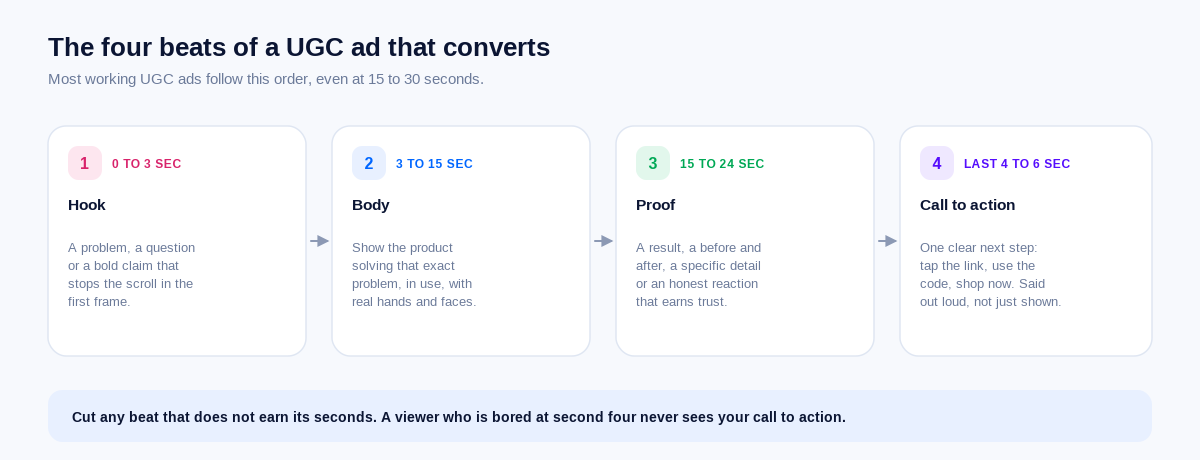
The four beats behind most working UGC ad formats.
The hook earns the first three seconds, the body shows the product doing the job, the proof gives a reason to believe it, and the call to action tells the viewer exactly what to do next, spoken out loud rather than just shown on screen. Our guide on UGC hooks has fifty hook examples if you need the opening line for any of these formats.
How to brief these formats without writing a full script
Give the creator the format name, the structure, and the product, then let them write the actual lines in their own voice. A rigid word for word script usually reads stiff on camera, even from an experienced creator.
- Name the format ("we want an objection buster style video").
- State the specific objection or problem to address.
- Give the length and platform.
- Ask for two takes of the hook line specifically.
Our full UGC brief template has a filled in example brief you can adapt for any of these fifteen formats.
Budgeting for a batch of UGC ad examples
Testing several formats properly means budgeting for a small batch of videos, not one hero asset, since you are comparing formats against each other rather than judging one in isolation. A realistic starting batch is four to six short videos covering two or three of the formats above.
Say you want to test problem reveal, honest review and an objection buster for a $50 product. At typical rates of $150 to $500 per video for early stage creators, a six video batch (two of each format) lands somewhere between $900 and $3,000 before any usage rights or ad spend. That is a wide range on purpose, since experience level and whether you need raw files or multiple hooks per video both move the number. Our UGC rates guide breaks this down further, and you can compare Wooly plans to see what a batch like this costs on each tier before you commit a budget.
Keep one format constant across the batch (same product, same length) so the format itself is the variable you are testing, not the creator or the product angle. Once you find a format that wins, that is the one worth scaling into a proper retainer or bundle rather than spreading budget thin across all fifteen at once.
BRIEF YOUR NEXT UGC AD
Post a format specific brief in minutes
Search creators by niche and platform, or publish a brief and review who applies. Funds stay held until you approve the work.
Post a brief on WoolyCommon questions
Which UGC ad format should I test first
Start with an honest review or a problem reveal, since both are versatile across most product categories and give you a baseline to compare future formats against.
How long should a UGC ad be
Most of the formats above run 15 to 30 seconds for top of funnel use, with demo heavy formats like screen walkthroughs running up to 60 seconds when the product genuinely needs that time to explain.
Can one creator deliver multiple formats in one session
Often yes. Many creators can shoot a problem reveal and an honest review of the same product in one booking, since the setup and product are already in place, though more complex formats like group reactions need separate planning.
Do these formats work for both TikTok and Meta
Yes, the structures translate across platforms, though TikTok generally favors faster, rawer pacing while Meta audiences tolerate a slightly longer and more composed build before the payoff.
What is the biggest mistake brands make picking a format
Choosing a format based on what looks impressive rather than what fits the funnel stage. A polished day in the life clip wastes its potential on a cold audience that needs a sharper hook first.
Should I claim specific results in a UGC ad
Only if they are true, documented and allowed under advertising rules in your market. Hypothetical or dramatized results should always be presented as such, never implied to be guaranteed outcomes.
Can a format get stale if I run it too long
Yes. Even a strong performing format wears out as an audience sees it repeatedly, usually showing up as a slow decline in hook rate over a few weeks rather than a sudden drop. Rotate in a fresh format from the list above before that decline shows up in your cost per result.
Do I need a different creator for every format
No. A capable creator can usually shoot several formats with the same product in one booking, since most of the setup time is shared. Ask upfront how many distinct formats they are comfortable delivering in a single session before you book separate creators for each one.
Keep reading
- 50 UGC hooks that stop the scroll
- TikTok UGC for brands
- Instagram UGC and Reels collabs
- Collabstr alternatives compared
- How to write a UGC brief
Related reading
- #ad, #gifted, Paid Partnership: Disclosure Rules for UGC and Gifted Products — A plain English look at disclosure rules for gifted products and paid UGC, including what counts as a material connection and how to label a post correctly.
- UGC Contract Checklist: 12 Clauses Every Brand and Creator Should Agree On — A UGC contract checklist covering deliverables, usage rights, payment and revisions, with what good looks like and red flags for both sides of the table.
- UGC vs Influencer Marketing vs Affiliate: Which One Does Your Brand Need? — UGC, influencer marketing and affiliate solve different problems at different costs. This guide compares all three on cost, control, reach and risk, with a decision flow for your budget.
More from the Wooly Network Blog