UGC vs Influencer Marketing vs Affiliate: Which One Does Your Brand Need?
UGC, influencer marketing and affiliate solve different problems at different costs. This guide compares all three on cost, control, reach and risk, with a decision flow for your budget.
By Nora Ellis, Affiliate Marketing & Creator Economy Writer · with Wooly Network, Editorial · 20 November 2026 · 7 min · Playbooks
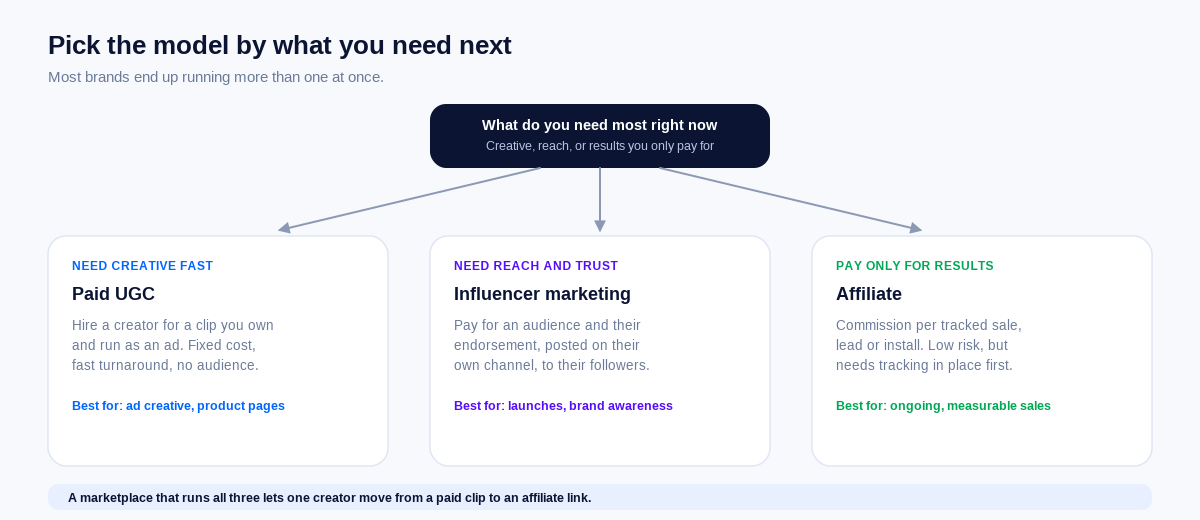
UGC, influencer marketing and affiliate marketing are three different ways to pay creators, and the right one depends on what you are solving for. UGC buys a piece of content you own and control, for a fixed fee. Influencer marketing buys a creator's audience and endorsement, posted on their own channel. Affiliate pays commission only when a tracked sale, lead or install actually happens. Most established brands end up running more than one at the same time.
The question we hear most from brands new to creator marketing is not "which is best" but "which one do I even need right now". The honest answer depends entirely on what is actually holding your growth back this quarter: a lack of creative, a lack of reach, or a lack of return you can prove.
UGC vs influencer marketing: what is the core difference?
UGC pays for content as a product. The creator makes a video or photo to your brief, you own it under agreed usage rights, and it typically never touches the creator's own audience at all. Influencer marketing pays for distribution: the content is posted on the creator's own account, to their existing followers, and the value is partly the content and partly who sees it.
This is why a creator with almost no followers can still do excellent UGC work, and why a creator with a huge following can produce a UGC style video for you with zero reach attached, if that is what you book.
UGC vs affiliate: who takes the risk?
UGC risk sits with the brand. You pay a fixed fee whether the resulting ad performs brilliantly or falls flat. Affiliate risk sits mostly with the brand too, but in the opposite direction: you pay nothing until a sale, lead or install is tracked, so a campaign that never converts costs you close to nothing, aside from the creator's own unpaid time.
That is also affiliate's limitation. A brand new product with no proven offer is a hard sell to affiliates, because they are being asked to do the work on spec. Affiliate tends to work best once a product already converts reasonably well through some other channel.
Influencer marketing vs affiliate: endorsement or measurement?
Influencer marketing is bought mostly for trust transfer: the audience trusts the creator, some of that trust transfers to the product. It is genuinely hard to measure cleanly, especially for brand awareness goals. Affiliate is the opposite: everything is tracked by design, down to the individual click and sale, which makes it easy to measure but harder to use for pure awareness, since affiliates are generally optimizing for the thing they get paid on.
Compare all three side by side
| Factor | UGC | Influencer marketing | Affiliate |
|---|---|---|---|
| You pay for | The content itself | Audience and endorsement | A tracked result |
| Typical cost | $50 to $1,200 plus per video | Varies widely by audience size | Commission per sale, lead or install |
| Who controls the content | The brand, per usage rights agreed | Mostly the creator, on their channel | Mostly the creator, on their channel |
| Reach included | None by default | Yes, the creator's audience | Yes, the creator's audience or links |
| Upfront financial risk | Full fee, performance unknown | Full fee or product, performance unknown | Minimal, paid on results |
| Best measured for | Ad and page level testing | Awareness and trust, harder to measure | Direct sales, leads or installs |
Most brands eventually run all three with the same pool of creators.
A decision flow by goal and budget
If what is missing is creative, your ads look stale, your product page has no proof, start with UGC. It is the fastest and cheapest way to get new testable assets. If what is missing is reach and trust around a launch or a new audience, influencer marketing is the better tool, even though it is harder to measure precisely. If what you actually need is more sales with controlled cost, and you already have a product that converts, affiliate is the model built for that, with commission paid only once a result happens; see how affiliate commissions work for the mechanics.
Budget matters too. A brand with almost nothing to spend upfront leans affiliate, because cost only appears after a sale. A brand with a fixed monthly content budget and no proven offer yet leans UGC, because at least the spend buys a tangible asset either way. A brand with budget and a launch moment leans influencer, accepting the measurement is fuzzier in exchange for reach.
FOR BRANDS
Run all three from one place
Post a one time UGC job, invite creators for a sponsored post, and launch an affiliate campaign, all with the same creator pool.
See affiliate campaignsWhat does each model actually cost in practice?
Say you sell a $60 skincare device and have $2,000 to spend this month testing creator marketing. A UGC run might buy 8 to 10 videos at $150 to $250 each, giving you a real pool of ad variations to test against your current creative. An influencer run with the same budget might book two or three small creators with modest, engaged audiences, which produces far less testable ad creative but puts the product in front of real followers who trust that specific person. An affiliate run with the same starting budget spends nothing upfront; instead you set a commission, recruit partners, and the $2,000 only leaves your account once sales actually happen, meaning a slow month costs you little beyond the platform fee.
None of these numbers are guarantees, they are a rough way to compare what the same budget buys under each model. The real answer always depends on your margin, your current conversion rate and how proven your offer already is.
Can you combine all three in one marketplace?
Yes, and increasingly this is the normal setup rather than the exception. A single creator can make a one time UGC video for your ads, later take a one time sponsored post on their own channel for a launch, and run an ongoing affiliate link for your product afterward, all tracked and paid through the same marketplace relationship. That progression is also a natural trust ladder: a creator who does good paid UGC work is a safer bet for an influencer post, and one whose post actually drove sales is a safer bet to hand an affiliate link to. It also bridges neatly into the older affiliate world; our piece on affiliate marketing vs influencer marketing covers that comparison in more depth if affiliate is the direction you are leaning. Whichever mix you land on, check plans and pricing first so you know what each model costs on top of what you pay creators.
Common questions
Is UGC cheaper than influencer marketing?
Usually, per piece of content. UGC prices mainly reflect the creator's time and skill, while influencer marketing pricing also reflects audience size and reach, which tends to push the total cost higher for comparable production quality.
Is affiliate marketing risk free for brands?
Not entirely, but it is the lowest financial risk of the three since you only pay after a tracked sale, lead or install. The remaining risk is mostly time: recruiting and activating enough affiliates to generate meaningful volume takes real effort.
Can one creator do UGC, influencer posts and affiliate for the same brand?
Yes, this is increasingly common and often efficient, since the creator already understands the product and the brand already trusts their work from an earlier, smaller collaboration.
Which model is best for a brand new product with no sales yet?
UGC usually makes the most sense first, since it produces testable ad creative regardless of whether a sales history exists yet. Affiliate tends to work better once a product has a proven conversion rate to offer partners.
Does influencer marketing work for small brands with small budgets?
Yes, by working with smaller creators rather than large ones. Smaller audiences cost less and often convert better relative to spend, even though total reach is lower per post.
How do I measure return on each of these three models?
UGC is measured like any ad creative: hook rate, click through, conversion. Influencer marketing is harder to attribute directly and often uses unique codes or links as a proxy. Affiliate is the most directly measurable since every sale, lead or install is tracked to a specific partner by design.
Which model should a brand start with on a tight budget?
Affiliate carries the least upfront financial risk since you pay only after a result, but it needs an already converting offer to attract partners. If your offer is unproven, a small UGC budget to generate real ad creative is usually the better first step, even on a tight budget.
GET STARTED
Not sure which model fits yet
Start free, try a one time UGC job first, and add affiliate or sponsored posts once you know what works.
Start free as a brandKeep reading
- What is a creator marketplace
- What is UGC
- How much do UGC creators charge
- Affiliate marketing vs influencer marketing
- How affiliate commissions work
Related reading
- #ad, #gifted, Paid Partnership: Disclosure Rules for UGC and Gifted Products — A plain English look at disclosure rules for gifted products and paid UGC, including what counts as a material connection and how to label a post correctly.
- UGC Contract Checklist: 12 Clauses Every Brand and Creator Should Agree On — A UGC contract checklist covering deliverables, usage rights, payment and revisions, with what good looks like and red flags for both sides of the table.
- 15 UGC Ad Examples and Formats That Convert on TikTok and Meta — These 15 UGC ad examples are mini scripts you can brief today, covering structure, length and best use, without claiming results from any real brand.
More from the Wooly Network Blog