How Affiliate Commissions Work
From the click that freezes the terms to the payment that lands: every state a commission passes through, who decides it, and the two places money quietly disappears.
By Nora Ellis, Affiliate Marketing & Creator Economy Writer · with Wooly Network, Editorial · 14 September 2026 · 6 min · Affiliate Marketing
An affiliate commission is calculated at the moment of conversion using the terms frozen onto the original click, then held pending while the advertiser checks it against published validation rules, then grouped into a payment period and released on the stated terms. Earning a commission and being paid one are separated by two decisions and several weeks, and almost every dispute lives in that gap.
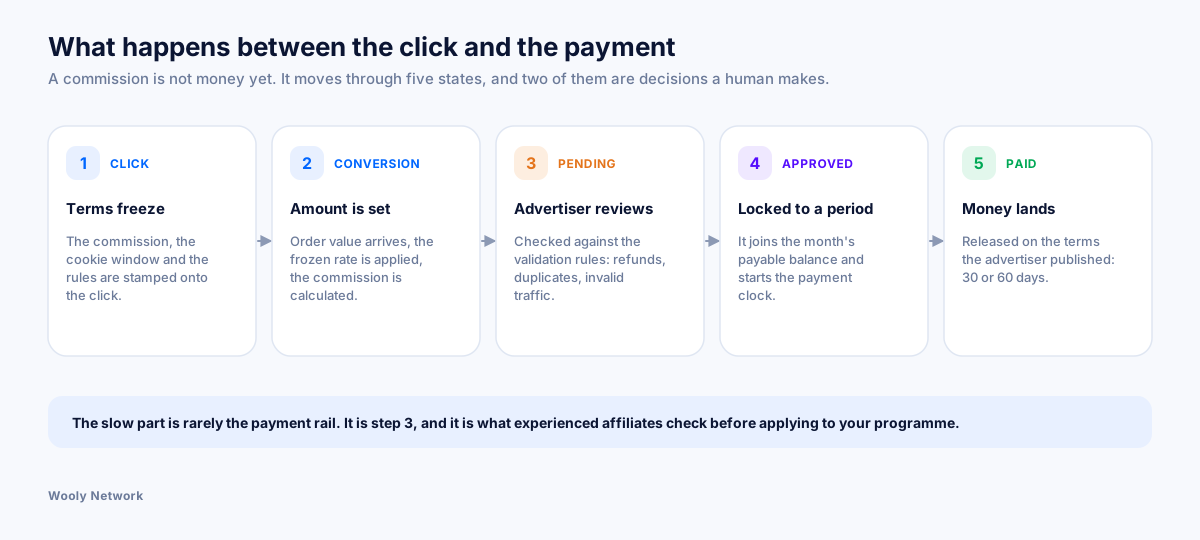
The slow part is rarely the payment rail. It is stage three.
Stage 1: the click freezes the terms
When someone follows a tracked link, the network records more than a visit. It stamps the campaign's current terms onto that click: the commission rate, the payout model, the attribution window and the validation rules as they exist at that second.
This is not a technicality. It is the rule that makes the channel trustworthy in both directions:
- A brand that cuts its rate on Tuesday still owes the old rate on Monday's clicks.
- A partner who publishes today cannot be re-priced retroactively by an edit next month.
- A brand that raises its rate is not accidentally uprating work that was already done under the old one.
The practical consequence for creators: the terms you agreed to are the terms attached to your clicks, not the terms showing on the offer page today. The practical consequence for brands: changing a rate affects future clicks only, so plan the change around your partners' publishing schedule.
Stage 2: the conversion sets the amount
The advertiser's site or server reports that something happened, with a value. The network applies the frozen rate and works out the commission. Note the division of labour: the advertiser's system reports what happened; it never gets to declare what it is worth. That is what stops a shop's own code from being able to change a payout.
How the amount is calculated depends on the model:
| Model | Calculation | Paid | Watch out for |
|---|---|---|---|
| Percentage of sale | Rate x order value | Once | Whether tax, shipping and discounts are in the base |
| Revenue share | Rate x each billing cycle | Every cycle, for a set period | The period, and whether upgrades count |
| CPA | Fixed amount per new customer | Once | The definition of "new" |
| CPL | Fixed amount per qualified lead | On the lead event | The definition of "qualified" |
The base is where the surprises live. A 20% commission on a $100 order is $20 if the base is the order value, $16.40 if tax is excluded and the order was $82 plus tax, and $16 if a 20% discount code was applied first. None of these are dishonest. All of them should be written down, and the payout model comparison goes through the trade-offs of each.
Stage 3: pending, where the real decisions happen
A calculated commission is not payable yet. It sits pending while the advertiser checks it against validation rules. Legitimate reasons to decline or hold:
- The order was refunded, cancelled or charged back
- It duplicates an order already credited
- The customer was not new, on a campaign that pays for new customers
- The traffic broke the campaign terms: prohibited placement, brand bidding where it is banned, incentivised clicks
- The lead was plainly not qualified under the published definition
- The click pattern was not human: conversions faster than a checkout can be read, repeated clicks from one address seconds apart, sessions with no interaction
And the reasons that are not legitimate, which are worth naming because they happen:
- "We did not budget for this much"
- "The customer would have bought anyway", applied after the fact rather than written into the rules beforehand
- A rule that was not published at the time of the click
If you are a creator: a declined commission should always come with a reason you can check against the published rules. If it does not, that is the thing to ask about, not the amount.
If you are an advertiser: the time this stage takes is a public fact among your partners. A median of a few days is a recruiting asset. A median of six weeks is why your best partners went quiet.
Stage 4: approved, and locked to a period
Once approved, a commission joins a payment period, usually the calendar month in which it was approved. The period closes, the total becomes a payable balance, and the payment clock starts.
The delay exists for a reason that is easy to forget: refunds. A commission paid out on day two and refunded on day nine has to be clawed back, and clawing back money from a hundred partners is a worse experience for everyone than waiting.
Stage 5: paid
Payment terms are usually expressed as a number of days after the period closes. Thirty and sixty days are the common choices. What matters more than the number is that it was published before the partner applied, and that it is kept.
On Wooly Network: advertisers choose 30 or 60 day terms on their profile and the choice appears on every offer, so creators know the answer before they apply rather than after they invoice. The mechanics are in understanding payments and commissions and, for creators, the earnings and payouts tab.
The two places money quietly disappears
Unreported conversions. The commission that never existed is the largest leak in the channel, and it is invisible by construction. Sales completed by phone, by invoice, on a payment link, or in a browser that blocked the tracking script produce no conversion at all. Nobody disputes them because nobody knows about them. The fix is server side reporting, covered in how affiliate tracking works.
Silent expiry. A click outside the attribution window is credited to nobody. Partners promoting considered purchases, where people research for three weeks before buying, lose real income to short windows without ever seeing a decline notice. Check the window before you promote; it is usually more consequential than the rate.
Reversals and clawbacks
A refund after a commission is approved creates a reversal. Two sane ways to handle it, and one unpleasant one:
- Deduct from the next payment period. The standard, and the least disruptive.
- Hold approval until the refund window closes. Cleaner, slower, and fairer to explain up front.
- Invoice the partner for money already paid. Legal, occasionally necessary, and reliably the end of the relationship.
Whichever you use, say so in the validation rules before launch. Reversals handled by a documented rule are business as usual; reversals handled by an email are a dispute.
Common questions
When exactly do I get paid?
After the period containing your approved commissions closes, plus the published payment terms. A sale approved on 5 March, in a monthly programme with 30 day terms, is typically paid at the end of April.
Creators on Wooly Network are paid monthly using Stripe, with nothing taken off the commission for using the platform. More on how affiliate payouts work for creators.
What happens if the customer buys again later?
On a first-sale model, nothing: you were paid for the acquisition. On a revenue share model, you keep earning for the period stated in the campaign. This difference is the single largest driver of long-run affiliate income.
Can a brand change my commission rate?
For future clicks, yes. For clicks already made, no, on any platform that freezes terms at click time. Ask about this directly if you are considering a programme that does not describe how it handles rate changes.
Why was my commission declined?
The common causes, in order: the order was refunded, it duplicated an existing credit, the customer was not new on a new-customer campaign, or the traffic broke a published rule. You are entitled to the specific reason.
Do I earn on shipping and tax?
Usually not, but it varies, and it should be stated in the validation rules. On a low margin physical product this can be a meaningful share of the order value.
Keep reading
- CPA vs CPL vs revenue share
- How much should you pay affiliates?
- How affiliate tracking works
- What is an affiliate network and how does it work?
- Affiliate marketing for creators
Related reading
- Affiliate Platform Comparisons and Alternatives — Honest side by side comparisons of the affiliate networks and partner platforms brands shortlist most, with pricing, fees, contracts and who each one suits best.
- Dub Partners Pricing Explained: Plans, Payout Fees, Limits — What each Dub plan includes for affiliate programs, how payout fees and monthly payout caps change the real cost, and a worked example at three sizes.
- PartnerStack vs Impact: Which Partner Platform to Choose — A neutral comparison of the two best known partner platforms: who each one is built for, how pricing works, and when neither is the right fit.
More from the Wooly Network Blog