Affiliate Marketing vs Influencer Marketing: What's the Difference?
One pays for a result, the other pays for a slot. A breakdown of who carries the risk, what each one costs, how to measure them honestly, and why most brands end up running both.
By Nora Ellis, Affiliate Marketing & Creator Economy Writer · with Wooly Network, Editorial · 30 September 2026 · 7 min · Performance Marketing
Affiliate marketing pays a creator a commission after a tracked sale or lead. Influencer marketing pays a creator a flat fee for agreed content, whether it sells anything or not. The difference is who carries the risk: the creator carries it in affiliate, the brand carries it in influencer. Everything else, the contracts, the creative, the measurement, follows from that one split.
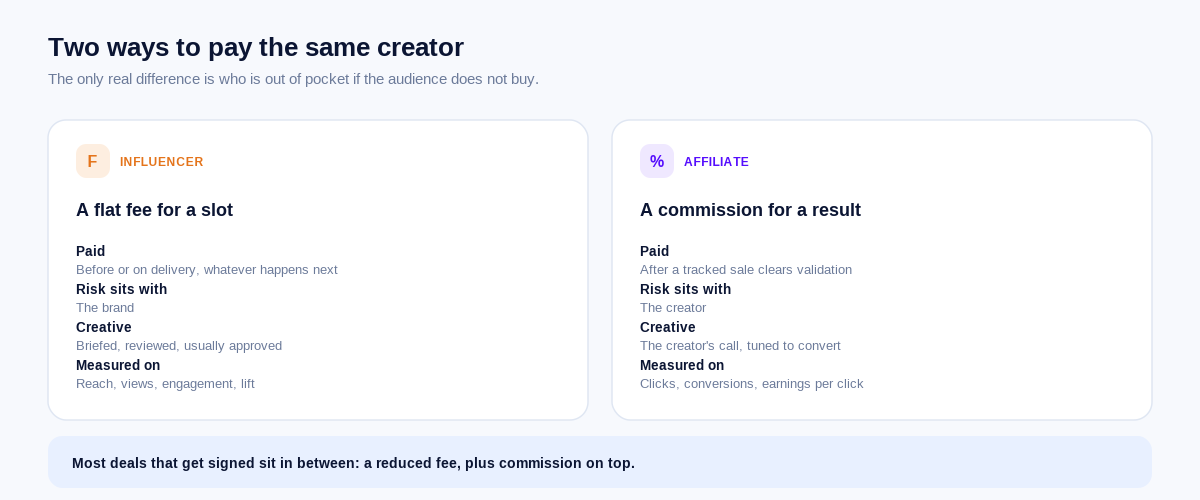
Same creator, same audience, two completely different risk positions.
The comparison, in one table
| Affiliate | Influencer | |
|---|---|---|
| When money moves | After a tracked result | Before, or on delivery |
| Who carries the risk | The creator | The brand |
| Priced on | % of sale, or a flat CPA or CPL | Audience size, format, exclusivity |
| Budget behaviour | Variable, scales with revenue | Fixed, committed in advance |
| Creative control | Low, the creator decides | High, usually briefed and approved |
| Typical measurement | Clicks, conversions, EPC, ROAS | Reach, views, engagement, lift |
| Time to first data | Hours | Days, sometimes weeks |
| Fails when | The offer converts badly | The audience does not match |
| Best for | Proven products with known margin | Launches, awareness, new categories |
Why the risk split changes everything else
Every other difference between these two channels is downstream of who gets paid first.
A creator taking a flat fee has been paid for their time. They will produce what the brief asked for, on schedule, and their commercial job is done when the post goes up. A creator taking a commission has been paid nothing. Their incentive is not to make the post that pleases the brand, it is to make the post that makes people buy, which is often a less polished, more specific, more caveated piece of content than a brand would ever approve.
This is why affiliate creative looks different. Comparison tables, honest downsides, "do not buy this if" paragraphs. Those elements exist because they convert, and the person writing them is paid on conversion. A brand that tries to enforce influencer level creative control on an affiliate deal usually gets influencer level conversion rates, which is to say, worse ones.
It also explains recruiting difficulty. Flat fee work is easy to sell to a creator because there is no downside for them. Commission work has to be sold on maths: what the creator can realistically earn per thousand people who see it. If you cannot make that number look good, you will not recruit, no matter how nice the brand is. Our guide on how to find affiliates goes through the pitch in detail.
How the money actually compares
Take a creator with a 40,000 subscriber newsletter and a fairly typical set of numbers. A dedicated sponsorship at a $40 CPM earns $1,600, guaranteed, on the send date.
Now price the same slot as affiliate. Say 3% of the list clicks, which is 1,200 clicks. Say 2.5% of those clicks buy, which is 30 orders. On a $90 average order at 15% commission, that is $405.
| Sponsorship | Affiliate | |
|---|---|---|
| Creator earns | $1,600 | $405 |
| Brand pays | $1,600 | $405 |
| Revenue generated | $2,700 | $2,700 |
| Brand cost of sale | 59% | 15% |
| Creator earnings per click | $1.33 | $0.34 |
Look at the last row rather than the first. The creator earns four times more on the flat fee, and that is exactly why creators default to asking for one. For the affiliate deal to compete, the offer has to do something to close that gap: a higher rate, a higher basket, recurring commission, or a much better converting landing page. This is the same arithmetic from the other side of the desk in newsletter sponsorships vs affiliate deals.
The honest summary is that affiliate is cheaper per sale and influencer is more attractive per creator. A brand that understands that tension will structure around it instead of arguing with it.
For creators, the takeaway is to stop treating the two as rival job offers. Plenty of creators run a paid placement and an affiliate link for the same brand, and a marketplace with both sponsorships and affiliate offers lets you compare them side by side.
The hybrid deals that actually get signed
In practice most negotiations with an established creator land somewhere in the middle, and there are four shapes worth knowing by name.
| Structure | Shape | Use it when |
|---|---|---|
| Fee plus commission | Reduced flat fee, then commission on top | The creator is proven but your offer is unproven |
| Fee against commission | Fee is an advance, earned back from commissions | You believe the offer converts and want to prove it |
| Performance bonus | Flat fee, plus a bonus at a sales threshold | You need approved creative but want upside shared |
| Test then convert | One paid post, then an ongoing affiliate link | Most first time creator relationships |
The last one is the one I would push for almost every time. A single paid post buys you real data on that specific audience, and the ongoing link costs you nothing if it produces nothing. The creator keeps a revenue stream they did not have to renegotiate, and you keep a partner who is now motivated to mention you again in three months without an invoice attached.
A hybrid only works if both halves run on the same tracking and reporting. That is how the advertiser side of Wooly Network is set up, with sponsorships and commission campaigns in one catalogue: running flat fee and commission partners from one brand account.
Where the two channels are converging
The clean split described above is getting blurrier every year, and the platforms are the reason.
- Instagram and TikTok both run commission programmes inside the app, so a creator can attach a paid partnership label and a commissionable product to the same post.
- Amazon runs Associates alongside its Creator Connections programme, letting brands offer a bonus commission on top of the standard rate card to specific creators.
- Shopify Collabs sits in the merchant admin and does gifting, discount codes and affiliate commissions in one place, which is a fair description of a hybrid channel.
- YouTube lets creators tag products under a video, which means an unpaid review and an affiliate placement are now the same object.
What this means practically: the question "is this an influencer deal or an affiliate deal" is becoming less useful than "what am I paying for, and what am I measuring". Ask those two instead.
Platform cost changes the comparison too. With affiliate, most of the spend follows results, so the fixed part is the tooling. Wooly Network advertiser plans are a flat monthly or annual fee with no setup fee, and creators never pay to join. For influencer-style work, brands can also start on the free plan and run collabs, paid per job: One-Time Jobs, Recurring Jobs, Bounties and Paid Product Collabs.
How to measure each one without fooling yourself
Both channels have a signature measurement mistake.
The affiliate mistake is counting coupon and loyalty traffic as new demand. If a partner's main contribution is intercepting people at the checkout who were already buying, last click attribution will make that partner look like your best performer while adding nothing. This is the incrementality problem, and it is worth reading last click vs first click attribution before you make budget decisions on affiliate reports.
The influencer mistake is measuring the thing that is easy to see. Views and engagement are available instantly and correlate weakly with revenue. The measurements that matter are harder: a holdout region, a branded search lift check in Google Search Console, a "how did you hear about us" survey after checkout. If you are buying influencer for awareness, measure awareness, and do not quietly grade it on the affiliate scoreboard where it will always lose.
A practical rule: give every creator a tracked link even when you are paying a flat fee. It costs nothing, it tells you which audiences actually click, and it turns a one off sponsorship into a list of candidates for your affiliate programme.
Which one should you start with?
Four questions, in order.
- Do you know your conversion rate and average order value? If no, start with influencer or a small paid test. Affiliate without those numbers means you cannot price a commission or answer a creator who asks what they will earn.
- Is your product understood without explanation? Affiliate works best where the buyer already knows they want the category. A genuinely new category usually needs paid placements first to create the demand that affiliate can then capture.
- Is your margin above roughly 30%? Below that, a meaningful commission is hard to fund, and you may be better off with fixed fee placements you can cap. The margin maths is in how much should you pay affiliates.
- Do you need results this quarter or a channel next year? Influencer gives you a spike. Affiliate compounds: content published for you in month two is still earning in month fourteen.
Setting up the affiliate side: Wooly Network gives you both halves of the answer in one place. You can run a commission campaign and, because every partner gets a tracked link and reporting from day one, you can see which creators deserve a flat fee before you commit one. Here is how a campaign is set up, and the full programme launch guide is here.
Common questions
Can the same creator do both for the same brand?
Yes, and it is common. A typical arrangement is a paid campaign for a launch month and a standing affiliate link the rest of the year. Keep the agreements separate so the paid post does not accidentally generate commission you did not budget for, or make it explicit that it does.
Is affiliate marketing cheaper than influencer marketing?
Per sale, almost always, because you only pay when a sale happens. In total, not necessarily: a scaled affiliate programme with strong partners can cost more in absolute terms than a handful of sponsorships, it just costs it against revenue that exists.
Do affiliate links need the same disclosure as sponsored posts?
Yes. In the United States, the FTC treats a commission as a material connection exactly like a payment, so the same clear and conspicuous disclosure rules apply. The details are in affiliate disclosure: what the FTC actually requires.
Which channel do creators prefer?
Most creators prefer flat fees for the certainty, and prefer affiliate for products they genuinely use and expect to keep recommending. The creators who earn most from affiliate are the ones treating it as a product decision rather than an ad slot, which is covered in affiliate marketing for creators.
Keep reading
- What is an affiliate network and how does it work?
- Affiliate marketing for brands: the complete guide
- Newsletter sponsorships vs affiliate deals
- CPA vs CPL vs revenue share
- How much do affiliate marketers actually make?
Related reading
- Spark Ads and Partnership Ads: How Creator Whitelisting Works — Whitelisting lets a brand run ads through a creator's own account. Here is how Spark Ads codes and Meta Partnership Ads permissions actually work.
- Affiliate Marketing for Brands: A Complete Guide — What the channel is actually good at, what it is bad at, how to budget for it honestly, and the operating rhythm that separates a programme that compounds from one that flatlines.
- Affiliate Marketing for SaaS: The Complete Playbook — Recurring commission, trial to paid lag, churn clawbacks and self serve versus sales led: the decisions that make a software affiliate programme work, with the numbers to check before you launch one.
More from the Wooly Network Blog