Wooly Network vs PartnerStack for SaaS Affiliate Programs
B2B partner software or an open creator marketplace? Costs, partner experience, payouts and recurring commission tracking compared for software companies.
By Nora Ellis, Affiliate Marketing & Creator Economy Writer · with Wooly Network, Advertiser Success · 7 October 2026 · 16 min · Affiliate Marketing
Wooly Network vs PartnerStack comes down to what kind of partner program you are building. PartnerStack is partner relationship software built for B2B SaaS companies that run affiliates, referral partners, resellers and co selling partners side by side, sold on quote based annual plans. Wooly Network is a performance marketplace with public monthly plans (from $99 a month, no setup fee) where SaaS brands publish a campaign, including recurring revenue share, and creators discover it and apply. If you have a partner team and a sales led motion, PartnerStack is built for you; if you want creators promoting a self serve product without a five figure contract, Wooly is the lighter fit.
Last checked October 2026. Pricing and features change, so confirm on each vendor's site before you sign. We refresh this page every three months.
We run Wooly Network, so read this with that in mind. We have also tried to write the page we would want to read if we were the buyer: where PartnerStack is clearly stronger, we say so, and there are several of those places. The goal is that you finish this with a decision, not a demo booked out of politeness.
What is PartnerStack, and who is it built for?
PartnerStack describes itself as "the only affiliate platform built for B2B" and, on its homepage, as an AI native partner relationship management (PRM) platform that helps B2B SaaS companies "recruit, engage, and scale" an ecosystem of partners, "from affiliates to referral and reseller partners." It is now an AppDirect company. That positioning is accurate, and it is the first thing to understand: PartnerStack is not trying to be a cheap affiliate tracker. It is trying to be the system of record for a whole partner function.
Where PartnerStack is genuinely strong
- Several partner types in one program. Its FAQ says it supports affiliate, referral, co sell and influencer programs, with separate onboarding and enablement paths for each type. If your agency partners need a different journey from your newsletter affiliates, this is where PartnerStack earns its fee.
- Lead and deal registration. The entry Launch plan already includes "affiliate link tracking or lead and deal registration" and CRM integrations, so a reseller can register a deal and get credit when your sales team closes it. That matters a lot for SaaS with a sales cycle longer than a lunch break.
- A B2B partner marketplace. PartnerStack Marketplace access is included from Launch ("Get discovered by active B2B partners"), and its homepage puts the network at more than 131,000 active partners as of October 2026. Enterprise adds network success and partner introductions.
- Enablement features. The Growth plan adds a learning management system, challenges and incentives, MDF (market development funds) management and advanced segmentation. These are partner team tools, not affiliate tools, and few lighter products have them.
- Reviews. PartnerStack holds about 4.7 out of 5 on G2 from roughly 920 to 940 reviews, according to G2 listing snapshots in October 2026. That is a strong score for a category where people mostly leave reviews when something has gone wrong.
The short version: if the phrase "partner ecosystem" appears in your board deck, PartnerStack is a serious candidate, and probably the default one in B2B SaaS.
What is Wooly Network, and how is it different?
Wooly Network is a marketplace. A brand publishes a performance campaign once (CPA, CPL for leads, revenue share one time or recurring, a fixed amount per sale, or a sponsorship), and creators browse the marketplace, read the terms and apply. You approve them instantly or manually. Tracking runs through a website tag plus signed server to server events, click terms are locked at the moment of the click, duplicate orders are counted once, and fraud and bot screening happens before any money moves. Creators are paid monthly on a fixed cycle through Stripe.
The difference in one line: PartnerStack helps you manage and grow a partner organization; Wooly helps you get a campaign in front of creators who are looking for something to promote. Wooly is a newer marketplace and is not trying to be a PRM suite. There is no deal registration, no partner LMS and no MDF module, and if you need those, the comparison is already over.
On Wooly Network: a SaaS brand can set a recurring revenue share, publish it once, and let creators who cover its category find it in the affiliate marketplace for brands, instead of recruiting every partner one cold email at a time.
How much does PartnerStack cost?
PartnerStack does not publish prices. Its pricing page says: "Pricing is based on your partner program size, feature needs and level of support. Your final plan and pricing are confirmed during your demo." The plans are called Launch, Growth and Enterprise, there is no limit on the number of partners, and internal users are unlimited too.
What buyers report paying, from third party sources (treat these as reported, not quoted):
- Uppercut reports PartnerStack starting at about $1,500 a month billed annually, roughly $18,000 a year, with Enterprise around $3,000 to $5,000 or more a month (Uppercut review).
- Vendr reports a median buyer spend of $19,616 a year across 62 purchases, ranging from about $9,186 to $37,770 (Vendr marketplace data).
- Annual contracts are reportedly standard.
- Several review sites report an additional platform fee on partner commissions charged to the company, with estimates ranging widely, from about 3% to 15%. PartnerStack does not publish this, so ask for it directly in your quote and get it in writing.
Older public prices from 2019 and 2020 ($800 a month and $1,500 a month) still float around the internet. They are out of date and you should not budget from them. If you came here from our Impact.com alternatives roundup, the pattern will look familiar: the bigger partnership suites price by conversation.
How much does Wooly Network cost?
Wooly's brand plans are public on the brand pricing page:
- Growth: $99 a month, with 1 live performance campaign.
- Scale: $249 a month, with up to 4 live campaigns plus the server to server conversion API, app install tracking, a fraud review queue, cross device attribution and automated Stripe payouts.
- Enterprise: custom.
Annual billing gives two months free. There is no setup fee, no network minimum, and you can cancel anytime. An operational fee applies to creator payouts only, so it costs nothing in a month when nothing sells. Creators join free and Wooly takes nothing from their commissions. There is no free trial, but there is a campaign demo on the advertiser page you can try before signing up.
Wooly Network vs PartnerStack: how do they compare side by side?
| Feature | PartnerStack | Wooly Network |
|---|---|---|
| Built for | B2B SaaS partner ecosystems: affiliates, referral, reseller, co sell and influencer partners | Brands running performance campaigns with creators and affiliates |
| Pricing model | Quote based, confirmed during a demo | Public: $99 or $249 a month, Enterprise custom |
| Reported entry cost | About $1,500 a month billed annually (Uppercut); median $19,616 a year (Vendr) | $99 a month, or ten months' price for a year on annual billing |
| Contract | Annual reportedly standard | Monthly, cancel anytime; annual optional |
| Setup fee | Not listed | None |
| Partner discovery | PartnerStack Marketplace from Launch; 131,000+ active partners per its homepage | Built in marketplace: creators browse campaigns and apply |
| Deal and lead registration | Yes, from Launch | None (CPL campaigns track leads, not sales deals) |
| Partner enablement | LMS, challenges, MDF management on Growth | Campaign brief and incentives (launch, bonus, seasonal) |
| Commission types | Percentage of sales, flat amounts, milestone rewards, recurring | CPA, CPL, revenue share one time or recurring, fixed per sale, sponsorships |
| Recurring tracking | Each billing transaction can trigger a commission via API or billing integrations | Recurring revenue share tracked through the tag and signed server events |
| Partner withdrawal fees | Stripe $2.25 plus 0.25% (max $20); PayPal 2% (max $20) | None taken from creator commissions |
| Payout timing | Typically the 13th of each month; partner withdraws manually from $5 | Monthly fixed cycle through Stripe |
| G2 rating | About 4.7 out of 5 (G2 snapshot, October 2026) | Not listed |
How does recurring commission tracking work on each platform?
This is the question that matters most for a SaaS affiliate program, because the money is in month seven, not month one. A recurring commission needs three things to go right: the referral has to be attached to the customer at sign up, every later payment has to be reported, and refunds or downgrades have to flow back into the commission.
PartnerStack
PartnerStack's integration guide splits the job in two. First, a JavaScript snippet (GrowSumoJS, from the company's earlier name) reads the partner key from a cookie set when someone clicks a referral link, and you create a customer in PartnerStack at sign up. Second, you report transactions against that customer, and triggers you configure turn each one into a commission. Its integrations page lists billing and CRM connectors including Stripe, Chargebee, Recurly, HubSpot and Salesforce, so for many SaaS stacks the renewals are picked up from billing rather than hand coded. Partner Payments are described as "built for B2B SaaS sales cycles, not just one time payouts."
It is a clean model, and the customer object is the reason it works: every renewal is tied to the same customer, so the partner keeps earning as long as your commission rules say they should.
Wooly Network
On Wooly you choose revenue share and set it as one time or recurring when you create the campaign. Conversions arrive through the website tag and signed server to server events from your backend, so a renewal your billing system confirms can be reported as a new event against the original referral. The commission terms the creator saw when they clicked are locked to that click, which avoids the classic argument where a brand lowers a rate and partners discover it on their statement. Duplicate orders are counted once, and screening runs before payouts.
For a typical self serve SaaS, both approaches get you to the same place: a creator who brought in a customer is paid every month that customer pays. The practical difference is the surrounding machinery. PartnerStack wraps recurring tracking in CRM sync, deal registration and partner tiers; Wooly keeps it to a campaign with terms. If you want the deeper mechanics first, our explainer on how affiliate tracking works covers cookies, server events and attribution in plain terms.
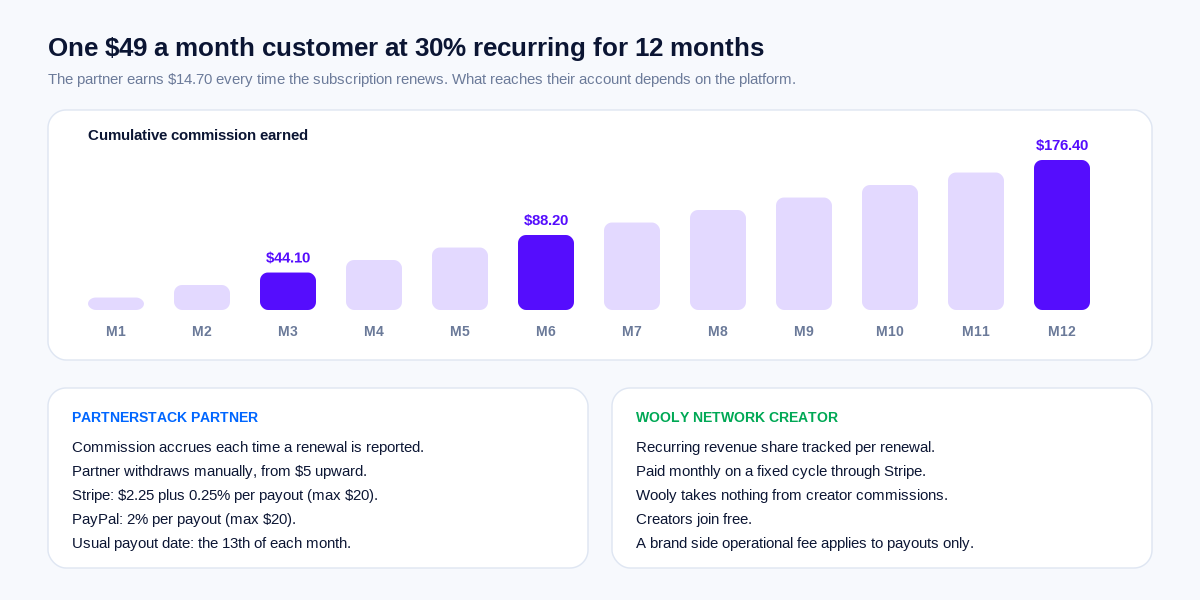
Same customer, same commission: what changes is how the money reaches the partner.
What does the partner experience look like on each side?
Brands tend to compare platforms on their own dashboard. Partners compare them on what lands in their account, and good partners have a long memory for fees.
Getting paid on PartnerStack
According to PartnerStack's partner help center, commissions are typically paid out on the 13th of each month, though some companies set custom schedules. Partners need at least $5 in commissions to withdraw, and withdrawing is manual, not automatic. The partner pays the withdrawal fee:
- Stripe: $2.25 plus 0.25% per payout, capped at $20.
- PayPal: 2% per payout, capped at $20.
- Direct deposit (through Airwallex, about 75 countries): fees vary by country, currency and amount.
On a large monthly balance those caps make the fees trivial. On a small affiliate's $60 month, a Stripe withdrawal costs $2.40, which is 4% of their income. Not outrageous, but noticeable, and partners do notice.
Getting paid on Wooly Network
Creators join free and Wooly takes nothing from their commissions. Payouts run monthly on a fixed cycle through Stripe. The operational fee that exists sits on the brand side and applies only to payouts, which is the reason a quiet month costs the brand nothing.
There is a second partner experience difference that matters more than fees: who the partner is. PartnerStack's marketplace is full of B2B partners, many of them agencies, consultants and SaaS review sites, who are used to deal registration and quarterly business reviews. A creator marketplace skews toward newsletter writers, YouTubers, podcasters and niche bloggers who want to read a campaign, decide in five minutes and post a link this week. Neither group is better. They want different things from you, and you should pick the platform your likely partners already live on.
On Wooly Network: creators can see your recurring terms before applying, which tends to attract the ones who plan to stick around; if you are a creator reading this, the free affiliate marketplace for creators is where SaaS campaigns are listed.
Wooly Network vs PartnerStack: what would a $49 a month SaaS app pay?
Say you run a $49 a month app and want to pay partners 30% recurring for the first 12 months of each customer. That is $14.70 per customer per month, or $176.40 per customer over a year if they stay. Say partners bring in a steady number of new customers every month and, to keep the arithmetic honest, nobody churns in year one (they will, so treat these as ceilings).
A customer acquired in month 1 pays 12 times in year one, a customer from month 12 pays once. So 10 new customers a month produces 10 times (12 + 11 + ... + 1) = 780 paid customer months in year one.
| New partner customers per month | Year one partner revenue | Year one commissions at 30% | PartnerStack platform (reported) | Wooly Scale, annual billing |
|---|---|---|---|---|
| 5 | $19,110 | $5,733 | About $18,000 to $19,616 | $2,490 plus the payout fee |
| 20 | $76,440 | $22,932 | About $18,000 to $19,616 | $2,490 plus the payout fee |
| 100 | $382,200 | $114,660 | About $18,000 to $19,616, likely higher at this size | $2,490 plus the payout fee, or Enterprise |
How the math works for row two: 20 customers a month gives 20 times 78 = 1,560 customer months, times $49 is $76,440, and 30% of that is $22,932. The PartnerStack figures are the Uppercut starting estimate and the Vendr median; your quote may differ, and any fee on commissions would come on top. Wooly's Scale plan at $249 a month comes to $2,490 a year on annual billing (two months free). We have not added Wooly's operational fee because we do not publish a percentage here; check it on the pricing page and add it to your model.
What the table tells you
- At 5 customers a month, a PartnerStack contract at the reported entry level would roughly equal your entire year one partner revenue. That is not a criticism of PartnerStack; it is a sign the program is too early for partner management software at that price. Prove the channel first.
- At 20 a month, the platform would cost around a quarter of partner revenue on PartnerStack and around 3% on Wooly before the payout fee. This is the zone where most early SaaS programs live, and where the cost difference decides things for a lot of founders.
- At 100 a month, PartnerStack's reported price drops to about 5% of partner revenue, and the question flips. You now have enough partners that deal registration, tiers, onboarding tracks and a CRM sync might save your partner manager more than the license costs. This is where PartnerStack is the more natural choice.
If you are still deciding what rate to offer in the first place, our guide to affiliate marketing for SaaS covers recurring versus one time payouts, trial handling and typical rates for software.
Is Wooly Network a good PartnerStack alternative?
For some SaaS companies, yes. For others, clearly not. Here is how we would sort it.
Choose PartnerStack if
- You run, or are about to hire, a partner team with several partner types: resellers, agencies, referral partners and affiliates.
- Your sales motion is sales led, and partners need lead or deal registration synced to Salesforce or HubSpot.
- You need partner enablement: courses, certification, MDF, challenges, partner tiers.
- You want access to a large B2B partner marketplace where agencies and consultants already look for SaaS programs.
- Your budget comfortably absorbs a five figure annual contract, and the program already produces revenue that justifies it.
Choose Wooly Network if
- Your product is self serve (sign up, trial, card), and partners send customers who buy without talking to sales.
- You want creators, newsletter writers and niche publishers to find your campaign, rather than recruiting every partner yourself.
- You want public monthly pricing with no setup fee, no network minimum and the option to cancel.
- You want a recurring revenue share without partners paying a fee to withdraw their commissions.
- You are testing whether the partner channel works at all and want the test to cost hundreds, not tens of thousands.
Some companies start on a marketplace to prove the channel and move to PRM software when they hire a partner team. That is a sensible path, and there is no shame in outgrowing a tool. The opposite path, signing an annual PRM contract before you have ten active partners, is the mistake we see most. It usually ends with a beautifully configured portal and three partners, one of whom is the founder's cousin.
What about other PartnerStack alternatives?
Wooly is not the only lighter option. If you mostly want to track referrals from your own users and partners through Stripe, a dedicated SaaS tracker may be enough. Our Dub Partners alternatives roundup compares several affiliate software for SaaS tools with public pricing, and the head to head on Wooly Network vs Dub Partners goes into payout fees and payout caps in detail. If you are also looking at impact.com because a board member said "everyone uses it," our Wooly Network vs Impact comparison covers that platform's public tiers and transaction fees.
Switching from PartnerStack: what to check first
If you are already on PartnerStack and considering a move, do it in this order:
- Read your contract's renewal clause. Annual contracts usually auto renew with a notice window. Put the notice date in your calendar today.
- Export your partner list and commission history. You owe partners whatever they have earned under existing terms, and recurring commissions keep accruing after you stop recruiting.
- Decide what happens to existing recurring commissions. The fair answer is to honor them for the promised period. Partners talk, and a program that cuts off recurring earnings once will struggle to recruit again.
- Map your partner types. If a meaningful share of revenue comes from resellers or registered deals, a marketplace will not replace that workflow, and you may want to keep PartnerStack for those partners.
- Run both in parallel for a cycle. New creator campaigns on the new platform, existing partners where they are, then compare.
For SaaS brands
Test a recurring creator campaign before you sign anything annual
Try the campaign demo, set a recurring revenue share and see how creators would find it. Plans start at $99 a month with no setup fee.
Try the campaign demoCommon questions
How much does PartnerStack cost in 2026?
PartnerStack does not publish prices; plans (Launch, Growth, Enterprise) are quoted during a demo based on program size, features and support. Uppercut reports a starting point of about $1,500 a month billed annually, and Vendr reports a median buyer spend of $19,616 a year across 62 purchases. Annual contracts are reportedly standard.
Does PartnerStack charge partners fees?
Yes. According to PartnerStack's partner help center, Stripe withdrawals cost $2.25 plus 0.25% per payout up to a $20 maximum, PayPal costs 2% up to $20, and direct deposit fees vary by country and currency. Partners need at least $5 in commissions and must withdraw manually.
Can Wooly Network track recurring SaaS commissions?
Yes. A brand can set a revenue share campaign as one time or recurring. Conversions are reported through a website tag and signed server to server events, commission terms are locked at the time of the click, duplicate orders are counted once, and creators are paid monthly through Stripe.
Is PartnerStack better than Wooly Network for B2B SaaS?
For sales led B2B SaaS with resellers, agencies and deal registration, PartnerStack is the stronger fit: it was built for that workflow and holds about 4.7 out of 5 on G2. For self serve SaaS that wants creators to discover a recurring campaign on public monthly pricing, Wooly Network is usually the simpler and less expensive option.
Does Wooly Network have a setup fee or minimum?
No. Wooly's brand plans are Growth at $99 a month and Scale at $249 a month, with Enterprise on custom terms. There is no setup fee and no network minimum, you can cancel anytime, and annual billing gives two months free. An operational fee applies to creator payouts only.
Keep reading
- Impact.com alternatives for startups and growing brands
- Wooly Network vs Impact.com: which affiliate platform fits?
- Dub Partners alternatives: 7 affiliate platforms compared
- Wooly Network vs Dub Partners: pricing, fees and discovery
- Affiliate marketing for SaaS
Related reading
- Affiliate Platform Comparisons and Alternatives — Honest side by side comparisons of the affiliate networks and partner platforms brands shortlist most, with pricing, fees, contracts and who each one suits best.
- Dub Partners Pricing Explained: Plans, Payout Fees, Limits — What each Dub plan includes for affiliate programs, how payout fees and monthly payout caps change the real cost, and a worked example at three sizes.
- PartnerStack vs Impact: Which Partner Platform to Choose — A neutral comparison of the two best known partner platforms: who each one is built for, how pricing works, and when neither is the right fit.
More from the Wooly Network Blog