Creator Bounties and Contests: How to Crowdsource Content That Converts
A creator bounty pays for the content that wins or passes review, not for a guess at who will deliver. Here is how to design one that is fair and cheap.
By Nora Ellis, Affiliate Marketing & Creator Economy Writer · with Wooly Network, Advertiser Success · 31 October 2026 · 7 min · Growth Marketing
A creator bounty is a brief open to many creators at once, where you pay only for results: either a ranked set of prizes for the best entries, or a fixed amount for every entry that meets your bar. It flips the usual hiring process. Instead of picking one creator and hoping, you let the market show you who can deliver, then you pay for what actually lands.
Bounties have a slightly chaotic, slightly fun energy that a one-on-one brief never has. Creators love a leaderboard almost as much as they love money, which is a strange but useful fact for a marketer to know.
What is a creator bounty?
A creator bounty, sometimes called a content bounty, is an open call where any eligible creator can submit an entry against your brief, and you pay based on results rather than hiring one person up front. It works well when you want volume (many takes on one idea), when you are not sure which creator or angle will win, or when you want a public, communal moment around your brand rather than a quiet one-to-one job.
Ranked prizes vs pay per approved entry: which is better?
Ranked prizes feel like a contest: a fixed pool split across the top finishers, say $500 for first, $250 for second, $100 for third, and nothing for everyone else. It is cheap and exciting, and it rewards genuine quality, but it is unfair to the fourth-best entry, which did real work and earned zero.
Pay per approved entry feels like a job: every entry that meets your bar earns the same flat amount, however many people enter. It costs more as volume grows, but it is fair to every creator who did the work, and it scales your spend with your results instead of capping it at a prize pool.
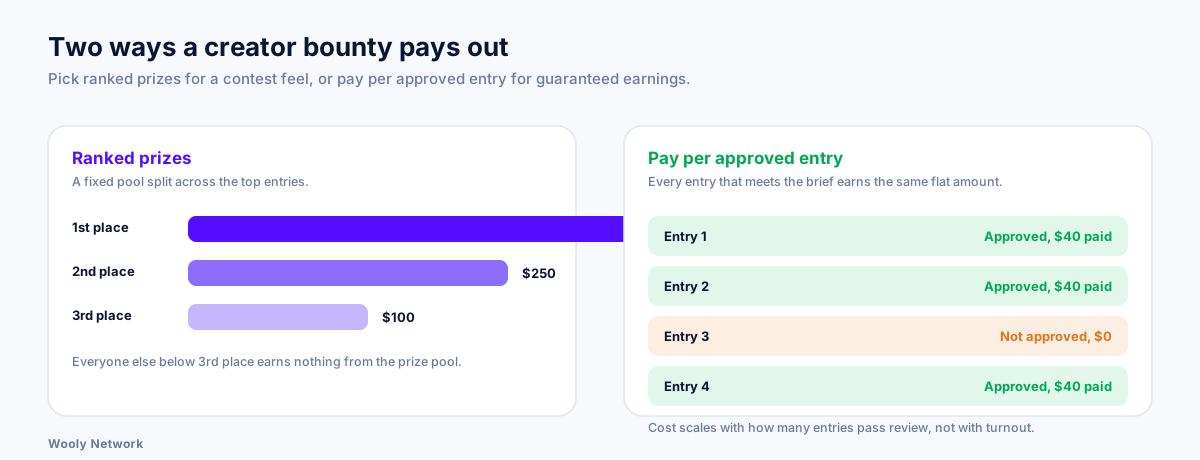
Ranked prizes cap your cost. Pay per approved entry caps your risk of unfairness.
A simple rule of thumb
Use ranked prizes when you want a splashy, limited budget event, like a launch moment. Use pay per approved entry when you want ongoing, reliable volume, like a steady stream of clips or UGC pieces over a month. Either way, a bounty costs nothing to publish: brands can start one on the Free plan, with Wooly's fee added to each payout and lower rates on paid plans, see pricing for the breakdown.
When do bounties beat hiring one creator?
Bounties beat a single hire when you genuinely do not know which angle will work and want several creators to try different hooks on the same product, when you want more raw volume than one creator can film in your timeline, or when your product or story has broad, communal appeal, the kind that makes a good contest (a challenge, a transformation, a funny use case). They lose to a single hire when you need a very specific, polished, on-brand piece, since open bounties bring variance in quality along with the variance in ideas.
Say you sell a $40 travel pillow and want to test five hook ideas before committing budget to ads. A bounty with pay per approved entry at $30 a clip, capped at 20 entries, costs at most $600 and gives you five or six genuinely different creative directions to test. One hired creator would give you one voice and one take.
How do you design prizes and rules for a creator contest?
Write the rules before you publish, not after the first entry arrives. At minimum, state: what counts as an eligible entry (format, length, must include the product), the deadline, how winners are chosen, when prizes or payments go out, and what happens with usage rights for entries you do not pay for (you should not use unpaid entries in your marketing; say so plainly).
| Element | What to decide | Example |
|---|---|---|
| Entry format | Length, platform, must-haves | 15 to 30 seconds, vertical video, product visible for 3 seconds |
| Prize structure | Ranked or per entry | 1st $500, 2nd $250, 3rd $100, or $40 per approved entry |
| Eligibility | Who can enter | Open to anyone, or a set niche or country |
| Judging | Who decides and on what basis | Marketing team scores on hook strength, clarity and brand fit |
| Timing | Open date, close date, payout date | Open two weeks, results and payouts within one week of closing |
BOUNTY FORMAT
Launch a bounty with either payout style built in
Choose ranked prizes or a set amount per approved entry when you create the brief, and the terms stay visible to every applicant.
Start a bountyHow do you judge entries fairly?
Score against the brief, not against your personal taste. Write three or four criteria in advance (hook strength, brand fit, clarity of the message, technical quality) and score every entry the same way, ideally with more than one person weighing in. Publish the judging criteria with the bounty; creators who know how they will be scored send better entries and complain less about a result they do not like.
Fairness for creators also means a realistic bar from the start. If your brief is vague, you will reject a lot of good faith work and burn trust with a pool of creators you might want again. Our brief template covers what a clear brief needs section by section.
What examples of brand challenges work well?
Hypothetical, but typical patterns: a hashtag challenge where entrants show a before and after using your product, judged on ranked prizes for a splashy launch; a review bounty where every honest review video that meets length and clarity requirements gets paid the same flat rate, useful for building up a library of product proof; a transformation or results bounty over 30 days, paid per approved entry, which works well for supplements, skincare or fitness products where the story takes time to show.
Running clipping as a bounty
A pay-per-approved-entry bounty is also the natural format for clipping, where fans or creators cut your long-form content into short clips and get paid per clip that clears review, rather than per view. Paying per approved entry rather than per view sidesteps the fake view problem entirely, since there is no view count for a clipper to try to inflate; the brand only ever pays for a clip a reviewer actually signed off.
What should a bounty cost you, roughly?
Work backward from what a result is worth, not from what feels generous. If a successful UGC style clip would normally cost you $150 to $400 to commission directly, a pay per approved entry bounty at $30 to $60 per clip, capped at twenty or thirty entries, can produce a similar volume of usable content for a fraction of that per piece cost, precisely because you are only paying for the share of submissions that actually clear your bar. Ranked prize bounties are even cheaper per entry on average, since the pool is fixed regardless of turnout, but remember that fixed cost comes at the price of leaving good, unrewarded work on the table below third place.
Either way, treat the first bounty you ever run as a pilot. Track how many entries you got, how many passed review, and what you actually paid out per usable piece of content. That number, more than any rate card, tells you whether to run a bigger one next time, and at what price.
TRY IT FREE
Crowdsource your next campaign with a bounty
Set ranked prizes or a flat rate per approved entry, publish to the marketplace, and pay only for what clears review.
Start free as a brandCommon questions
What is a content bounty?
A content bounty is an open brief that many creators can enter at once, paid either as ranked prizes for the top entries or as a flat amount for every entry that meets the brief. It trades the certainty of hiring one creator for volume and variety of ideas.
How many entries should I expect?
It depends heavily on the prize, the brief's difficulty and how widely you promote it. A clear brief, a fair reward and promotion to an existing marketplace of creators all raise turnout more than the prize size alone.
Do I own the content I do not pay for?
No. If an entry is not approved or paid, you have no right to use it. State this clearly in your rules so there is no confusion, and never repost an unpaid entry even informally.
Is pay per approved entry more expensive than ranked prizes?
It can be, since your total cost rises with every entry that clears the bar rather than staying fixed at a prize pool. The tradeoff is fairness and predictability per entry, which often matters more once you run bounties regularly.
Can a creator contest replace hiring UGC creators entirely?
Not usually. Bounties are great for testing ideas and getting volume, but a hired creator under a One Time Job or a retainer is still the better choice when you need a specific, polished, on-brand piece delivered on a set date.
How fast should I pay out a bounty?
As fast as your judging allows, ideally within a week of the bounty closing. Slow payouts are the single fastest way to make creators skip your next one.
Keep reading
- What is a creator marketplace
- What is UGC
- How much do UGC creators charge
- How to write a UGC brief creators love
- Paid product collabs explained
- How to build a UGC portfolio
Related reading
- Best UGC Platforms for Brands in 2026: Prices, Fees and Models Compared — A fair, numbers first look at the best UGC platforms for brands in 2026, what each one actually charges, and which model fits your order volume.
- How to Find UGC Creators for Your Brand: 7 Places That Actually Work — Every brand that wants to find UGC creators asks the same question: where. Here are 7 real sources ranked by effort, a vetting checklist and a message that gets replies.
- What Is a Creator Marketplace? How Brands and Creators Work Together in 2026 — A creator marketplace is where brands and creators find each other and run the deal end to end. Here is how it actually works, and when it beats an agency or cold outreach.
More from the Wooly Network Blog