How to Pitch Brands as a UGC Creator: Message Templates That Get Replies
Four copyable pitch templates for UGC creators, who to contact, what to attach, a follow up cadence, and why applying beats cold pitching most of the time.
By Nora Ellis, Affiliate Marketing & Creator Economy Writer · with Wooly Network, Creator Success · 1 November 2026 · 7 min · Creator Monetization
To pitch brands as a UGC creator, send a short, specific message to the right person, with one or two portfolio links attached, state your rate range plainly, and follow up twice before moving on. Most replies come from volume and a clear ask, not from a clever opening line, so a simple repeatable template will outperform a perfect one-off message every time.
Cold pitching has a reputation problem, mostly earned. Most pitches land in a general inbox, get skimmed in four seconds, and vanish. That is not a reason to stop, it is a reason to make your message skimmable in those four seconds and to stop treating each one like a wedding speech.
Who should you actually pitch as a UGC creator?
Skip the general "info@" inbox when you can. Look for a marketing manager, brand or social media lead, or a founder at a small company, since they are the ones who actually commission content. LinkedIn, the brand's Instagram bio, or the team page on their website usually gets you a name in under five minutes.
Small and mid-sized brands reply more often than large ones, since they usually do not have an agency filtering every message before it reaches a person. Start there while you build a track record.
What should a UGC cold email include?
Four things, nothing more: who you are in one line, what you noticed about their brand specifically, a link to one or two relevant portfolio videos, and your rate range or a question about their budget. Here is a template:
Subject: UGC video for [Brand Name]
Hi [Name], I am [Your Name], a UGC creator in the [niche] space. I liked how [specific brand detail, a recent launch or post]. Here is a quick sample close to what I would make for you: [link]. My rate for one edited video with organic usage starts around [$X]. Happy to send a few more examples if useful.
Keep it under 100 words. A long pitch reads as needy; a short one reads as someone who respects a busy inbox.
What should a UGC pitch DM on social look like?
Shorter again, since DMs get read on a phone between other things:
Hey, love what you are doing with [specific product or post]. I make UGC content in [niche] and think I could put together something similar for your page or ads. Here is a quick sample: [link]. Want me to send a rate?
Ending with a question rather than a hard pitch makes replying feel low effort, which is exactly what gets a reply from someone scrolling between meetings.
How do you follow up without sounding pushy?
One follow-up after about five to seven days is normal and expected; most people are not ignoring you, they are busy. A second, lighter follow-up a week or two after that is fine. After that, let it go.
Follow up: Hi [Name], just floating this back up in case it got buried. Still happy to put a sample together for [Brand Name] if useful, no pressure either way.
After a clear no, a short, gracious reply keeps the door open for later: "No worries at all, feel free to reach out if that changes." Brands remember creators who took a no well far more than you would expect.
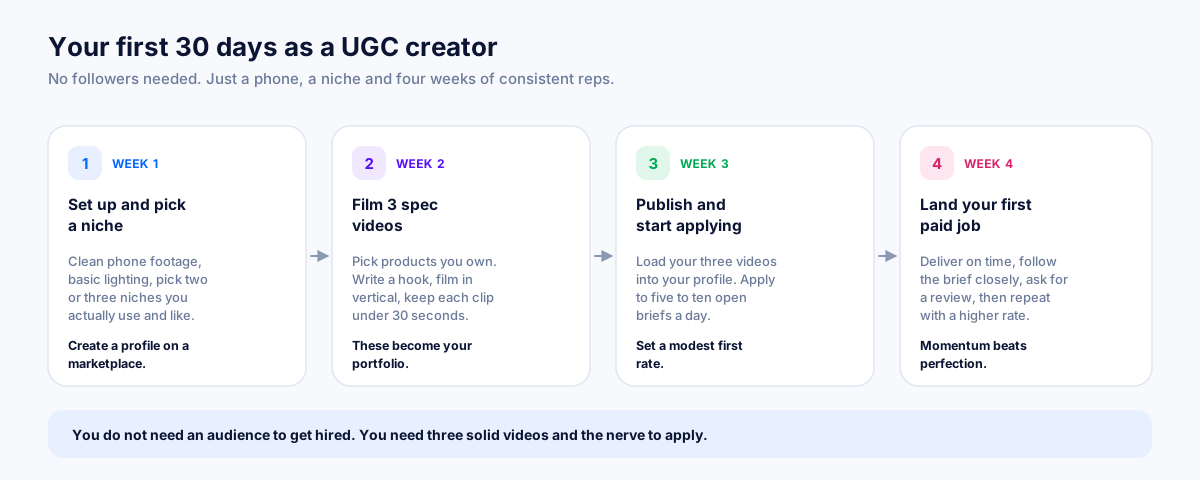
Pitching works best once you already have a small set of spec videos to attach.
What should you attach to a pitch?
One or two video links maximum, chosen specifically for that brand's niche, not your whole portfolio dumped in one message. If you are early and building your first samples, our guide on how to build a UGC portfolio that gets you hired covers exactly which videos to film first and how many you need before pitching seriously.
Never attach a large video file directly. A hosted link that opens in one tap gets watched; an attachment that needs downloading usually does not.
SKIP THE GHOSTING
Apply to briefs that already want a creator
Brands posting a brief on Wooly are actively looking right now, so your application lands somewhere that expects it.
Join free as a creatorWhy does applying on a marketplace often beat cold pitching?
Because a brand posting a brief has already decided to hire someone this week, while a cold pitch has to first convince them the idea is worth considering at all. The reply rate difference is not small. On Wooly Network, brands publish a brief to the marketplace and creators apply directly, or a brand searches creators by niche, platform, country and audience and invites them. Either way, you are responding to active intent instead of guessing at it.
That does not mean cold pitching is pointless, especially for a dream brand you want in your portfolio. It means splitting your time: most of your weekly effort into applying where demand already exists, a smaller slice into pitching specific brands you are excited about.
How many pitches should you send per week?
Treat it like a numbers game, because it is one. Five genuinely tailored pitches a week, each referencing something specific about the brand, will outperform fifty copy-pasted ones sent to a generic list. Quality of targeting matters more than raw volume once you are past the first ten or twenty pitches you send to learn the ropes.
| Pitch type | Best used for | Typical reply pace |
|---|---|---|
| Cold email | Dream brands, larger companies | Slow, often a week or more |
| Social DM | Small and mid-sized brands active on social | Faster, sometimes within days |
| Follow up | Any pitch that went quiet | Mixed, worth one attempt |
| Applying to a posted brief | Brands already looking to hire now | Fastest, often within a day or two |
What should you do differently when pitching a brand you have never worked with versus a repeat client?
A first pitch needs proof: a sample link, a clear rate, something specific about their brand to show you did not mass send it. A repeat client needs almost none of that. A short, friendly note referencing the last project and asking if they have anything else coming up usually gets a faster yes than a full pitch, since the trust and proof are already established from the first job.
This is part of why retainers and recurring work end up being so valuable for creators: every pitch after the first one gets dramatically easier, and eventually the brand is the one reaching out to you.
What makes a pitch look obviously mass-sent?
A greeting with no name, a sample video that has nothing to do with the brand's category, or a rate quoted before anything about their product is mentioned at all. These are the three fastest ways to get skimmed and deleted. The fix for all three is small: look up one real name, pick the one sample closest to their niche, and mention something specific before you mention money. It takes an extra two minutes per pitch and changes how the whole message reads.
Common questions
How long should a UGC cold pitch be?
Under 100 words for email, even shorter for a social DM. State who you are, what you noticed about the brand, one sample link, and your rate or a question about budget.
Should I mention my rate in the first message?
A rate range is usually better than staying silent, since it filters out brands whose budget does not match before either side spends time on a back-and-forth.
How many times should I follow up after no response?
Twice is a reasonable norm: once after about a week, a lighter second nudge a week or two later, then move on without a third message.
Is it better to pitch cold or apply to posted briefs?
Applying to posted briefs on a marketplace usually gets faster replies since the brand already wants to hire. Cold pitching still has a place for specific dream brands worth the extra effort.
Should I send a different template to every brand?
Keep the structure the same but personalize the one line about the brand itself. A fully generic pitch reads as mass-sent and gets ignored more often.
What should I do after a brand says no?
Reply graciously and leave the door open. Brands often come back later for a different project, and a creator who handled a no well is easy to remember positively.
STOP COLD EMAILING ALONE
Apply where brands are already hiring
Build a free profile, apply to open briefs, and let brands searching by niche and platform find you directly.
Join free as a creatorJoining is free, and brands choosing a plan can compare options on the pricing page before posting their first brief.
Keep reading
- How to build a UGC portfolio that gets you hired
- How to become a UGC creator with no followers
- UGC rate card, how to price videos and usage rights
- What is a creator marketplace, how brands and creators work together
Related reading
- How to Build a UGC Portfolio That Gets You Hired (With Examples) — What brands actually scan for in a UGC portfolio, the six videos worth including, spec work ideas by niche, and the mistakes that get profiles skipped.
- Paid Product Collabs: How to Send Products to Creators and Get Guaranteed Content — A paid product collab pairs the free product with a small fee so creators actually post. Here is how to run one, from shipping to approval.
- UGC Usage Rights Explained: Organic, Paid Ads, Whitelisting and How Long to License — UGC usage rights decide where a brand can post a video and for how long. Here is the ladder from organic use to full whitelisting, in plain English.
More from the Wooly Network Blog