Last Click vs First Click Attribution: Which One Pays the Right Partner?
Why last click quietly overpays coupon sites and underpays the content that created the demand, what the alternatives actually cost to run, and how to test incrementality without rebuilding your stack.
By Nora Ellis, Affiliate Marketing & Creator Economy Writer · with Wooly Network, Editorial · 18 September 2026 · 6 min · Tracking & Attribution
Last click attribution pays the partner whose link was clicked most recently before the purchase. First click pays the partner who introduced the customer. Last click is the default across almost every affiliate platform because it is unambiguous and cheap to compute, not because it is the most accurate account of what happened.
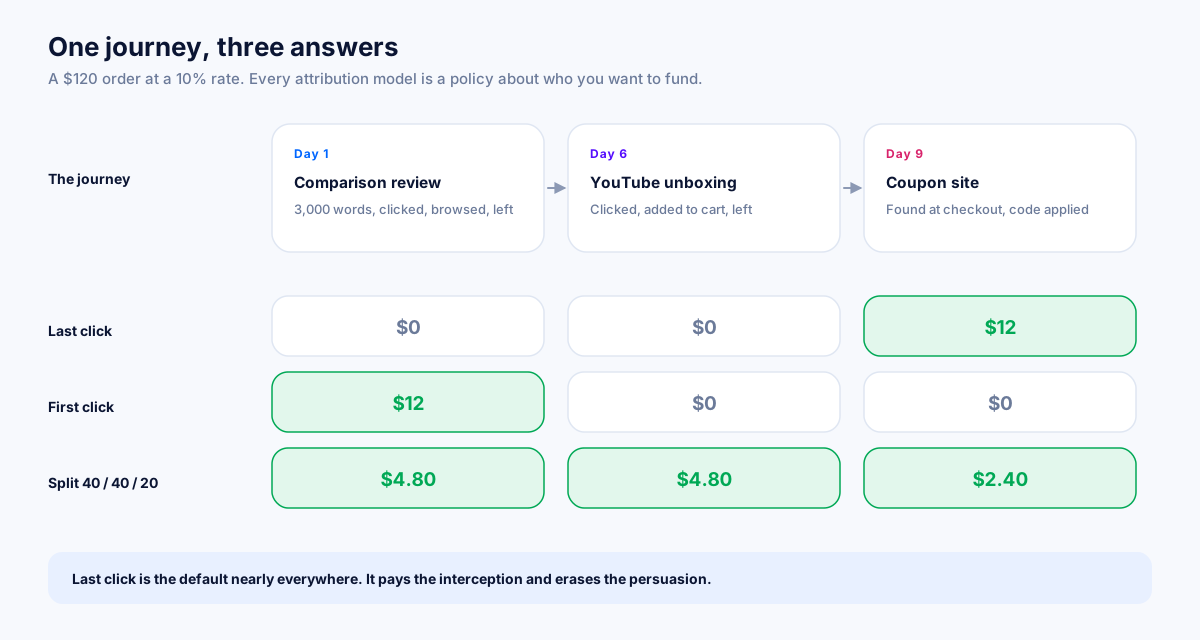
One journey, three answers. Every model is a policy about who you want to fund.
The example that shows the problem
A shopper's path to a $120 order:
- Day 1. Reads a 3,000 word comparison review on a niche blog. Clicks through, browses, leaves.
- Day 6. Watches a YouTube unboxing. Clicks the description link, adds to cart, leaves.
- Day 9. Comes back directly, goes to checkout, opens a new tab, searches "brand discount code", clicks a coupon site link, applies a code, orders.
| Model | Blog | YouTube | Coupon site |
|---|---|---|---|
| Last click | $0 | $0 | $12 |
| First click | $12 | $0 | $0 |
| Linear split | $4 | $4 | $4 |
| Weighted, 40/40/20 | $4.80 | $4.80 | $2.40 |
Under last click, the two partners who did the persuading earn nothing, and the partner who intercepted a decided buyer at the checkout earns the full commission plus you gave away a discount. Repeat that a few thousand times and your affiliate report will confidently tell you that coupon sites are your best channel, which will be true in the report and false in reality.
Why last click became the default anyway
It is worth stating the case for it, because it is a real case.
- It is unambiguous. One click, one partner, one commission. No arguments about fractions.
- It is cheap to compute and needs no cross-partner identity graph.
- Partners understand it. A creator can look at their own click and their own conversion and see a match.
- It matches how money moves. Paying a fraction of a commission to four parties creates payout complexity, minimum thresholds that never get reached, and reconciliation work for everyone.
- Privacy changes made multi-touch harder. Stitching one person's journey across partners, devices and browsers is exactly the thing that has become least reliable since 2020.
So the honest position is not "last click is wrong". It is "last click is a reasonable default with one specific, well known, expensive failure mode", and the job is to manage that failure mode rather than to rebuild your attribution stack.
The models, compared properly
| Model | Credits | Strength | Cost to you |
|---|---|---|---|
| Last click | The final partner | Simple, universal, disputes are rare | Overpays interception, underpays discovery |
| First click | The introducing partner | Rewards demand creation | Overpays a partner whose influence had faded |
| Linear | Everyone equally | Nobody is erased | Splinters payouts, rewards a cheap final click as much as a review |
| Position based | First and last most | A sensible compromise in theory | Needs cross-partner tracking almost nobody has |
| Time decay | Recent clicks most | Reflects fading influence | Still favours the checkout interceptor |
| Rate by partner type | Last click, different rates | Practical, works today, no new tech | Requires you to classify partners honestly |
That final row is where most experienced programme managers actually land, and it is worth dwelling on. You keep last click, which everyone understands, and you set different commission rates for content partners, coupon partners, cashback partners and loyalty partners. The incrementality problem gets priced instead of debated.
How to find out whether a partner is incremental
You do not need a data science team for this. Three tests, in increasing order of effort.
1. The new customer ratio
Split each partner's conversions into new and returning customers. A partner sending 90% new customers is creating demand. A partner sending 80% returning customers is mostly being paid for people you already had. This one number, available in most reporting, explains more than any model change.
2. The time-to-convert distribution
Look at how long elapses between click and order for each partner. Content partners show a spread across days. A partner whose conversions cluster in the first two minutes after the click is being clicked by people already at the checkout. On Wooly Network this pattern also surfaces per conversion as a Bot speed label, described in the commissions guide.
3. The pause test
The real one. Deactivate a suspicious partner for two to four weeks and watch total revenue, not channel revenue. If overall sales are flat while that partner's commission drops to zero, those sales were happening anyway. This test is unpopular because it feels risky, and it is the only one that actually answers the question.
A variation that is easier to get approved internally: instead of pausing the partner, stop honouring their discount code for two weeks while keeping their links live. Revenue that survives was never dependent on the coupon.
What to do on Monday
Practical sequence, no platform migration required.
- Classify your partners into content, coupon, cashback, loyalty, email and paid. Most programmes have never done this and cannot answer the incrementality question without it.
- Pull new versus returning customer share for each group. You will usually find the answer is obvious within ten minutes.
- Set different rates per group rather than changing your attribution model. Content at your headline rate, interception partners materially lower. Publish the tiers so it reads as policy rather than punishment.
- Add a checkout rule if code leakage is the main leak: no commission on orders where the code was applied after the cart already existed with a different referral attached, if your platform supports it.
- Run one pause test a quarter on the partner you are least sure about.
On Wooly Network attribution is last click within a window you set per campaign, terms are frozen at click time, and the reporting separates new from returning conversions so the classification above is a filter rather than a project. Reports are here.
A note for creators reading this
If you publish comparison content, last click is working against you and there are two things you can do about it.
First, keep the reader inside your click. A reader who clicks your link and buys in the same session is unaffected by any of this. Long research pages that send people away and hope they return are the ones that lose credit.
Second, prefer programmes with a personal discount code alongside the link. A code is credited to you regardless of what happened in the browser afterwards, which makes it the single best defence a content creator has against being outbid at the checkout. More on picking programmes in affiliate marketing for creators.
Common questions
Which attribution model do affiliate networks use by default?
Last click, effectively universally. Some enterprise platforms offer multi-touch reporting, but the commission is still normally paid on last click because payouts have to resolve to one recipient.
Is first click attribution ever used in affiliate marketing?
Rarely as a payout model, occasionally as a reporting view, and sometimes in referral programmes where the introduction is the whole product. Its weakness is symmetric with last click: it can pay a partner for a click from eleven weeks ago that had nothing to do with the purchase.
How does this interact with my cookie window?
The window decides who is eligible, the model decides who among the eligible gets paid. A long window with last click maximises the number of chances for a late interceptor to take the credit, which is worth knowing before you extend one. See what is a cookie window.
Should I move to multi-touch attribution?
Probably not, unless you are large enough to have identity resolution and a team to maintain it. Differentiated rates by partner type get you most of the benefit for a fraction of the cost and stay explainable to partners, which matters more than precision.
Keep reading
- How affiliate tracking works
- What is a cookie window in affiliate marketing?
- Affiliate fraud: how to spot it and stop it
- Affiliate marketing for brands: the complete guide
- CPA vs CPL vs revenue share
Related reading
- Affiliate Fraud: How to Spot It and Stop It — The six schemes that actually cost advertisers money, the signals that expose each one, and a review process that catches them without accusing honest partners of anything.
- What Is a Cookie Window in Affiliate Marketing? — The number that decides whether a partner gets paid: how windows work, what length suits your category, why browsers shortened them, and the resets and overlaps that cause most disputes.
- How Affiliate Tracking Works — Cookies, click IDs, server postbacks and mobile attribution, explained without the marketing: what each one measures, where each one fails, and why a 30 day window is a promise your server has to keep.
More from the Wooly Network Blog