What Is a Cookie Window in Affiliate Marketing?
The number that decides whether a partner gets paid: how windows work, what length suits your category, why browsers shortened them, and the resets and overlaps that cause most disputes.
By Nora Ellis, Affiliate Marketing & Creator Economy Writer · with Wooly Network, Editorial · 19 September 2026 · 7 min · Tracking & Attribution
A cookie window, also called an attribution window or referral period, is how long after clicking a partner's link a purchase still earns that partner a commission. Thirty days is the most common setting, ranges run from 24 hours to 365 days, and the length is chosen to match how long people take to decide to buy in that category.
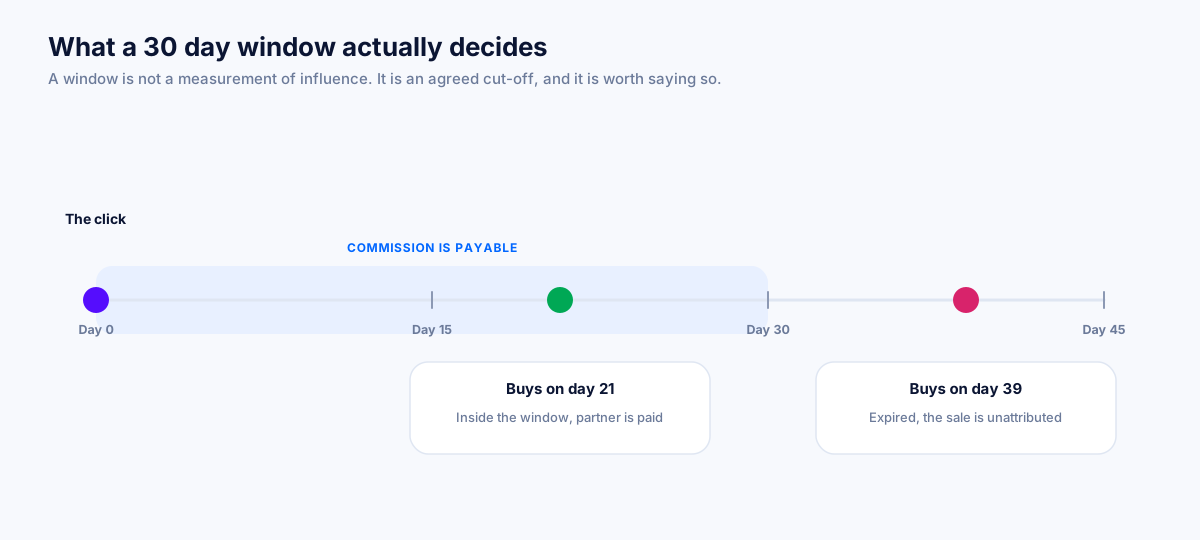
Same click, same buyer. The only thing that decides the commission is which side of the line the purchase lands on.
How the window works, mechanically
A shopper clicks a partner link. The click is recorded, and an identifier for that partner is stored, historically in a browser cookie, increasingly in a first-party record on the advertiser's own domain or in the advertiser's database. The window is a timestamp: click time plus N days.
When an order comes in, the system looks for a stored referral, checks whether it is still inside its window, and credits the partner if it is. If the window has expired, the order is unattributed and the partner earns nothing, even though their content is demonstrably why the person eventually bought.
That last sentence is the entire emotional content of this topic. A window is not a measurement of influence, it is an agreed cut-off. It is worth being honest about that with partners rather than pretending it is scientific.
What the number should be for your category
| Category | Typical window | Why |
|---|---|---|
| Impulse and low price goods | 7 to 30 days | The decision happens in one session or not at all |
| Fashion and beauty | 30 days | Basket building, wishlists, waiting for payday |
| Home and furniture | 30 to 60 days | Measuring, comparing, partner approval at home |
| SaaS, self-serve | 30 to 60 days | Trial periods and internal discussion |
| SaaS, sales-led | 60 to 90 days | Procurement and security review |
| Travel | 30 to 90 days, sometimes to travel date | Long research phase, group decisions |
| Finance and insurance | 30 to 90 days | Applications, underwriting, comparison |
| Education and courses | 60 to 365 days | Enrolment cycles are seasonal |
The method for choosing is simpler than the table suggests: look at the time between first touch and purchase in your own analytics, take something near the 80th percentile, and round. If four fifths of your buyers decide within 26 days, a 30 day window is generous enough to recruit with and honest enough to defend.
The windows partners will compare you against
Partners do check, and a handful of well known programmes set their expectations.
- Amazon Associates runs a 24 hour window, which is famously short, extended to 90 days if the item is added to the cart within that day. Amazon can afford this because its conversion rate is extraordinary.
- Most retail programmes on the large networks sit at 30 days, which is why 30 reads as normal.
- Booking and travel platforms commonly use a session-based or short window, because the decision and the booking usually happen together.
- Software programmes cluster at 60 to 90 days, which partners in that niche expect and will notice the absence of.
A short window is not automatically a bad offer. A 7 day window on a product converting at 8% can easily beat a 90 day window on a product converting at 0.4%. Creators evaluating this trade-off properly should read how to find affiliate programs, which covers reading an offer as a whole rather than one field of it.
Why browsers made this harder
The word "cookie" in "cookie window" is increasingly historical, and that matters for anybody setting one.
Safari's Intelligent Tracking Prevention caps client-side cookies set by script at seven days, and at 24 hours in some cases where the visitor arrived with tracking parameters in the URL. Firefox blocks known third-party trackers by default. Google spent years planning to remove third-party cookies from Chrome, reversed that decision in April 2025, and then in October 2025 announced it was winding down the Privacy Sandbox proposals built to replace them.
What this leaves is a mess with a clear practical conclusion: your 90 day window is only real if the storage behind it is real. If attribution depends on a script-set cookie in Safari, the effective window for a meaningful chunk of your traffic is seven days no matter what your offer says.
The fixes are all about moving the record somewhere durable:
- First-party storage on the advertiser's own domain, set by a server response rather than by script, which is not subject to the same caps.
- Attach the referral to the account at signup, so from that moment the attribution lives in a database rather than a browser.
- Report the conversion from the server, which removes the browser from the critical path entirely.
All three are explained properly in how affiliate tracking works. On Wooly Network, the server side of it is the webhook, and the browser side is the tracking tag.
The three details that cause almost every dispute
Does the window reset on a new click?
If the same shopper clicks the same partner's link again on day 20, does the clock restart? Most partners assume yes. Many programmes do not reset. Both are defensible; only one of them is written in your terms, and if it is not, you will be arguing about it eventually. Say it explicitly.
What happens when two partners are involved?
A shopper clicks partner A on day 1 and partner B on day 12, then buys on day 14. Under last click, which is the default nearly everywhere, B is paid and A is not. Whether that is fair is a bigger question, and it is the subject of last click vs first click attribution.
Do discount codes respect the window at all?
Usually not, and this surprises people. A code entered at checkout is credited to its owner regardless of clicks or timing, which is precisely why codes are valuable to podcasters and precisely why code leakage is a margin problem. The defences are in affiliate marketing for Shopify stores.
Should you just set a very long window?
It is tempting, because it is free to announce and it recruits well. Three reasons to be careful.
- You will pay for sales you would have got anyway. A 365 day window means a customer who read a review last spring and bought this spring after seeing your own email campaign still generates a commission.
- It rewards volume over quality. The longer the window, the more valuable it is simply to be the last link somebody clicked, which is the behaviour you least want to subsidise.
- Partners will notice if it does not work. Announcing 180 days while your storage lasts seven in Safari is worse than announcing 30 and delivering it, because the first one destroys trust when a partner compares their own analytics to your report.
A better lever, if you want to recruit harder without opening that door, is a higher rate for the first ninety days of a new partnership, or a tier that rises with volume. Both are covered in how much should you pay affiliates.
On Wooly Network the attribution window is a field on the campaign, and terms are frozen at click time, so changing the window later never rewrites what an existing click was promised. Campaign setup is here.
Common questions
What is the standard affiliate cookie window?
Thirty days is the most common single setting across retail programmes. It is standard by convention rather than by evidence, so treat it as a starting point and check it against your own time-to-purchase data.
What happens if a customer clears their cookies?
With browser-only tracking, the referral is gone and the sale is unattributed. This is why programmes that matter attach the referral to an account or an order at the first opportunity and report conversions from the server.
Does the window apply per product or per visit?
Per referral, not per product. Inside the window, the partner usually earns on whatever the customer buys from that store, which is why average order value matters so much to partner earnings. Some programmes exclude specific categories, which should be stated in the brief.
Can an advertiser shorten the window after I have published content?
They can change it for future clicks. On a platform that freezes terms at click time, clicks you already sent keep the terms they were sent under. Ask about this specifically before committing a large piece of evergreen content to a programme.
Keep reading
- How affiliate tracking works
- Last click vs first click attribution
- How affiliate commissions work
- What is an affiliate network and how does it work?
- How to write an affiliate program brief
Related reading
- Affiliate Fraud: How to Spot It and Stop It — The six schemes that actually cost advertisers money, the signals that expose each one, and a review process that catches them without accusing honest partners of anything.
- Last Click vs First Click Attribution: Which One Pays the Right Partner? — Why last click quietly overpays coupon sites and underpays the content that created the demand, what the alternatives actually cost to run, and how to test incrementality without rebuilding your stack.
- How Affiliate Tracking Works — Cookies, click IDs, server postbacks and mobile attribution, explained without the marketing: what each one measures, where each one fails, and why a 30 day window is a promise your server has to keep.
More from the Wooly Network Blog