How to Start an Affiliate Program for Your Business
The sequence that works: the margin maths before the commission, the validation rules before the launch, and the ten partners that matter more than a thousand signups.
By Nora Ellis, Affiliate Marketing & Creator Economy Writer · with Wooly Network, Advertiser Success · 22 September 2026 · 8 min · Affiliate Marketing
To start an affiliate program you need five things in this order: the margin maths that tells you what a customer is worth, a payout model, written validation rules, a brief good enough to publish from, and tracking that works without a browser. Software is the easy part. The sequence is what decides whether the programme is alive in six months.
Almost every stalled programme was built in the wrong order: tool first, commission guessed, rules written after the first dispute, recruiting attempted last with no brief to send anyone.
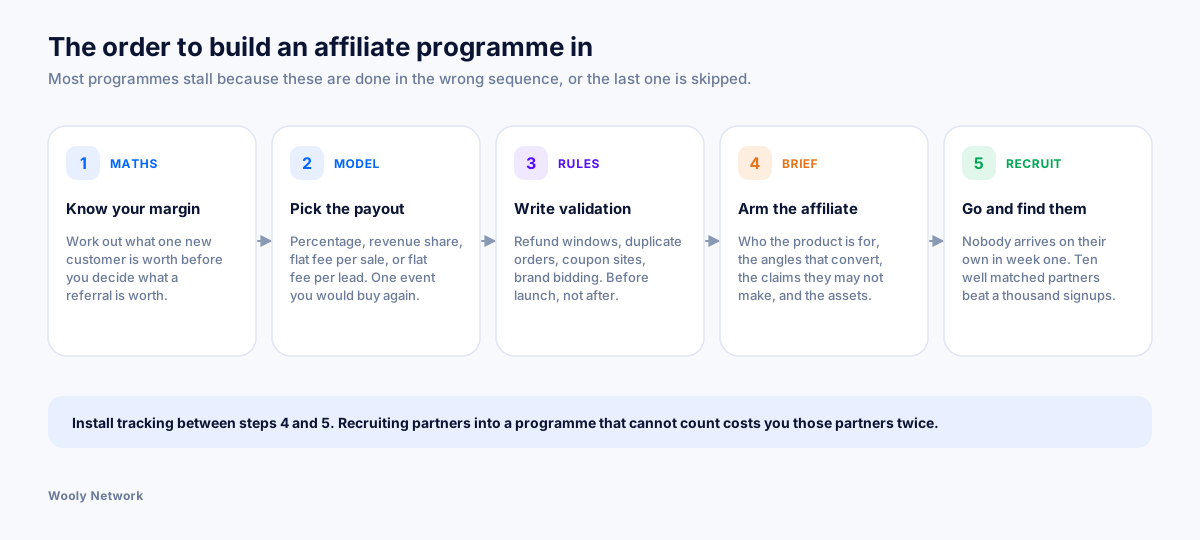
Install tracking between steps four and five. Recruiting partners into a programme that cannot count costs you those partners twice.
Step 1: Work out what a customer is worth, before you decide what a referral is worth
You cannot set a commission without a number to set it against. Two numbers, really.
- Contribution margin per order. Price, minus cost of goods, minus payment fees, minus shipping and returns. Not revenue. Revenue has killed more affiliate programmes than any competitor.
- Customer lifetime value, if you have repeat business. If the average customer buys 2.4 times, a first order commission that looks reckless against one order can be conservative against the relationship.
Write both down. A worked example, deliberately unglamorous:
| Line | Physical product | SaaS subscription |
|---|---|---|
| Order value | $120 | $49 per month |
| Cost of goods or delivery | $48 | $6 |
| Payment and fulfilment | $12 | $2 |
| Contribution margin | $60 (50%) | $41 (84%) |
| Average orders per customer | 1.8 | 11 months retained |
| Lifetime contribution | $108 | $451 |
| Sensible commission ceiling | $25 to $30 | $90 to $130 total |
The SaaS row is why software programmes pay what look like alarming percentages. A 30% revenue share for twelve months on that subscription costs about $162 against $451 of contribution, and the customer is still there in month thirteen paying you in full. The physical product cannot survive the same generosity, which is why it pays a flat $25 instead.
The full rate discussion, by industry, with the sanity checks, is in how much should you pay affiliates.
Step 2: Pick the payout model, which is really picking what you are buying
There are four, and the choice follows from your product rather than from your preference.
| Model | You pay | Choose it when | The trap |
|---|---|---|---|
| Percentage of the first sale | Once, on purchase | Basket size varies and margin is a stable percentage | Discount stacking quietly eats the margin you priced from |
| Revenue share | Every cycle, for a fixed period | Subscriptions, where retention is the business | Forgetting to cap the period, then owning it forever |
| CPA, a flat fee per customer | Once, on purchase | You need a known, capped cost per customer | Partners push the cheapest product to trigger the same fee |
| CPL, a flat fee per lead | On a qualified lead | The sale happens off-platform: demos, quotes, applications | Volume without quality, unless "qualified" is defined tightly |
If you are torn between the last three, the CPA vs CPL vs revenue share comparison works through the decision properly, including the hybrid setups.
Step 3: Write the validation rules before anyone can break them
This is the step that gets skipped, and it is the one that will cost you a partner relationship. Validation rules are the plain English definition of a commission that qualifies. You will point at this text when you decline something, so write it as if you will have to read it aloud.
Cover at least these, with numbers:
- The refund and cancellation window. "Commissions are confirmed 30 days after delivery" is a rule. "Subject to returns" is not.
- Duplicates and self-referrals. The same customer, the same order, the partner buying through their own link.
- Discount and coupon behaviour. Whether a partner may publish a code, whether commission is calculated before or after the discount, and what happens when a customer arrives through a link and then applies a code from somewhere else.
- Paid traffic and brand bidding. The single most common cause of affiliate disputes. Say explicitly whether partners may bid on your brand name, run paid social to your landing page, or use your trademarks in ad copy.
- Prohibited placements. Toolbars, incentivised traffic, adult or political adjacency, cookie stuffing, anything you do not want your product next to.
- Minimum order value, if any. And whether shipping and tax count towards it.
On Wooly Network: validation rules are a required field on the campaign, up to 2,000 characters, published on the offer page where creators read them before applying, so the rules are agreed before the first click rather than argued after it.
Step 4: Write the brief, not the terms
A partner deciding whether to promote you is not reading your commission. They are estimating how long this will take and how likely it is to work. The brief answers that.
The six questions that make the difference, in the order partners actually ask them:
- Who is this for? Be specific enough to exclude people. "Marketing teams" is not an answer. "Solo founders selling a digital product, doing under $20k a month" is.
- What do they need to know before promoting? Pricing, trial length, the countries you ship to, anything that will waste their audience's time if it is discovered at the checkout.
- What makes you different? Give them the comparison they would otherwise have to research. Naming your competitors is a gift, not a risk.
- What are the angles that actually convert? You have the data from your own ads. Hand it over. This is the single most under-used asset in most programmes.
- What may they not say? Claims, guarantees, regulated language, competitor comparisons you cannot defend.
- Where are the assets? One shared folder with logos, product shots, short video, and screenshots. Partners who have assets publish in days. Partners who must ask for assets publish in weeks, or not at all.
Step 5: Make the counting boring, then recruit
Install tracking and prove it with a real test order before you invite anybody. The order matters: a partner who publishes into a broken tag has spent their credibility on you and received nothing, and you will not get a second attempt.
Two things to get right on day one:
- Report conversions from your server, not only from the browser. Browser reporting misses ad blockers, privacy settings and every sale completed by phone, invoice or a payment link. Server to server reporting misses none of them.
- Report refunds too. Programmes that only report sales end up clawing back commissions manually, which is unpleasant for everybody. Wire the refund webhook at the same time as the sale one.
The mechanics are covered in how affiliate tracking works, and if you are on Wooly Network, the setup walkthroughs are installing your tracking tag and connecting the server webhook.
Then, and only then, go and find partners. How to find affiliates for your business is the whole method, but the headline is this: ten partners who match your customer beat a thousand signups who do not, and nobody finds you on their own in week one.
Your first ninety days, in one table
| Weeks | What you do | What good looks like |
|---|---|---|
| 1 to 2 | Margin maths, payout model, validation rules, brief, tracking installed and tested | A test order appears in reporting with the right commission attached |
| 3 to 4 | Publish the offer. Approach 20 to 30 well matched partners by hand | Five to eight partners approved, at least two publishing |
| 5 to 8 | Answer every application within 48 hours. Approve commissions weekly. Send the winning angles to everyone | First revenue. A pending queue that never gets older than a week |
| 9 to 12 | Find what worked and fund it: higher rate for the top partners, a bonus on a target, better assets for the format that converted | Two or three partners producing repeatably, and a reason for the rest to try harder |
Five mistakes that cost the most
- Setting the commission from revenue instead of margin. It feels generous for one quarter and then it is unfixable without annoying everybody.
- Launching with manual approval and no time to do it. An application queue with a two week response time is worse than instant approval, because it converts interest into resentment.
- Leaving commissions pending. Your approval speed is a public fact among partners, whether or not it is published.
- Recruiting by audience size. Fit beats reach at every level, and it is not close. A newsletter with 4,000 of exactly the right readers will outperform a channel with 400,000 of nearly the right ones.
- Judging the channel at week four. Content needs to be made, indexed and found. Give it a quarter before you conclude anything.
Common questions
How much does it cost to start an affiliate program?
The platform is the small number: a self-hosted tool starts around $50 a month, a network typically takes a percentage of what you pay out, and a marketplace subscription sits in between. The real cost is the commission budget and the time to run it, which is roughly half a day a week once it is going.
On Wooly Network, brand plans start at $99 a month, with no setup fee and no network minimum. You can compare affiliate program costs by plan. Brands that only want creator content can start on the free plan with collabs: One-Time Jobs, Recurring Jobs, Bounties and Paid Product Collabs.
Should approval be instant or manual?
Manual, while you are small enough to read every application, because your first ten partners set the tone of the programme. Move to instant when the reading becomes the bottleneck, and keep manual for any campaign where brand adjacency matters.
Do I need a lawyer for the programme terms?
For the validation rules, no; write them yourself, because they are commercial decisions. For the partner agreement, the disclosure obligations and anything regulated (finance, health, gambling, children), yes.
What if I have no margin to give away?
Then pay for a lead instead of a sale, or run a lower rate with a performance bonus on top. A programme with a defensible 8% beats a programme with an aspirational 25% that you start declining commissions to afford.
Keep reading
- What is an affiliate network and how does it work?
- How to find affiliates for your business
- How much should you pay affiliates?
- CPA vs CPL vs revenue share
- Affiliate marketing for brands: a complete guide
Ready to publish an offer? See how campaigns work on Wooly Network.
Related reading
- Affiliate Platform Comparisons and Alternatives — Honest side by side comparisons of the affiliate networks and partner platforms brands shortlist most, with pricing, fees, contracts and who each one suits best.
- Dub Partners Pricing Explained: Plans, Payout Fees, Limits — What each Dub plan includes for affiliate programs, how payout fees and monthly payout caps change the real cost, and a worked example at three sizes.
- PartnerStack vs Impact: Which Partner Platform to Choose — A neutral comparison of the two best known partner platforms: who each one is built for, how pricing works, and when neither is the right fit.
More from the Wooly Network Blog