Rewardful vs Dub vs Wooly Network for Startups (2026)
Three affordable ways to launch an affiliate program, compared on price, Stripe tracking, partner recruitment and what partners pay to withdraw their earnings.
By Nora Ellis, Affiliate Marketing & Creator Economy Writer · with Wooly Network, Editorial · 9 October 2026 · 16 min · Growth Marketing
Rewardful vs Dub vs Wooly Network comes down to one question: do you already have partners, or do you need to find them? Rewardful is the simplest Stripe affiliate tracking for a startup, priced from $49 to $149 a month by how much affiliate revenue you track, with no transaction fee and payouts through PayPal or Wise. Dub runs its partner program on the Business ($90 a month) and Advanced ($300 a month) plans, with a payout fee of 5% by ACH that the brand pays and monthly payout caps. Wooly Network is a marketplace from $99 a month where creators discover your campaign and apply, payouts run through Stripe, and creators join free.
Last checked October 2026. Pricing and features change, so confirm on each vendor's site before you sign. We refresh this page every three months.
All three are honest, affordable tools, and none of them will ask you to sit through four demo calls and a procurement questionnaire before you see a price. That already puts them ahead of most of this category. The differences are about where the work goes: into tracking, into paying people, or into finding people worth paying.
What is the difference between Rewardful, Dub and Wooly Network?
They look similar on a feature grid because all three track a click, attribute a sale and pay a commission. They were built for different jobs, and that shows the moment you try to run a program on them.
- Rewardful is affiliate software for subscription businesses. It connects to your billing system (Stripe, Paddle, Chargebee and 20+ integrations, according to its pricing page), tracks referrals and recurring commissions, and gives your affiliates a portal. You recruit the affiliates yourself.
- Dub is a link platform with a partner program on top. Short links, click analytics and conversion tracking come first; Dub Partners adds commissions, payouts, tax forms and partner groups on the Business plan and above. You recruit the partners yourself, unless you are on Enterprise, which adds Dub's Partner Network and a Program Marketplace listing.
- Wooly Network is an affiliate and creator marketplace. You publish a campaign once (CPA, CPL, revenue share, a fixed amount per sale or a sponsorship) and creators find it, apply and promote it with tracked links. Discovery is built in, and you can still invite people you already know.
If you read only one line of this article, read this one: software tracks partners you bring, a marketplace also brings partners to you. Everything else is pricing detail.
Rewardful vs Dub vs Wooly Network: how do the prices compare?
Here is the side by side, using each vendor's public pricing page as of September and October 2026.
| Item | Rewardful | Dub (Partners) | Wooly Network |
|---|---|---|---|
| Entry plan for an affiliate program | Starter, $49 a month | Business, $90 a month | Growth, $99 a month |
| Next plan | Growth, $99 a month | Advanced, $300 a month | Scale, $249 a month |
| Top tier | Enterprise, from $149 a month | Enterprise, custom annual billing | Enterprise, custom |
| What sets your tier | Affiliate revenue tracked: up to $7,500, $15,000 and $30,000 a month | Partner payouts sent: up to $2,500 (Business) and $15,000 (Advanced) a month | Number of live campaigns and features: 1 on Growth, up to 4 on Scale |
| Annual billing | 12 months for the price of 10 | 10% discount | Two months free |
| Transaction fee on revenue | 0% on every plan | None on revenue | None on revenue |
| Fee on payouts, paid by the brand | Only with optional Managed Payouts: 3% | 5% by ACH, 8% by card (3% and 6% on Enterprise) | An operational fee on creator payouts |
| Partner discovery | None listed | Enterprise only | Built in marketplace on every plan |
| Payout rails | PayPal mass payouts, Wise bulk payouts | Bank via Stripe Express, or USDC stablecoin | Stripe, monthly on a fixed cycle |
| Free trial | 14 days | 14 days on paid plans | None; a campaign demo on the brand page |
| Setup fee | None listed | None listed | None |
Rewardful pricing, in plain numbers
Rewardful's plans are Starter at $49 a month ($490 a year), Growth at $99 ($990 a year) and Enterprise from $149 ($1,490 a year), according to Rewardful's pricing page. The thing that moves you between plans is affiliate attributed revenue: Starter covers up to $7,500 a month, Growth up to $15,000, and the entry Enterprise tier up to $30,000. Starter is limited to one campaign and two team members; Growth adds unlimited campaigns, a branded portal and a custom domain. There is a 0% transaction fee on affiliate revenue on every plan, which is rarer than it should be.
The cost to watch is the revenue cap. It is a nice problem (your affiliates are working) that still arrives as a price rise. Budget for the next tier the month you cross about two thirds of your current cap.
Dub Partners pricing, in plain numbers
Dub's Free and Pro ($30 a month) plans are for links only; the partner program starts on Business at $90 a month and Advanced at $300 a month, per Dub's pricing page. Yearly billing is a 10% discount, which works out to roughly $81 and $270 a month (our arithmetic; the page does not print those numbers). Business includes up to 500 partners and $2,500 in partner payouts a month; Advanced removes the partner limit and raises the payout cap to $15,000. When you hit the cap, Dub's FAQ says you cannot send payouts until the next billing period.
On top of the plan, the brand pays a payout fee: 5% by ACH or 8% by card on Business and Advanced, 3% and 6% on Enterprise, according to Dub's partner payouts help article. We go deeper on that structure in Wooly Network vs Dub Partners: pricing, fees and discovery, and on the other tools Dub buyers usually shortlist in Dub Partners alternatives.
Wooly Network pricing, in plain numbers
Wooly Network has three brand plans: Growth at $99 a month with one live performance campaign, Scale at $249 a month with up to four campaigns plus a server to server conversion API, app install tracking, a fraud review queue, cross device attribution and automated Stripe payouts, and a custom Enterprise plan. Annual billing gives two months free ($990 or $2,490 a year). There is no setup fee, no network minimum, and you can cancel anytime. An operational fee applies to creator payouts only, so it costs nothing in a month when nothing sells. Full details are on the brand pricing page.
Wooly is the newer company in this comparison, and it is not trying to be an enterprise partnership suite. It is a marketplace for brands that want creators to come to them.
How does Stripe affiliate tracking work on each?
Every Stripe affiliate tracking setup solves the same puzzle. Stripe knows who paid you. It has no idea which affiliate sent that person. Somewhere between the click and the charge, you have to write the affiliate's identity onto something Stripe will carry through to the payment. Each tool does it a little differently.
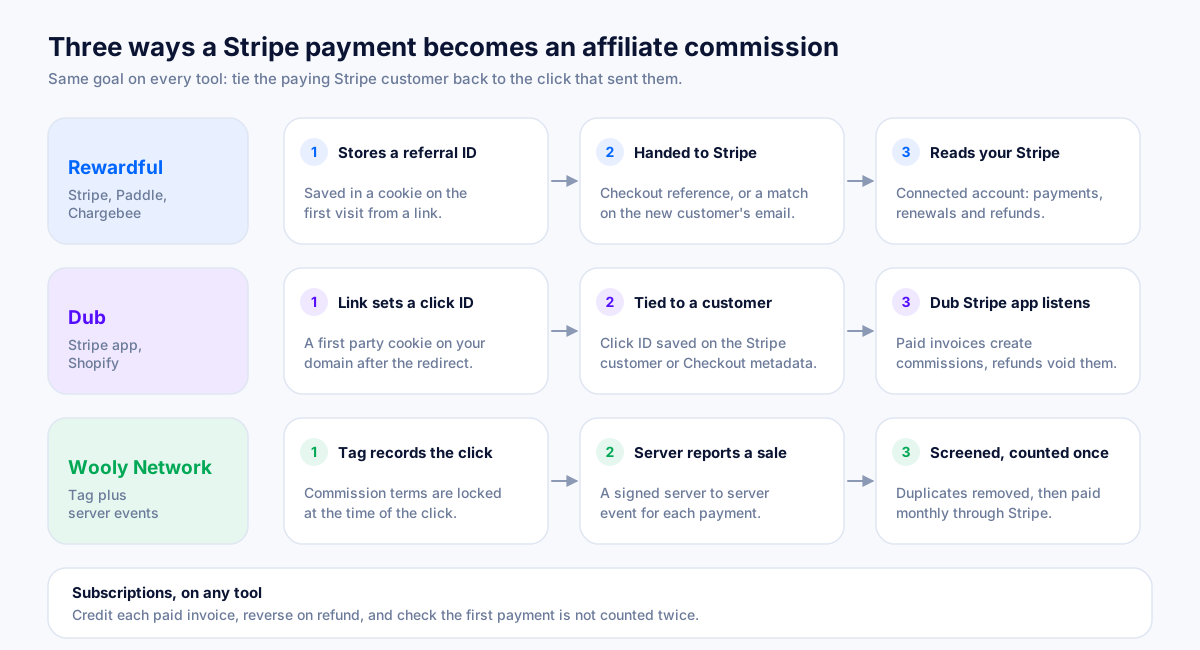
The three tools take different routes to the same place: a Stripe payment credited to the right partner.
Rewardful: a script plus a connected Stripe account
You add Rewardful's JavaScript snippet to your site. When a visitor arrives through an affiliate link, it stores a referral ID in a cookie. You then either pass that referral ID into Stripe Checkout as the session's reference, or call Rewardful's convert function with the customer's email on your thank you page, and Rewardful matches it to the Stripe customer created at checkout (its docs say that customer must have been created within the last 24 hours for the client side method). Because Rewardful is connected to your Stripe account, it then sees renewals, upgrades and refunds without you writing a webhook handler. For a SaaS team on Stripe Checkout, this is about as little engineering as affiliate tracking gets.
Dub: a click ID carried into Stripe by the Dub app
Dub's short links set a click ID cookie (dub_id) on your domain. You install Dub's app from the Stripe App Marketplace, record the signup as a lead so the click ID is tied to a customer, and pass the identifier into Stripe through customer metadata, Checkout Session metadata, or a client_reference_id on Payment Links, according to Dub's Stripe conversion docs. The Stripe app listens for completed checkouts, paid invoices and refunds, so recurring commissions are created on each paid invoice and voided on a refund. It is a little more setup than Rewardful, and it is very comfortable for developers who already use Dub links everywhere.
Wooly Network: a website tag plus signed server events
On Wooly Network the website tag records the click and locks the commission terms at the time of the click, so a creator is paid on the deal they signed up for even if you change the campaign later. Your server then reports each conversion with a signed server to server event (on Scale, through the conversion API); for a Stripe business that usually means sending an event from your Stripe webhook handler when a payment succeeds. Duplicate orders are counted once, and conversions go through fraud and bot screening before money moves. Payouts to creators then run monthly through Stripe. It is more of a "you report, we verify" model than a direct Stripe connection.
The Stripe tracking mistakes that cost real money
- Counting the first payment twice. A completed checkout and the first paid invoice can describe the same money. Pick one event for month one.
- Ignoring refunds. If a refund does not reverse the commission, you will pay affiliates for customers you no longer have.
- Losing the ID at signup. Free trials are the classic leak: the click happens on day one, the card is charged on day fifteen, and nobody saved the referral on the customer record in between.
- Testing in live mode with your own card. Everyone does it once. Your accountant will ask about it.
If you want the mechanics without any vendor attached, our explainer on how affiliate tracking works covers cookies, click IDs and server events from first principles.
Who recruits the partners on Rewardful vs Dub?
Neither, on their standard plans. That is not a criticism; it is what the products are. Rewardful's pricing page lists no marketplace. Dub's Partner Network and Program Marketplace listing are Enterprise features. On both, the partners are people you invite: customers who already love you, a few newsletter writers, the agency your cofounder knows, the YouTuber who reviewed you once without being asked.
For many SaaS startups that is the right shape. Your best early affiliates are usually your own users, and a 30 day outreach plan beats any directory. Our plan for recruiting your first 10 affiliates is written for exactly that situation.
The problem appears when your list of "people who might promote us" is eleven names long and three of them are your parents. Then the tracking software is ready, the portal is branded, and nobody is in it. A program with perfect attribution and zero partners has a conversion rate that is technically undefined.
On Wooly Network: campaigns are listed in a marketplace where creators browse and apply, and you choose instant or manual approval, so recruitment is part of the product rather than a separate project. If that is the part you are missing, the affiliate marketplace for brands page has a campaign demo you can try before signing up.
What do partners pay to withdraw their earnings?
This is the line item founders forget, and partners do not. A partner choosing between two programs with the same commission will pick the one where the money arrives whole.
| Partner side cost | Rewardful | Dub | Wooly Network |
|---|---|---|---|
| How partners receive money | PayPal or Wise, sent by the brand in bulk | Bank account via Stripe Express, or USDC stablecoin | Stripe, monthly on a fixed cycle |
| Fee charged by the platform to the partner | None listed for standard payouts; with Managed Payouts, affiliates may pay withdrawal fees depending on method and location | None on bank payouts above $10; $0.50 to withdraw under $10; 0.5% on stablecoin | None: creators join free and Wooly takes nothing from their commissions |
| Third party costs | PayPal or Wise terms for the recipient's account and country | Bank payouts can take up to 15 business days, in local currency | Not listed |
| Who pays the processing cost | The brand, through PayPal or Wise fees, or 3% with Managed Payouts | The brand, 5% by ACH or 8% by card | The brand, through the operational fee on payouts |
Dub's $0.50 small withdrawal fee only touches payouts under $10, so most partners will never see it. It is still worth knowing if you run a referral program with lots of tiny commissions.
What does each cost at three sizes of affiliate revenue?
Here is a worked example. It is hypothetical, and the arithmetic is the point. Say you run a $49 a month SaaS app and pay affiliates 30% recurring. We look at three months in the life of the program:
- Small: $2,000 of affiliate attributed revenue a month, so $600 in commissions.
- Medium: $10,000 a month, so $3,000 in commissions.
- Large: $25,000 a month, so $7,500 in commissions.
The table shows the platform cost on top of commissions, at monthly prices.
| Monthly platform cost | Small ($600 commissions) | Medium ($3,000 commissions) | Large ($7,500 commissions) |
|---|---|---|---|
| Rewardful plan | Starter, $49 | Growth, $99 | Enterprise, $149 |
| Rewardful with optional Managed Payouts (3%, which its FAQ says is available on every plan) | $49 + $18 = $67 | $99 + $90 = $189 | $149 + $225 = $374 |
| Dub plan | Business, $90 | Advanced, $300 (Business caps payouts at $2,500) | Advanced, $300 |
| Dub payout fee by ACH (5%) | $30 | $150 | $375 |
| Dub total | $120 | $450 | $675 |
| Wooly Network plan | Growth, $99 | Scale, $249 | Scale, $249 |
| Wooly Network total | $99 plus the operational fee on payouts | $249 plus the operational fee on payouts | $249 plus the operational fee on payouts |
A few things jump out.
- Rewardful is the lowest software bill at every size, especially if you pay affiliates yourself through PayPal or Wise. If you already have partners and you live in Stripe, it is hard to argue with $49.
- Dub's medium column is the trap. At $3,000 of commissions you are $500 over the Business payout cap, so you either move to Advanced or hold payouts until next month. Either way the bill nearly quadruples. If you expect to cross $2,500 in monthly payouts within a quarter, price Dub on Advanced from the start.
- Wooly Network costs more than Rewardful in software terms and buys something different: partners you did not have to find. The medium and large columns assume Scale because recurring Stripe renewals are best reported server to server. If you only pay on the first payment, a tag based setup on Growth may be enough.
- Annual billing changes the order a little. Over a year at the medium size, Rewardful Growth is $990, Dub Advanced is about $3,240 plus $1,800 in ACH payout fees, and Wooly Scale is $2,490 plus the operational fee.
The cost that does not appear in the table is the one that matters most: commissions you never pay because no partner ever joined. A $49 tool with no partners costs $588 a year and produces nothing. Before you pick, write down where your first ten partners are coming from.
Is Dub a good Rewardful alternative?
It depends on why you want to leave Rewardful. Dub is a good Rewardful alternative if your marketing already runs on short links, you want link analytics and partner payouts in one place, and you like an API first product with tax forms and partner groups included. It is a weaker swap if your main complaint about Rewardful is price, because Dub's partner program starts at $90 a month and adds a payout fee.
Other Rewardful alternatives worth a look: FirstPromoter and Tolt are close cousins with similar revenue capped plans, and Tapfiliate suits teams billing on a mix of platforms. We compare those in our Dub alternatives roundup. If your real problem is that you have no partners to track, the answer is a marketplace, not a cheaper tracker.
And if you have outgrown all three and are being pitched by enterprise suites, our guide to Impact.com alternatives for startups explains what the next step up costs, and Wooly Network vs PartnerStack covers the B2B SaaS partner ecosystem option.
Rewardful vs Dub vs Wooly Network: which should you pick?
Pick Rewardful if
- You bill through Stripe, Paddle or Chargebee and want affiliate tracking working this afternoon.
- You already have partners: customers, a community, a handful of creators you know.
- You want the smallest possible software bill and no transaction fee.
- You are comfortable sending PayPal or Wise payouts yourself, or paying 3% for Managed Payouts.
Pick Dub if
- Your team already uses Dub for links, or you want links, analytics and partner payouts in one developer friendly product.
- You want tax forms, partner groups and payouts in local currency handled for you.
- Your monthly partner payouts will stay under $2,500 for a while, or you are happy to budget for Advanced.
- You accept a 5% ACH payout fee as the price of not handling payouts yourself.
Pick Wooly Network if
- You do not yet have a list of partners and want creators to find your campaign and apply.
- You want to pay on outcomes beyond subscriptions: leads (CPL), a fixed amount per sale, sponsorships or seasonal bonuses.
- You want creators to receive their full commission, with payouts through Stripe on a fixed monthly cycle.
- You want no setup fee, no network minimum and a platform fee that is zero when nothing sells.
Can you use Rewardful or Dub and Wooly Network together?
Yes, and some startups should. A common pattern is to keep Rewardful or Dub for the partners you recruited yourself (customers, agencies, a referral program) and use Wooly Network to reach creators you would never have found. Two rules keep it sane:
- One partner, one system. Never enroll the same person in both, or you will argue about which link they used.
- Decide who wins a tie. If a customer clicks two different partners' links, your terms should say which click earns the commission, usually the last one. Our guide to last click vs first click attribution explains the tradeoffs.
If you are still at the stage of deciding commission rates and terms, start with how to start an affiliate program for your business, then come back to tooling.
If discovery is the missing piece, see how a campaign works on the brand side of Wooly Network and compare plans. If you already have partners and live in Stripe, start a Rewardful or Dub trial today; either one is a fine choice.
Common questions
Is Rewardful cheaper than Dub?
On software price, yes. Rewardful starts at $49 a month with a 0% transaction fee, while Dub's partner program starts on the Business plan at $90 a month and the brand pays a payout fee of 5% by ACH or 8% by card. Dub also caps payouts at $2,500 a month on Business and $15,000 on Advanced.
Does Dub take a percentage of affiliate revenue?
Not of revenue. Dub charges the brand a fee on partner payouts: 5% by ACH or 8% by card on Business and Advanced, and 3% or 6% on Enterprise. Partners receive bank payouts above $10 at no additional cost, pay $0.50 to withdraw under $10, and pay 0.5% on stablecoin payouts.
Which affiliate software is best for Stripe?
Rewardful is the simplest Stripe affiliate tracking for subscription startups: a JavaScript snippet plus a connected Stripe account that sees renewals and refunds. Dub tracks Stripe sales through its Stripe App and click IDs stored in metadata. Wooly Network uses a website tag and signed server to server events that you send when a Stripe payment succeeds.
Do Rewardful or Dub help you find affiliates?
Not on standard plans. Rewardful lists no marketplace, and Dub's Partner Network and Program Marketplace listing are Enterprise features. Wooly Network is a marketplace on every plan: brands publish a campaign and creators discover it and apply.
How are Wooly Network creators paid?
Monthly, on a fixed cycle, through Stripe. Creators join free and Wooly Network takes nothing from their commissions; brands pay a plan fee plus an operational fee on creator payouts.
Does Wooly Network have a free trial?
No. There is a campaign demo on the brand page that you can try before signing up. Plans have no setup fee and no network minimum, and you can cancel anytime. Rewardful and Dub both offer 14 day free trials.
Keep reading
- Wooly Network vs Dub Partners: pricing, fees and discovery
- Dub Partners alternatives: 7 affiliate platforms compared
- Wooly Network vs PartnerStack for SaaS affiliate programs
- Impact.com alternatives for startups and growing brands
- How affiliate tracking works
- Affiliate marketing for SaaS
Related reading
- How to Find Affiliates for Your Business — Seven recruiting channels ranked by what they actually return, the outreach message that gets replies, and how to tell a partner who will publish from one who will not.
- How to Write an Affiliate Program Brief (With a Template You Can Copy) — The one page partners actually read before deciding whether to promote you, section by section, with a full worked example you can paste and edit in twenty minutes.
- How to Recruit Your First 10 Affiliates: A 30 Day Plan — A week by week sequence for going from an empty programme to ten active partners, with the outreach template, the list of people to contact first, and the response rates to expect.
More from the Wooly Network Blog