Spark Ads and Partnership Ads: How Creator Whitelisting Works
Whitelisting lets a brand run ads through a creator's own account. Here is how Spark Ads codes and Meta Partnership Ads permissions actually work.
By Nora Ellis, Affiliate Marketing & Creator Economy Writer · with Wooly Network, Advertiser Success · 27 October 2026 · 8 min · Performance Marketing
Spark Ads and Partnership Ads are the two main ways to turn a creator's own post into a paid ad that still carries their handle, a technique generally called whitelisting. Spark Ads uses a code the creator shares from TikTok, Partnership Ads uses a permission grant in Meta's business tools, and both require the underlying post to stay live while the ad runs. Either one usually beats a plain repost, because ads shown as coming from a real account tend to earn more trust than an obvious brand ad.
Whitelisted ads often beat a brand's own polished creative, and a campaign can just as easily stall for two days because nobody told the creator not to delete the original post. Whitelisting is simple once you have done it twice and genuinely confusing the first time, so let's walk through it properly.
What is creator whitelisting?
Creator whitelisting is a permission a creator grants a brand to run paid ads that appear to come from the creator's own account, instead of the brand's. The ad shows the creator's handle, profile picture and often their existing engagement, which is why it tends to feel less like an obvious ad to a viewer scrolling past. It is different from the brand simply reposting the video as its own content, and it is different from a basic paid media usage license, because whitelisting specifically grants access to run ads through the creator's identity, not just the footage.
How do Spark Ads work on TikTok?
Spark Ads let a brand boost a creator's existing TikTok post as an ad, using a code the creator generates and shares, no password or login access required. Here is the step-by-step:
- The creator posts the video organically on their own TikTok account
- In TikTok's creator tools, they generate a Spark Ads authorization code tied to that specific video
- They share that code with the brand or its media buyer, usually with an expiry date on the code itself
- The brand enters the code in TikTok Ads Manager and attaches it to a campaign
- The ad runs showing the creator's handle, while engagement (likes, comments, shares) accrues back to the original post
The code approach is deliberately low risk for the creator: nobody logs into their account, and the authorization only covers that single post for the window they choose, commonly 30 to 60 days matching whitelisting pricing norms. The one rule that trips people up: the original post must stay live for the whole time the Spark Ad is running. If the creator deletes it, archives it, or the account goes private, the ad typically stops serving.
How do Partnership Ads work on Meta?
Partnership Ads (Meta's current name for what used to be called branded content ads) work through a permission grant inside Meta's business tools rather than a shareable code. The creator tags the brand as a partner on a post, or grants the brand access through Meta Business Suite, and the brand can then promote that post as an ad from the creator's Instagram or Facebook identity.
The practical differences from Spark Ads: the permission is account-level access rather than a single-use code, it typically needs to be set up once per creator relationship rather than per post, and it surfaces a "Paid partnership with" label on the ad automatically, which helps cover the disclosure that a paid relationship generally requires. Access usually runs on its own timer, commonly 30 to 60 days, matching the broader whitelisting duration norms reported by Sideshift.
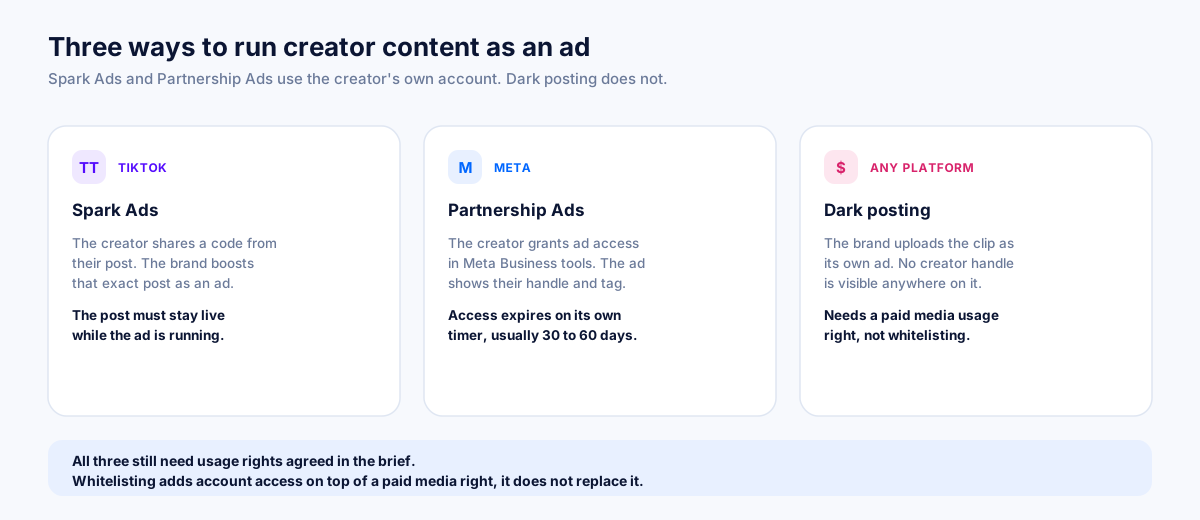
Spark Ads and Partnership Ads both run through the creator's identity. Dark posting does not, and needs a different right.
When should you use whitelisting instead of dark posting?
Use whitelisting when the creator's existing audience trust is part of what is working in the content, and use dark posting (uploading the clip as a standard ad with no creator handle visible) when you just need the footage and the message, not the identity behind it. Dark posting only needs a paid media usage license, which is simpler to agree and usually cheaper. Whitelisting needs that license plus account permission, and typically costs more because of it.
A rough rule we use: if the ad's hook leans on "I tried this and here is what happened," keep the creator's handle attached, because stripping it out removes the exact thing that made the hook believable. If the ad is really a product demo with no personal story, dark posting usually performs just as well for less setup.
What does whitelisting typically cost?
Reported add-on pricing from Sideshift puts whitelisting at roughly 30 to 50% of the creator's base filming rate, for a 30 to 60 day window, and that is on top of any separate paid media usage fee if the brand also wants to dark post the same footage elsewhere. For a creator charging $400 for a video, a 60-day whitelisting grant at 40% adds $160, landing the full package at $560. Our guide to UGC usage rights breaks down how this fits into the wider licensing ladder, and our UGC rates guide has base pricing by niche and experience.
| Method | Runs through creator handle | Setup | Typical cost add-on | Typical duration |
|---|---|---|---|---|
| Spark Ads (TikTok) | Yes | One code per video, creator-generated | 30 to 50% of base rate | 30 to 60 days |
| Partnership Ads (Meta) | Yes | One-time account permission grant | 30 to 50% of base rate | 30 to 60 days |
| Dark posting | No | Paid media usage license only | 25 to 50% of base rate | 30 to 90 days |
A checklist before you launch a whitelisted ad
Run through this before any Spark Ads or Partnership Ads campaign goes live, for both sides of the deal:
- Is the exact video, and only that video, named in the whitelisting agreement
- Does the agreement state the exact start and end date, not "a month or so"
- Has the creator agreed not to delete or edit the original post during that window
- Does the brand know the post must stay public, not switched to private
- Is the disclosure label (paid partnership, or a clear caption disclosure) actually showing on the ad
- Does someone own the calendar reminder to either renew or pull the ad on the end date
On Wooly, usage rights and whitelisting terms, including the exact duration, are set directly in the collab brief before work starts, with ready-made templates for formats like TikTok UGC packs that already include the fields you need. That does not remove the need for a calendar reminder on the end date, but it does remove the back-and-forth of figuring out what to even put in the agreement.
ADVERTISER SUCCESS
Run whitelisting terms through one brief
Set the channels, duration and whitelisting permissions once, and reuse the template for every creator you work with.
See UGC for paid adsWhat are the risks of whitelisting?
The main risk for creators is a brand running the ad past the agreed end date, or using a code for a different video than agreed, since Spark Ads codes are tied to the TikTok system but trust still matters in how the relationship is set up. The main risk for brands is losing the ad entirely if the creator deletes the post, which is why the agreement should explicitly cover what happens if that occurs mid-flight, including whether fees are refunded for lost days. Fraud screening and clear terms reduce both risks, but they do not replace a written agreement with real dates in it.
FOR ADVERTISERS
Brief whitelisting terms before the shoot, not after
Start free on Wooly and set usage rights, whitelisting and duration directly in the collab brief.
Start free as a brandCommon questions
What is the difference between Spark Ads and Partnership Ads?
Spark Ads is TikTok's system, using a code generated per video that the creator shares with the brand. Partnership Ads is Meta's system, using an account-level permission grant that covers posts the creator tags the brand on. Both let an ad run under the creator's own handle.
Does whitelisting require the creator's password?
No. Spark Ads uses a shareable authorization code, and Partnership Ads uses a permission grant inside Meta's own business tools. Neither requires the creator to hand over their login credentials to the brand.
Can a brand whitelist a video without paying for usage rights?
Typically no. Whitelisting grants account access to run the ad, but the underlying footage still needs a usage right covering paid use. Most agreements price them as related but separate items, often bundled into one whitelisting fee.
What happens if the creator deletes the original Spark Ads post?
The ad generally stops being able to run, since Spark Ads depends on the live post. This is exactly why agreements should state that the post stays public for the full whitelisting window, with a clear remedy if it gets taken down early.
How long does a typical whitelisting agreement last?
Commonly 30 to 60 days, based on reported industry add-on pricing, though brands can negotiate longer windows for a higher fee. Always put a specific end date in writing rather than an open-ended term.
Is a paid partnership label required on whitelisted ads?
If the relationship is a material connection, meaning the creator was paid or given product, disclosure is generally required, and Meta's Partnership Ads label handles this automatically. This is general information, not legal advice for your specific campaign.
Set up right, whitelisting is one of the most efficient ways to turn a working organic post into paid reach without reshooting anything. See our pricing page for how collab costs are structured, or visit the page for advertisers to see how briefs, usage rights and whitelisting all sit in one place.
Keep reading
- What is a creator marketplace
- How much do UGC creators charge
- UGC usage rights explained
- How to find UGC creators for your brand
Related reading
- Affiliate Marketing for Brands: A Complete Guide — What the channel is actually good at, what it is bad at, how to budget for it honestly, and the operating rhythm that separates a programme that compounds from one that flatlines.
- Affiliate Marketing vs Influencer Marketing: What's the Difference? — One pays for a result, the other pays for a slot. A breakdown of who carries the risk, what each one costs, how to measure them honestly, and why most brands end up running both.
- Affiliate Marketing for SaaS: The Complete Playbook — Recurring commission, trial to paid lag, churn clawbacks and self serve versus sales led: the decisions that make a software affiliate programme work, with the numbers to check before you launch one.
More from the Wooly Network Blog